Admissions
Building a community
A dynamic, diverse, and motivated group of MBA students is a cornerstone of MIT Sloan’s community and an essential part of the overall MBA experience. It’s a community that has the power to transform you personally and professionally as you learn inside and outside the classroom.
The entering class represents individuals from more than 60 countries, with an array of personal experiences and professional backgrounds. It is our goal that all students emerge from their MBA experience as informed and responsible global citizens — with the vision, drive, and real-world experience to contribute lasting change to a variety of organizations.
In carefully building this robust community, we seek individuals who demonstrate:
- Leadership and an ability to inspire others
- A collaborative spirit and focus on community
- Intellectual curiosity and analytical strength
- Creativity to generate new solutions to existing challenges
- Growth in both professional and personal endeavors
When asked why they chose MIT Sloan over other business schools, MBA candidates often cited the exceptional collaborative community they experienced while visiting campus. The School’s unique one-semester Core fosters that connection. During the Core semester, students are assigned to groups called cohorts which are composed of about 68 students who remain together through all Core classes. Within the cohort, students are assigned to study groups of six to seven students. As our students will tell you, these relationships are vital to the overall MIT Sloan experience, and are often just the beginning of lifelong friendships.
Personalized Curriculum
The MIT curriculum encourages freedom of choice and academic experimentation. After the powerful shared experience of the first-semester Core, students construct a personalized course of study. In addition to the analytic rigor you would expect from MIT, the curriculum focuses on the broad concepts and subtle nuances of real-world business challenges. You will have exclusive opportunities to engage in decision-making and big-picture analysis that serves to enhance your leadership skills.
Follow Your Interest
Through entrepreneurial energy and a willingness to experiment and innovate, MIT Sloan presents a broad portfolio of management education to our MBA students. Our program is exceptional among top-tier business schools, because it is designed to meet the needs of different learners with distinct visions. Fulfill your personal path of study by following a specific track by selecting particular courses from a variety of MIT and MIT Sloan options, or by pursuing one of several dual degrees.
Real-World Challenges Equal Unparalleled Experience
MIT's motto, "Mens et Manus" (Mind and Hand) fosters an attitude of excellence that transforms a career path into a lifetime of exploration, innovation, and leadership. “Learning by doing” is fundamental to the MIT Sloan experience, as it allows you to fill the gap between what you know and how to apply that knowledge to make a powerful impact in your chosen field or career. In hands-on Action Learning Labs, student teams develop solutions to partner organizations’ most pressing business challenges, and then go on-site to implement those solutions. This in-depth interaction — coupled with the application of knowledge and skills gained from the multitude of unique course offerings at MIT— exemplifies the School’s motto.
Intrigued? If so, join us for a campus tour, familiarize yourself with our world-renowned professors, and meet with our students from around the globe. Read about student experiences in our MBA Viewbook, and then decide whether you can see yourself working toward your own vision of an MBA at MIT Sloan.
A Realm of Possibility, a World of Opportunity
“The School will never be finished. It will always be a work in progress, anticipating and responding to a changing world,” stated benefactor and former chairman of General Motors Alfred P. Sloan, Jr. His vision in 1964 still holds true today — as clearly evidenced by the ongoing evolution of both our courses and our campus.
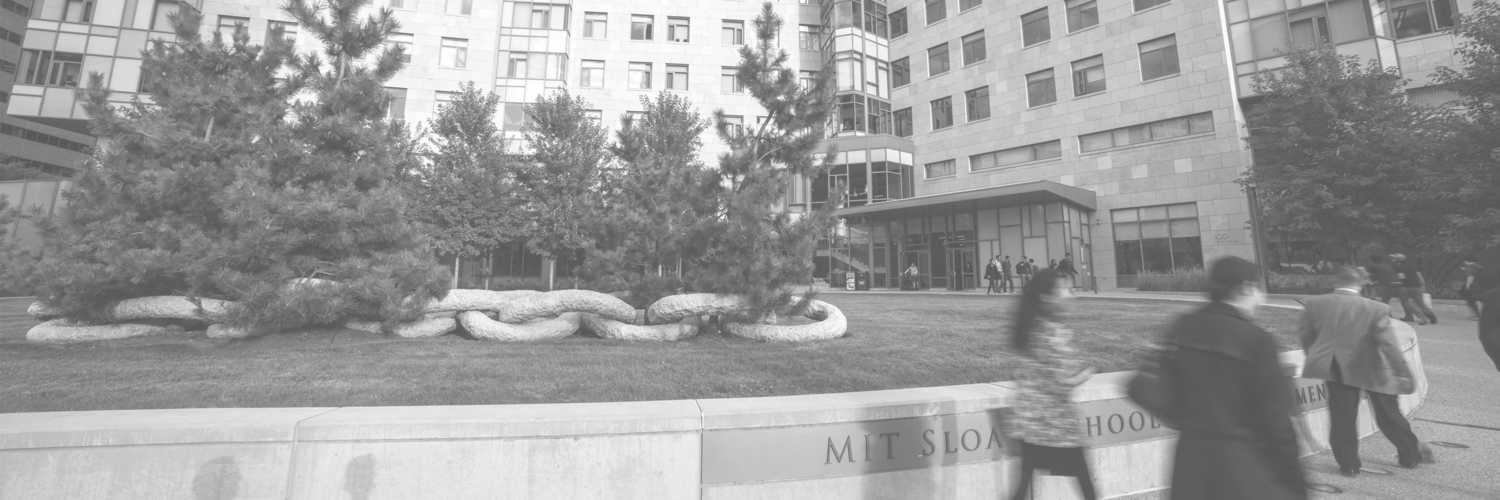
One example is the new physical and intellectual center of MIT Sloan, Building E62, and the Joan and William A. Porter 1967 Center for Management Education. Designed to provide a dynamic platform for cross-disciplinary collaboration by bringing together our entire faculty under one roof, E62 features numerous gathering spaces, along with classrooms equipped with sophisticated technology. E62 also carries the distinction of being the “greenest” building on the MIT campus.
What remains constant, however, is our reputation as one of the leading management, science, and technical institutions in the world, which in turn attracts preeminent corporations, not-for-profit organizations, NGOs, and government agencies to seek out and recruit our students for employment. Those with an entrepreneurial interest will also find themselves at home in an educational ecosystem built to foster the innovation and creativity that lead to the formation of successful and diverse companies across the globe.
“Our mission, along with the mission of MIT Sloan, is to both develop leaders who make a difference in the world, and also to make a contribution to thinking about the topic of leadership.”
“At MIT Sloan you have a lot of opportunities to explore entrepreneurship. Especially in a place like Kampala where you have a lot of development, entrepreneurship can be very exciting.”
“Because of the diversity of our backgrounds, when we hit the ground in Tanzania it almost was a natural play where different people assume different roles.”
“I love being in a place that is such a nexus of people and ideas — people coming to learn something new and to define themselves. Being a part of that process is a real honor and a real gift.”
“We’re very interdisciplinary. Among the faculty in the group are an economist, a political scientist, a sociologist, and an industrial relations specialist. We’ve always made a big effort to be open to a variety of perspectives, but also to go beyond being open to them, to want to bring them in, because it makes for a richer environment.”
"The relationships that we forged helped us to turn out a better project. We were able to test our hypotheses with the people that we spoke with every single day. And really, I think the friendships that you develop really propel the work that you’re doing."
“I can honestly say that when I was planning on coming to business school I never thought that witnessing the birth of a child would be included in the education. It was definitely an experience.”
“One of the reasons I came to Sloan was because I wanted to be at a top MBA institution worldwide. But I also wanted access to working with the latest innovations and the highest technology that was coming out of the MIT labs.”
“You could talk about watershed management and conservation of energy all you want. But until you put numbers to it and financial analysis to it, you’re not going to get much done. I came to business school to speak that language, speak with people in terms of numbers, financial numbers so that I can get projects done.”
“The conditions in the neighborhoods we were visiting were different than what we realized before getting there. Beyond that, what was surprising was that there weren’t surprises!”
“These companies are really excited to work with MIT students.They reach out to the community to set up these projects and are great to work with. They give us access to all their resources and are very open to us.”
“I knew about American business, but not enough about what’s really become a global economy. … You can read about it all you want, but there’s no substitute for being there and seeing the context and seeing how completely different these [other countries] are.”
“The concept behind enterprise architecture is that you have all these machines, you have all these business processes, you have all these people doing things, how do you make sure they all come together and achieve business objectives that make you more competitive.”
“It was really rewarding that they wanted to know what we thought. We left there being fairly certain that they will do some of the things that we suggested.”
“I find the students to be very interested, engaged, and valuable in terms of what they bring to the classroom. Because of their diversity and their own work experiences, they bring a unique perspective to the class work.”
