Cross-Campus Integration
An interdisciplinary approach
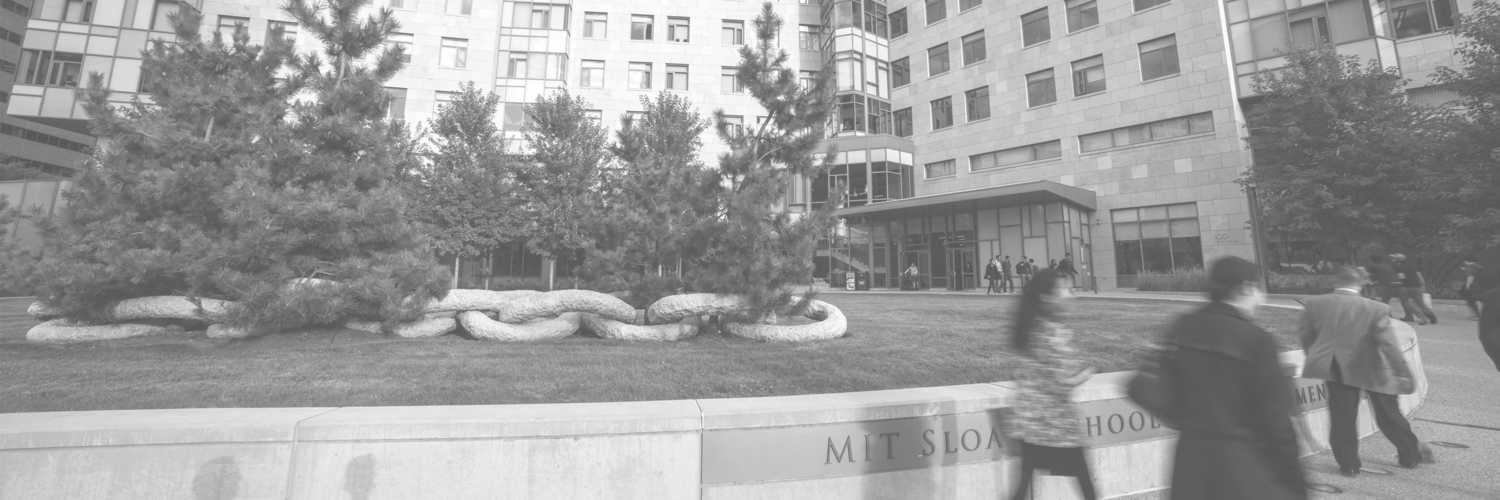
Both cross-disciplinary study and teamwork are built into the structure and culture of both MIT Sloan and MIT. Face-to-face contact across departments has long been recognized here as crucial to truly innovative thinking. Our buildings are designed to promote that span. Each school at MIT leverages the vast intellectual capital of every academic program to solve problems that span diverse fields and industries.
No Barriers
MIT is known for its porous borders, which encourage the sharing of knowledge. Engaged in a dynamic and diverse learning environment, each student contributes a unique brand of expertise, insight, and vision — the best preparation for fostering innovation and their careers.
MBA students routinely take classes from departments outside MIT Sloan to follow their passion and round out the knowledge and skills they wish to acquire. Many classes, such as multidisciplinary Innovation Teams (I-Teams), allow a focus on problems in areas as varied as energy, sustainability, and digital technologies. These and other cross-disciplinary courses, such as the X-Prize Labs, require mixed teams from a variety of MIT departments.
Innovation Teams (I-Teams)
In these real-world project classes, Innovation Team (I-Team) students organize in multidisciplinary groups of four or five members. These working teams focus on developing commercialization plans for carefully selected MIT faculty research efforts in collaboration with MIT’s Deshpande Center for Technological Innovation in the School of Engineering.
Each team of management and technical students deconstructs the features of the budding technology, and learns about the intellectual property issues in concert with the MIT Technology Licensing Office. Coached by a seasoned entrepreneur, teams perform a go-to-market analysis that results in recommendations for a specific course of action. Some I-Team business plans are entered in the MIT $100K Entrepreneurship Competition, while a select few go straight to investors and on to development.
X-Prize Labs
Variations of I-Teams, X-Prize Labs specialize in areas such as sustainable technologies, clean energy, and mobile devices. Team members develop ideas for the X-Prize competition, which recognizes radical breakthroughs for the benefit of humanity. Coordinated academic courses — dealing with energy markets, technologies, competition, and regulatory aspects — run in parallel, so students can learn theory and practice together.
Clubs
MIT students participate in more than 60 student-run clubs, ranging from business and professional groups to groups representing different cultural, regional, religious, sports, recreation, arts, and personal affiliations. These clubs form a key component of life at MIT, blending students from all levels, departments, interests, and backgrounds. Specific examples include:
- The Sloan Entrepreneurship Club creates networking events within MIT Sloan, and connects students with the Greater Boston community, other local MBA programs, and established area organizations.
- The Venture Capital Private Equity (VCPE) Club runs two nationwide conferences: the MIT Venture Capital (VC) Conference and the MIT Private Equity (PE) Symposium. The VC Conference is one of the largest and most prominent VC gatherings in the country, with more than 500 attendees each year, while the PE Symposium attracts 300 to 400 industry professionals and students.
- TechLink, the largest club on campus with 1,200 members, organizes "treks" to dozens of companies each year, from startups to industry icons, like Apple and Cisco.
- The MIT Innovation Club helps its members hone new ideas and commercialize cutting-edge technologies.
- Other groups include the Finance, Astropreneurs, Real Estate, BioPharma Business, Energy, Mobile Media and Internet Technology, NeuroTech, Energy and Environment, Marketing, and NanoTech clubs.
Events
Martin Trust Center for MIT Entrepreneurship has created a powerful network of entrepreneurs who advise and assist each other in the starting of new ventures. It reaches well beyond MIT’s borders to further expand students’ options. Along with offering educational programs to inspire, train, and coach a new generation of entrepreneurs, the Center provides numerous networking opportunities. Examples include:
- "Bio Bash," which draws more than 850 people, and connects founders, CEOs, board members, students, entrepreneurs, and venture capitalists. With MIT’s location in the center of a dynamic biotechnology cluster, the program draws executives to Cambridge from around the globe.
- A reception held each semester to honor past and present CEOs of Entrepreneurship Lab (E-Lab) companies, who have hosted student teams from E-Lab classes. Current students are given a prominent role at this event to promote summer internships and permanent jobs with leaders of high-tech companies and with their many venture capital investors, who regularly attend this event.
- A black-tie networking event held in London, in conjunction with The University of Cambridge.
See for Yourself
Take the time to mingle with the MIT community. We think you’ll be pleasantly surprised by the multitude of opportunities here.
“You could talk about watershed management and conservation of energy all you want. But until you put numbers to it and financial analysis to it, you’re not going to get much done. I came to business school to speak that language, speak with people in terms of numbers, financial numbers so that I can get projects done.”
“The assistant to the CEO was like our host mom while we were there. She arranged our housing for us, she took us out to her friend’s game farm, and we got driven around in 4x4s. She was just wonderful to meet, and we developed a personal as well as professional relationship with her.”
"After we gave our recommendations, the great part was that the very next day the CEO was in the boardroom implementing them with his top vice presidents."
“Our mission, along with the mission of MIT Sloan, is to both develop leaders who make a difference in the world, and also to make a contribution to thinking about the topic of leadership.”
“The conditions in the neighborhoods we were visiting were different than what we realized before getting there. Beyond that, what was surprising was that there weren’t surprises!”
“I knew about American business, but not enough about what’s really become a global economy. … You can read about it all you want, but there’s no substitute for being there and seeing the context and seeing how completely different these [other countries] are.”
“Because of the diversity of our backgrounds, when we hit the ground in Tanzania it almost was a natural play where different people assume different roles.”
“It was really rewarding that they wanted to know what we thought. We left there being fairly certain that they will do some of the things that we suggested.”
“These companies are really excited to work with MIT students.They reach out to the community to set up these projects and are great to work with. They give us access to all their resources and are very open to us.”
“For 35 years, we’ve been studying how companies get value from information. … We try to help organizations take a more holistic view of what they are trying to do.”
“I love being in a place that is such a nexus of people and ideas — people coming to learn something new and to define themselves. Being a part of that process is a real honor and a real gift.”
“At MIT Sloan you have a lot of opportunities to explore entrepreneurship. Especially in a place like Kampala where you have a lot of development, entrepreneurship can be very exciting.”
“One of the reasons I came to Sloan was because I wanted to be at a top MBA institution worldwide. But I also wanted access to working with the latest innovations and the highest technology that was coming out of the MIT labs.”
“We’re very interdisciplinary. Among the faculty in the group are an economist, a political scientist, a sociologist, and an industrial relations specialist. We’ve always made a big effort to be open to a variety of perspectives, but also to go beyond being open to them, to want to bring them in, because it makes for a richer environment.”
“One of the things that has always struck me is the level at which the students really enjoy learning. You hear laughter in the classrooms — not just to relieve tension, but real laughter, because they’re really excited to be learning.”
