
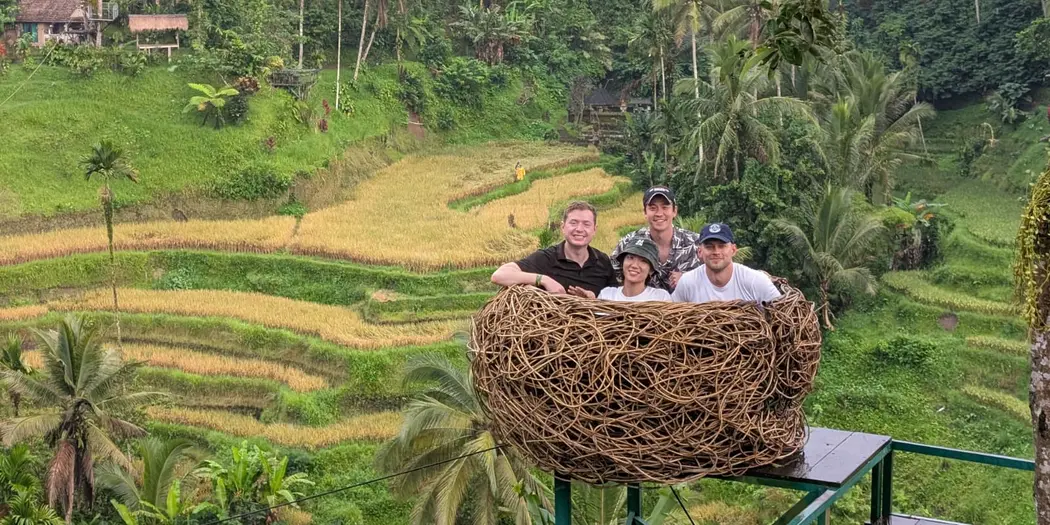
MIT Sloan G-Lab students pictured from left to right: Grant Tesdahl, MBA '26; Michelle Kang, MBA '26; Leo Carillon, MBA '26; and Till Krengel, MBA '26.
Chicken is one of the most popular options in Indonesia’s meat industry, valued at $17.5 billion and growing. It’s an affordable, widely available source of protein, as well as a promising market with plenty of room for growth. However, pricing is extremely volatile, as there is no agreed-upon benchmark pricing. Sellers negotiate daily, and prices fluctuate widely based on the city, feed prices, chicken weight class, and other factors.
Chickin Indonesia, a rapidly scaling poultry-tech company, has three interconnected businesses that serve the whole supply chain. Smart Farm supports upstream needs, such as selling day old chicks, feed, vitamins, and tech to smallholder farmers. Live Birds serves the midstream, negotiating prices daily with traders and distributors. Chickin Fresh deals with downstream services, distributing poultry to slaughterhouses, restaurants, and supermarkets. While all parts of the supply chain are affected by price volatility, it’s the midstream level that is most heavily impacted.
Combining diverse professional backgrounds to address pricing volatility
To better predict pricing fluctuations, Chickin Indonesia tasked a team of MIT Sloan Global Entrepreneurship Lab (G-Lab) students with creating a Live Bird Price Engine. The students were eager to take on the challenge.
“We were excited to step into an industry we interact with every day, but rarely think about deeply,” says Till Krengel, MBA ’26. “Chicken is the most consumed protein in Indonesia, yet the pricing dynamics behind it are highly complex and surprisingly opaque.”
“Chickin’s ambition to build the first Live Bird Price Engine in Indonesia aligned really well with our team’s interests in strategy, data science, and technical modeling,” says Leo Carillon, MBA ’26. “It was a chance to build real infrastructure for price transparency.”
The team’s diverse professional backgrounds in options trading, commodity modeling, modeling electricity markets and other capital-intensive industries, private equity, operations, consulting, and data science, allowed them to approach this project from multiple angles.
“That combination of quantitative rigor and client-facing execution drew directly on our prior professional experiences,” says Grant Tesdahl, MBA ’26.
Building and testing the Live Bird Price Engine
Using stakeholder research and data gathered from public and community sources, the team built a prediction model capable of forecasting chicken prices for the next 14 days. The model even accounts for the seasons and demand shocks. In January, the G-Lab team traveled to Indonesia for three weeks to help Chickin strategically implement the new tool. The onsite period gave them even more insight about the company’s operations and allowed them to see the complex pricing landscape in action.
“The onsite experience changed our understanding of the project entirely,” says Michelle Kang, MBA ’26. “Meeting the sales teams and Smart Farm operators – the real-life users-to-be of the tool we were building – helped us see how pricing decisions actually happen. The model shifted from an abstract forecasting exercise to a tool that would directly influence decisions in harvest timing and inventory management.”
For Krengel, the experience highlighted the importance of reliable price forecasting.
“Touring the chicken farms and processing facilities made the operational constraints real,” he says. “Live chickens grow quickly and cannot wait for better prices, and physical space is limited and valuable. Once the chickens reach harvest weight, decisions must be made. That reality sharpened our focus on forecast reliability and usability.”
Key takeaways: understanding the importance of working with stakeholders and building trust
The G-Lab team's host, Arief Iriansyah, a business analyst at Chickin, was enthusiastic about the students’ results and recommendations.
“Among the various recommendations, the most impactful for our organization is the 7 to 14 day sales price forecasting capability,” says Iriansyah. “We plan to implement this recommendation, as it has strong potential to become a valuable decision-support tool, particularly for our sales team in planning pricing strategies and responding more quickly to market conditions.”
The G-Lab team learned the importance of involving stakeholders early in the process of creating this price forecasting model.
“Our biggest takeaway is the importance of engaging stakeholders early and often,” says Tesdahl. “When building a client-facing decision tool, the technical model is only one piece. Adoption depends on trust, usability, and alignment with real workflows.”
Both the students and their host were grateful for taking part in this Action Learning project.
“[Chickin Indonesia’s] leadership was open, responsive, and ambitious throughout the project,” says Krengel. “They invested real time and energy into helping us understand the full ecosystem, from farmers to finance teams.”
“Overall, we truly appreciated the opportunity to collaborate with the MIT students on this project,” says Iriansyah. “It was a valuable experience for our team, and we were impressed by the students’ professionalism, enthusiasm, and commitment throughout the engagement. We look forward to implementing the outcomes of this collaboration and hope that the results will create meaningful impact not only for our company, but also for our partner poultry farmers across Indonesia.”
“This project perfectly embodied what Action Learning promises to be: a difficult strategic analytical challenge paired with real-world complexity, cultural immersion, and tangible impact,” says Krengel.