What you’ll learn:
- Panelists agreed the U.S. healthcare system is fragmented and urged physicians to help drive meaningful change.
- Speakers highlighted innovation, AI, and systems thinking as key tools for improving healthcare.
- Alumni leaders encouraged physicians to combine entrepreneurship, patient-centered care, and leadership to build scalable solutions.
How can physicians make sense of the massive changes meant to improve—and perhaps redefine—their industry right now? Can healthcare professionals bring scalable changes within and across their organizations? Is it possible to build a better healthcare system?
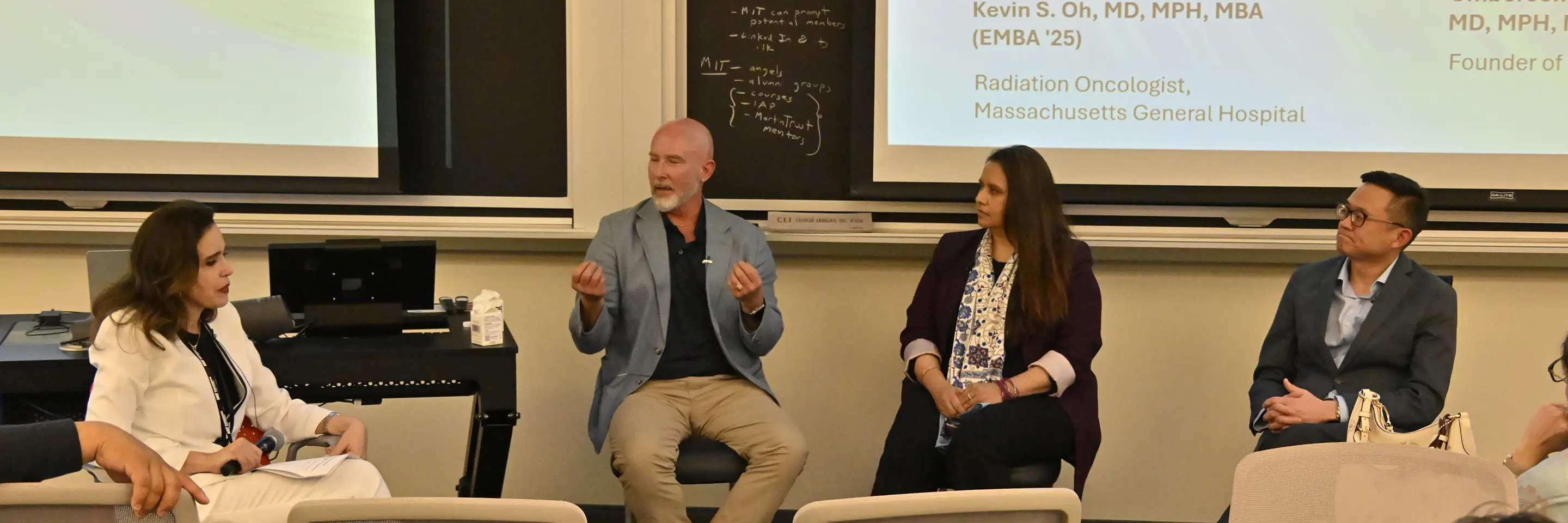
In a panel titled “Physician, Heal Thy Organization: How Doctors Can Lead the Transformation of Healthcare,” innovators and leaders in the medical space explored these challenges and opportunities at MIT Sloan Reunion 2026. Moderator Dr. Andrea Doria, MBA ’19, engaged a panel of alumni on AI, digital health, organizational models, and more.
During the conversation, speakers voiced their frustrations, talked about their work, and encouraged audience members to keep working towards progress despite significant oppositional forces in the industry.
The panelists agreed on one thing: Healthcare systems in the United States are broken. Each approached potential solutions based on their vantage point within their own context and had different pieces of advice for the gathered audience. But the main takeaways centered around innovation, disruption, and being a force for change.
We don’t actually have a system—what we have is fragmented.
As a radiation oncologist at Massachusetts General Hospital, Dr. Kevin S. Oh, EMBA ’25, noted, “There is a friction between why most people become physicians, and then inserting it into the business of healthcare … You’re dealing with physicians who are, for the most part, brilliant people who are craftsmen at their soul—and then you’re trying to, as an organization, do that at scale. I think that’s where the inefficiencies come from.”
Based on his experience as an innovator, Oh explained, “Problems are always more complicated than you think they are,” adding that, “as a physician leader, at least you can understand what those trade-offs are. Then you can communicate it with all the stakeholders, and then you can try to make the best management decisions.”
Dr. Carl Robert Dahlberg, SF ’17, recalled how as an emergency physician he saw first-hand the problems our healthcare system wasn't solving, which is what drove him to apply to MIT Sloan. In his words, “The Emergency Department is ‘where the rubber meets the road’ in medicine. Every untreated problem that isn't solved ends up in the ER. I came to Sloan because I wanted to better understand the economic and structural incentives driving healthcare dysfunction.”
As president of Dahlberg Healthcare Solutions, he advises organizations on improving their processes and coaches physicians on how to become more engaged at the systems level. “Physicians need to act in ways that earn the patient’s trust by owning the mission of improving their health, by truly listening to them, and by being transparent and honest about what the system is and isn't delivering for them.”
Every untreated problem that isn't solved ends up in the ER. I came to Sloan because I wanted to better understand the economic and structural incentives driving healthcare dysfunction.
Dr. Umbereen S. Nehal, SFMBA ’24, founder of HER Heard, approached challenges from the most systems-based perspective. “We don’t actually have a system—what we have is fragmented. It’s a historical remnant or relic, where different choices were made in different decades: for instance, to maintain employer-based healthcare, or to have a [separate veterans affairs] system,” she said. This has an impact on the data, she noted. Even though there's significant promise with AI and its systems-level integration, it’s important to understand varying quality based on its sources, who's included, and who isn’t.
“We’re really diverse. We are not the U.K., We’re not Denmark,” she said, remarking on country size and economic models. “We also are a capitalist society,” she added. “We need to have more design thinking, have more of the entrepreneurial mindset: What is the pain point, who experiences it, and what is the motivation? How much is that a pain point? What are they willing to do to make it go away?”
Nehal continued, "Perhaps not everything is going to be worked out through a national system.”
Check out the MIT Sloan Reunion 2026 website to see more highlights and videos.