
Meals & Wheels MBA Study Tour: Sustainability, Food Systems, and Mobility in Chile and Argentina
Los Glaciares National Park, Argentina
Our MBA study tour to Chile and Argentina began, as many do, with a sense of curiosity and a set of defined learning goals: to better understand transportation and food systems in practice. What emerged, however, was a far more expansive perspective on how geography, policy, and culture intersect to shape economic development. In Chile, the country’s unique geography—a long, narrow stretch bordered by mountains and ocean—proved to be more than a physical characteristic; it is a defining force that influences everything from transportation and energy systems to agricultural patterns and community organization. What stood out most was the sense that, as Chile continues to build out large-scale infrastructure, it is doing so in an integrated and forward-looking way, often aligning energy, logistics, and trade strategies simultaneously.
This forward momentum was particularly evident in the country’s approach to sustainability. Across conversations with business and government leaders, there was a clear commitment not just to discussing clean energy, but to actively building it, supported by coordinated public policy and private sector investment. Yet, this optimism was tempered by the realities of political change. Just days after these discussions, shifts in national leadership led to a rollback of climate priorities, underscoring how fragile even the most promising progress can be.
The study tour deepened our understanding of how interconnected systems—food, energy, transportation, and governance—evolve within shifting contexts.
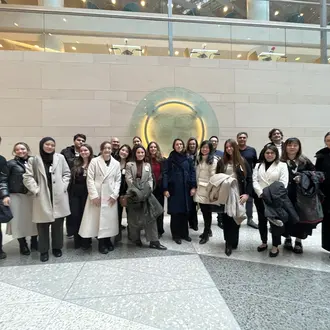
Company Visit to LATAM Airlines
Argentina offered a complementary perspective, where debates around natural resource extraction—particularly mining in environmentally sensitive areas—highlighted the tension between economic development and environmental stewardship. The speed with which policy can move, even in the face of known risks, was a powerful reminder of the complexity of these decisions.
Taken together, the experience reinforced a critical insight for our team: progress is rarely linear. While it was inspiring to see organizations investing in long-term sustainability and innovation, it was equally clear how vulnerable these efforts are to political, economic, and social pressures. Ultimately, the study tour deepened our understanding of how interconnected systems—food, energy, transportation, and governance—evolve within shifting contexts. It also challenged us to carry forward a more nuanced perspective: one that embraces both the possibilities of innovation and the contradictions that inevitably accompany real-world progress.
Keep reading to get the student perspective from several of the MBA students who took part in this study tour.

Prachi Athavale
-
Degree ProgramMBA '26

Caitlyn Huang
-
Degree ProgramMBA '26

Amanda Sugiharto
-
Degree ProgramMBA '27

Patrick Sulaiman
-
Degree ProgramMBA '26

Jeff Zhang
-
Degree ProgramMBA '26