
Yasheng Huang's book cited as one of the best books of 2008 by The Economist
December 1, 2018
Faculty

Yasheng Huang (黄亚生)
@YashengHuang
Yasheng Huang is a Professor of Global Economics and Management at the MIT Sloan School and also holds the Epoch Foundation (时代基金会)Professorship of Global Economics and Management . From 2013 to 2017, he served as an Associate Dean in charge of MIT Sloan’s GlobalPartnership programs and its Action Learning initiatives. His previous appointments include faculty positions at the University of Michigan and at Harvard Business School.
Huang is the author of 11 books in both English and Chinese and of many academic papers (such as on regulatory transparency, historical autocracy, statistical falsifications, tax, financing, sectoral and regulatory biases, history of reforms and strategy, political economy of controls, etc.) His book, The Rise and Fall of the EAST: How Exams, Autocracy, Stability, and Technology Brought China Success, and Why They Might Lead to its Decline, will be published in paperback by Yale University Press in 2025. The book was a 2023 Best Book of the Year by Foreign Affairs magazine. He is collaborating with other scholars on a book project, Reframing The Needham Question, based on a comprehensive database on Chinese historical inventions (under contract at Princeton University Press). His book, Statism with Chinese Characteristics (under contract at Cambridge University Press), examines economic reforms and economic performance of China since 1978. Huang was a co-principal investigator in a large-scale multi-disciplinary research project on food safety in China.
Outside of his academic research, Huang has written for New York Times, Wall Street Journal, Financial Times, Foreign Policy and Foreign Affairs, and Project Syndicate, Caixin and Caijing. He is working on several policy projects related to US-China relations. He was one of the coauthors of MIT’s report, “University Engagement with China: An MIT Approach” and he is a co-chair of an implementation committee of that report. He is a member of a taskforce at Asia Society on US-China policy and a member of Brookings-CSIS Advisory Council on Advancing US-China collaboration. During 2023-4, he is a visiting fellow at the Kissinger Institute at the Woodrow Wilson Center in Washington DC.
Huang founded and runs China Lab, ASEAN Lab and India Lab, which have provided low-cost consulting services to hundreds of small and medium enterprises in these countries. From 2015 to 2018, he ran a program in Yunnan province to train women entrepreneurs (funded by Goldman Sachs Foundation). He has held or received prestigious fellowships such as the National Fellowship at Stanford University and the Social Science Research Council-MacArthur Fellowship. The National Asia Research Program named him one of the most outstanding scholars in the United States conducting research on issues of policy importance to the United States. He has served as a consultant at World Bank, Asian Development Bank, and OECD, and serves on advisory and corporate boards of non-profit and for-profit organizations. He is a founding member and is serving as the president of Asian American Scholar Forum, an NGO dedicated to open science, protection of rights and well-being of Asian American scholars.
Huang, Yasheng. Cambridge, United Kingdom: Cambridge University Press, 2026.
Zheng, Enying, Wei Hong, Yasheng Huang, and Rongzhu Ke. Social Forces Vol. 103, No. 4 (2025): 1465-1488.
Qihua Gao, Yasheng Huang, El Ghali Zerhouni, and Y. Karen Zheng, MIT Sloan Working Paper 7044-23. Cambridge, MA: MIT Sloan School of Management, September 2024.
Huang, Yasheng. Yale, CT: Yale University Press, 2023.
Gao, Qihua, Yasheng Huang, Yuze Sui, and Y. Karen Zheng. PNAS Nexus Vol. 2, No. 3 (2023): pgad028.
Huang, Yasheng, and Clair Yang. Journal of Politics Vol. 84, No. 2 (2022): 1165-1175. SSRN Preprint.

Indorama Ventures, headquartered in Bangkok, is one of the world's leading sustainable chemical companies, with operations across more than 30 countries. Among its diverse businesses is a premium wool division that manufactures high-quality worsted fine count yarns for leading apparel brands and customers in more than 25 countries across Asia, Europe, and North America. Following the post-COVID market correction, Indorama's wool business navigated a more challenging demand environment while continuing to invest in innovation, sustainability, and customer-centric solutions. As part of its commitment to continuous improvement and long-term competitiveness, the company saw an opportunity to bring fresh external perspectives to a complex strategic challenge. Indorama Ventures engaged with a multidisciplinary team of MIT Sloan ASEAN Lab students to explore new avenues for growing its wool business. The team was eager to help.
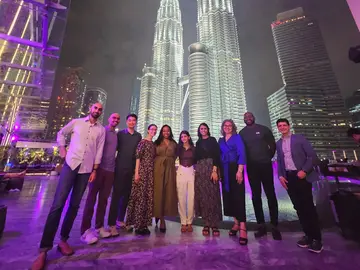
Two Asia Lab teams from MIT Sloan traveled to Malaysia's Asia School of Business (ASB) to tackle two projects: educational synergies and branding. The on-the-ground international work experience, particularly in ASEAN, was an enormous draw for students eager to go beyond case studies.
Professor Yasheng Huang said: "About 35 percent of the Chinese population still lives in rural areas, and if you look at the Chinese household registration system, that proportion reaches 60 percent. We admire high-speed rail lines, but we ignore the rural homes that were demolished to make way for them. Even progressives in the United States — who are generally sensitive to the plight of the most disadvantaged — shrug their shoulders. They, too, remain fixated on the 800 million Chinese who have supposedly escaped poverty. But then we should ask ourselves: who plunged them into poverty in the first place?"
Professor Yasheng Huang argued that low wages are not merely an unfortunate by-product of China's development model; keeping labor costs down has been fundamental to its manufacturing success. He described China as an "absolute-advantage economy" competing with America at the high end, in AI, electric vehicles, and electronics, while simultaneously competing with much poorer countries in textiles and other labor-intensive goods.
Professor Yasheng Huang wrote: "What Yang Jian (541–604) created was a system that outlived him, outlived his short dynasty (581–618), and then ran through the rest of imperial history and beyond. Keju is the imperial civil service examination, established in 587. If I had to name one thing that separates Chinese civilisation from European civilisation, I would name keju. Is it an exaggeration to say that Chinese AI capabilities and the trophies won at the Math Olympiad came from 1,300 years of doing problem sets again and again? I do not think so. You can credit, or blame, much of this to Yang Jian."
Professor Yasheng Huang wrote: "Australia and New Zealand are not unduly worried about China Shock, which has preoccupied policymakers in many countries. They have good reason not to be. China Shock means the surge of Chinese manufactured exports that, over the past two decades, hollowed out factory employment across much of the developed world and probably has had a dampening effect on industrialisation in the developing world. China Shock is a huge boon to consumers but a bane to producers worldwide."