
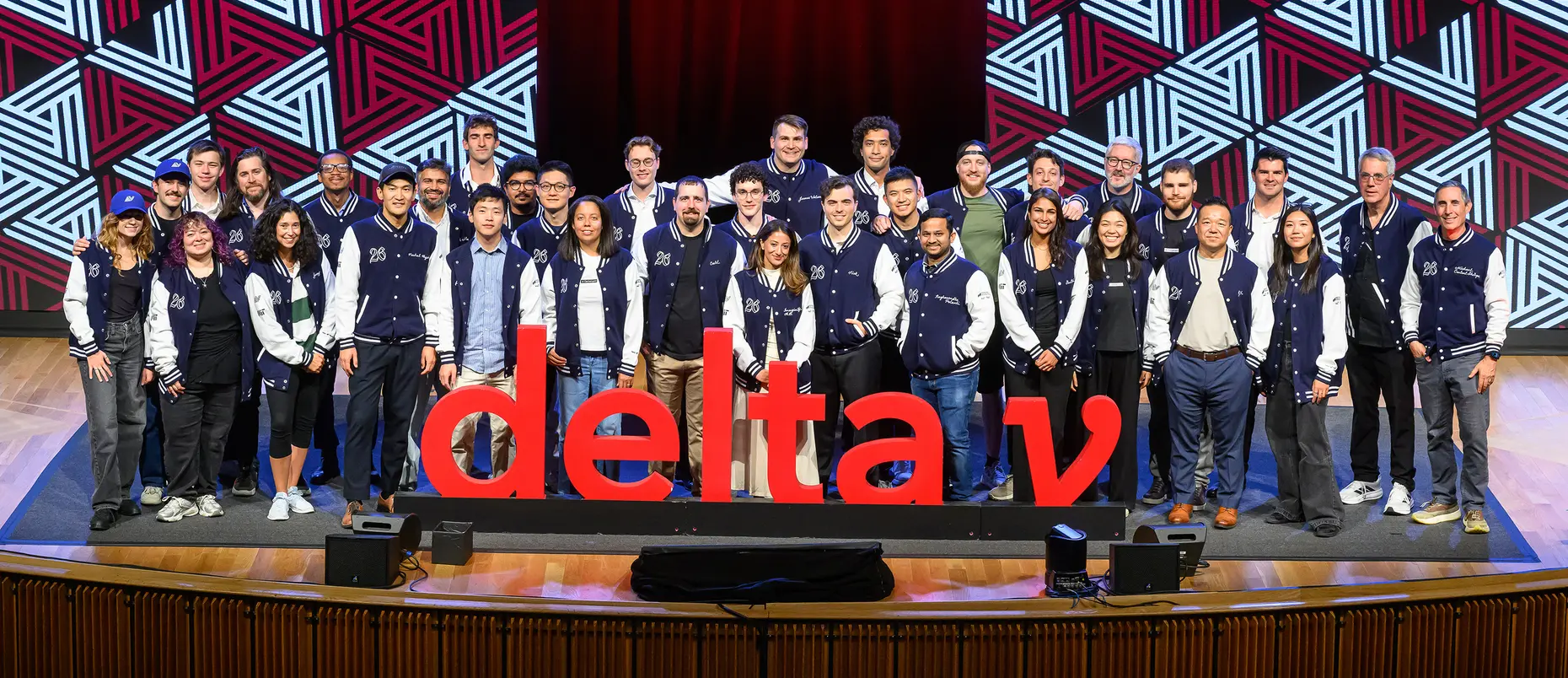
What you’ll learn: Innovations from the delta V showcase include a trust layer for AI agents, an autonomous underwater vehicle for overboard rescues, a hands-free pump for mobile blood transfusions, and AI diagnostics for property owners.
From slashing healthcare spending to streamlining small-town banking, the startups at MIT’s delta v Demo Day tackled stubborn problems with audacious solutions. Martin Trust Center for MIT Entrepreneurship managing director Bill Aulet characterized the group as “hackers, hustlers, and hipsters together working to build great companies.
This year marked the 15th Demo Day for delta v, MIT’s flagship accelerator for student entrepreneurs. The 2026 cohort comprised 13 teams and 28 founders working across biotechnology, healthcare, artificial intelligence, cybersecurity, robotics, finance, and manufacturing.
Participants were eligible for up to $75,000 in equity-free funding, up from $20,000 in previous years, and had access to an inaugural partner network of C-suite executives, founders, venture capitalists, and domain experts across multiple industries.
Over the span of the three-month accelerator, participating companies collectively raised nearly $20 million, more than doubled the size of their teams, and increased revenue by 139%, Trust Center executive director Ana Bakshi said.
Here are the 13 companies that took the stage to the tune of Elvis Costello’s “Pump It Up.”
Alpaca Research
Most powerful AI models rely on vast computing infrastructure housed in data centers. Alpaca Research wants to transfer this capability onto users’ own hardware. The team built a vertically integrated platform of hardware, software, models, and applications around a custom memory chip and a high-speed inference engine. The goal: to run enormous AI models on inexpensive local hardware rather than relying exclusively on cloud providers — shifting computing power and control from a data center to a worker’s desk.
Banzai
Banzai wants to turn home repair from a string of logistical headaches into a streamlined service. The company is building an AI-powered diagnostic agent to identify a property owner’s problem, locate the appropriate contractor, coordinate the visit, and assess pricing. The company plans to serve large property managers, asset owners, and insurance companies, helping them to diagnose issues faster, improve repair accuracy, and reduce maintenance costs.

Entrepreneurship Development Program
In person at MIT Sloan
Register Now

Bizon Labs
Bizon Labs is developing a more precise way to engineer lipid nanoparticles, the delivery vehicles used to carry genetic medicines into the body. Instead of focusing only on the nanoparticles’ chemical makeup, Bizon aims to control their size, shape, and structure. The goal is to make these therapies more potent and stable, and easier to manufacture so they can reach patients faster.
CerberusAI
As companies give AI agents greater autonomy, CerberusAI is tackling the question of what those agents can actually see, access, and do, by offering a trust layer for agentic systems. Its Intent-Based Analysis detection method monitors the API calls, database queries, and other actions AI agents take inside a company’s systems, attributing each action to the actor behind it and flagging when behavior drifts from what has been approved — boosting a company’s security.
Cortheon
Casting patterns made with traditional tooling are cost-effective only at high production volumes, while patterns 3D-printed directly are economical only at very low volumes — leaving complex, midvolume parts poorly served by either approach. Cortheon’s SynthCast platform aims to close that gap. The company manufactures 3D-printed casting patterns to order: Foundries send a CAD file and get back a pattern built specifically for investment casting, enabling them to produce complex parts without building new production infrastructure.
Exo AI
Money may move electronically, but much of the work behind commercial lending still relies on manual processes and antiquated software. Exo AI is building an AI back office for financial institutions, starting with time-strapped Main Street lenders. The company automates work, beginning with an incoming financing request and continuing through closing and ongoing monitoring of a lender’s portfolio. This allows smaller lenders to access capabilities that have historically demanded far larger teams and to run processes far more quickly.
A Gander Robotics drone submarine, built for man-overboard and other mission areas. Photo courtesy of Gander Robotics.
Gander Robotics
When someone falls overboard, maritime search-and-rescue crews can lose crucial minutes launching a boat and locating the person in the water. Gander Robotics builds small, low-cost autonomous underwater vehicles for rapid man-overboard rescues and other missions. Its first vehicle operates on an open-source platform developed at MIT and Woods Hole Oceanographic Institution, while its newer model, the Autonomous Rescue Swimmer, is a more advanced, closed-source system designed for defense and commercial use.
Neural Physics
Artificial intelligence has hyper-accelerated software development. Neural Physics wants to do something similar for physical engineering. The company builds physics simulation models for tasks like predicting car aerodynamics and crash response. It is working toward an AI model to help engineers design and simulate hardware in seconds, with a long-term goal of automating more of the hardware design process.
Pixology.AI
Professional sports teams can sell sponsorship deals worth millions, but the sales process can still involve weeks of assembling mock-ups, graphics, and pitch decks. Pixology.AI is building an AI-powered platform for sports marketing and sponsorship sales that lets teams rapidly create brand-specific visuals and pitch materials to quickly show prospective partners what a sponsorship could look like, accelerating sales cycles and boosting revenue opportunities.
RBT Resources' portable blood device, designed to expedite the delivery of blood and blood products in trauma and austere care settings. Photo courtesy of RBT Resources.
RBT Resources
RBT aims to make blood transfusions faster for medics to administer. Its system uses a compact, hands-free, reusable pump designed to make transfusions more effective in military settings and other challenging scenarios where hospital equipment is unavailable. The company says its roughly 1-pound prototype can deliver blood at a rate of up to 300 milliliters per minute.
Robox
Robox uses AI to help companies design complex robotics and automation systems faster. Its software turns customer requirements, images, and floor plans into validated system designs in minutes, helping systems integrators in areas like logistics and semiconductor manufacturing reduce engineering time.
Talys Health
Talys helps hospitals and surgical centers optimize spending and increase savings quickly. The company offers an AI-based, human-reviewed margin-improvement platform that combines clinical, financial, and operational data to pinpoint savings opportunities in areas such as procurement, procedure costs, and supply chain spending, delivering qualified savings in days, not months.
The Trade Lab
Tariff rules can change fast. The Trade Lab helps companies determine what tariffs and customs rules apply to the products they import and whether they can legally pay less. It uses AI to match millions of trade regulations with a company’s product and supply chain data, helping businesses rapidly monitor compliance and identify lawful opportunities to shrink duty costs.
MIT delta V is the Institute’s flagship accelerator for student founders. This year, the Martin Trust Center for MIT Entrepreneurship sharpened the focus of delta v to serve as an accelerator for students who are already committed to building a company and developing as founders and CEOs. This shift includes increasing equity-free funding to $75,000 per team and launching a partner model that includes a network of founders, C-suite operators, investors, and leaders supporting delta v ventures through workshops and office hours.
Bill Aulet is managing director of the Martin Trust Center for MIT Entrepreneurship and a professor of the practice at the MIT Sloan School of Management. He is the author or co-author of “Disciplined Entrepreneurship,” “Disciplined Entrepreneurship for Climate and Energy Ventures,” and the forthcoming “Disciplined Entrepreneurship Finance for Founders” and “Disciplined Entrepreneurship — The Revenue Engine,” among other titles.