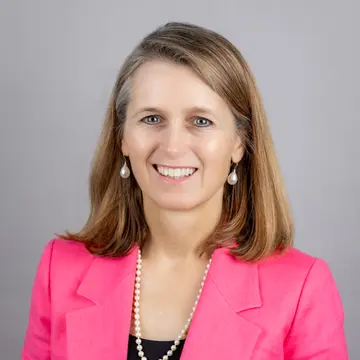
Catherine Wolfram

Faculty

Catherine Wolfram

Support Staff

Get in Touch

Title

About

Academic Groups

Academic Area

Catherine Wolfram is the William Barton Rogers Professor of Energy Economics at the MIT Sloan School of Management.

She previously served as the Cora Jane Flood Professor of Business Administration at the Haas School of Business at UC Berkeley. 

From March 2021 to October 2022, she served as the Deputy Assistant Secretary for Climate and Energy Economics at the U.S. Treasury, while on leave from UC Berkeley. Since March 2025, Wolfram has served on the COP30 Ad Hoc Council of Economists and chaired a working group on climate coalitions.

Before leaving for government service, she was the Program Director of the National Bureau of Economic Research's Environment and Energy Economics Program and a Research Affiliate at the Energy Institute at Haas. Before joining the faculty at UC Berkeley, she was an Assistant Professor of Economics at Harvard.

Wolfram has published extensively on the economics of energy markets. Her work has analyzed rural electrification programs in the developing world, energy efficiency programs in the US, the effects of environmental regulation on energy markets and the impact of privatization and market restructuring in the US and UK. She is currently working on projects at the intersection of climate, energy, and trade, including work on carbon border adjustment mechanisms and oil market sanctions.

She received a PhD in economics from MIT in 1996 and an AB from Harvard in 1989.


Honors

Wolfram elected to the American Academy of Arts and Sciences

April 23, 2025

Publications

"Who Bears the Burden of Climate Inaction?"

Clausing, Kimberly A., Christopher R. Knittel, and Catherine Wolfram. Brookings Papers on Economic Activity. Forthcoming.

"The Global Effects of Carbon Border Adjustment Mechanisms."

Clausing, Kimberly A., Jonathan M. Colmer, Allan Hsiao, and Catherine Wolfram, Working Paper. September 2025. NBER Working Paper No. 33723.

"A Theory of Price Caps on Non-Renewable Resources."

Johnson, Simon, Lukasz Rachel, and Catherine Wolfram, Working Paper. August 2025. NBER Working Paper No. 31347.

"Building a Climate Coalition: Aligning Carbon Pricing, Trade, and Development."

Global Climate Policy Project Working Group on Climate Coalitions. Cambridge, MA: Global Climate Policy Project at Harvard and MIT. (2025).

Load More

Recent Insights

Press

Why climate change is costing U.S. households hundreds of dollars a year

From insurance premiums to energy bills, a new study from MIT Sloan shows how Americans are already paying the price of climate change, and climate inaction, driven by extreme weather.

Read Article
Press

How modeling scenarios informed the emergence of a global carbon market coalition at COP30

The Open Coalition on Compliance Carbon Markets, announced by leaders from 10 countries and the European Union, draws from a proposal from the Global Climate Policy Project at Harvard and MIT.

Read Article
Load More

Media Highlights

Press WBUR

$900 a year: That's how much climate change costs the average US household

In this "Cognoscenti" opinion piece, professors Catherine Wolfram, Christopher Knittel, and co-author wrote: "In a research paper slated for publication in the Brookings Papers on Economic Activity (BPEA) later this spring, we document the key vectors through which climate change affects household costs. We have found that climate change now costs the average American household $900 each year, while the annual price tag exceeds $1,300 per year for 10% of U.S. counties."

Read Article
Press Marketplace

Some countries are capping gas prices. Here's why the U.S. is unlikely to

As the war in Iran pushes oil prices higher, some governments are shielding consumers with price controls. But economists warn that caps mask scarcity signals and can trigger the kind of panic buying that can drive up oil prices even more. "You just kind of exacerbate a problem by not letting consumers see that this commodity is in fact very very scarce right now and very expensive," said professor Catherine Wolfram.

Read Article
Press The Boston Globe

Gas prices are spiking. An MIT expert explains why they're unlikely to come down any time soon.

Professor Catherine Wolfram said: "When oil prices go up, gasoline prices go up like a rocket. They kind of match. But then when oil prices come back down, gasoline prices float down like a feather. They don't go down as fast. A refinery that was hit by a bomb, it's not going to come back online, even if the Strait of Hormuz opens up. There's going to be some dislocation that is more permanent."

Read Article
Press ABC News

What to know about South Pars, the largest natural gas field in the world and lifeline for Iran, after Israeli strike

The U.S. is relatively insulated from natural gas price shocks due to the strikes on Iran's gas fields because the U.S. is a big producer and doesn't have enough export capacity to fully link itself to Asian and European markets, professor Catherine Wolfram told ABC News. Countries like Japan, Korea and the Europeans who are dependent on imports will take a big hit to their supply as a result of the attack on South Pars, she said.

Read Article
Load More