
Leadership
From Navy Captain to CEO: A Veteran Alum on Leadership, Innovation, and the MIT EMBA
When Van Gurley, EMBA '18, enrolled in the MIT Executive MBA, he was already a seasoned leader with 26 years of experience as a U.S. Navy captain and a rising executive at Metron, a 40-year-old advanced technology company specializing in national security. Yet, he felt there was more to learn to prepare for a leadership transition as the potential CEO of Metron. Today, as President and CEO of the privately-owned company, Gurley, who already had a master’s in engineering from MIT, credits the MIT EMBA program for reshaping his approach to leadership, fostering innovation and creating a lasting cultural impact at Metron.
What motivated you to pursue the MIT EMBA, and how did it shape your career?
Van Gurley, EMBA '18
When I retired from the Navy in 2013, I thought I’d found my final career destination at Metron as a senior manager developing innovative solutions to wicked hard problems in the defense tech space. However, when the founder approached me about the possibility of succeeding him as CEO, I realized I needed to broaden my skill set. The program at MIT stood out because of its focus on innovation and principled leadership. I felt the Navy had given me a very full toolbox for organization, strategy, team building, execution, leadership and management. In my last Navy job, I ran a worldwide organization with over a thousand people in it. However, I knew I understood very little about finance, boards, negotiations, sales and marketing, and the business of running a business. So, I really walked in with only a half-full toolbox. What surprised me was, yes, I filled up the empty parts of my toolbox, but even in those parts I thought I already had solidly stocked, I had so much to learn. The program not only prepared me for the CEO role but fundamentally changed how I see the world and approach challenges.
At the beginning of the program, I was moved to a senior vice president role at Metron to give me exposure to the C-suite. Halfway through the program, they made me COO. What was particularly rewarding was seeing how quickly I could bring new ideas from the classroom to the C-suite. The founder was so excited by this that he asked, “Why don’t we move the transition up a year to January of 2018.” I was scheduled to graduate in June of 2018. I said, “No, no, no.” I knew I could not successfully make that leadership transition in my last six months of the program while also trying to complete a very high-risk research and development project for one of our toughest clients. The ability to think strategically about the timing and phasing of this transition showed me how transformative the program already was for both me and the company.
Can you share how the EMBA program directly influenced your leadership at Metron?
One of the most impactful lessons was from Leading Organizations, which emphasized the importance of humility, transparency, and collaborative problem-solving. As a former Navy officer, I was used to decisive leadership, but I learned the power of co-creating strategies with my team. For example, during a significant revenue loss in my first year as CEO, I leaned on these principles to rebuild trust and navigate the crisis. In the last quarter of 2018 one of our largest clients notified us they were going to end our biggest program early. We were performing well technically, but the government decided they were going to shift budget to another set of priorities. So, starting my first quarter as CEO, I'm down 25% in revenue with 90-day notice. That was clearly a challenge. But at the end of the year, we were even. We had grown it all back.
What innovative practices have you implemented at Metron inspired by the EMBA program?
The Metron Innovation Fund is one of my proudest initiatives. Modeled after lessons from IDEA Week, we now have an internal pitch-fest every six months where employees can pitch blue-sky passion projects. We select up to three each round for six months of seed funding to support initial development. Over the past five years, we’ve funded more than 30 ideas, some of which have yielded tech that is now integrated into our government solutions. This initiative has not only fueled creativity but also strengthened employee engagement by giving our team the opportunity to pursue their passions.
The program also equipped me with process improvement tools that had an immediate impact. My project for Organizations Lab successfully fixed a broken purchasing system that had been a problem for years and threatened key client relationships. This holistic approach to innovation has helped Metron remain competitive in a rapidly evolving industry while empowering employees to think like entrepreneurs within the company.
How has the EMBA program supported your commitment to being a principled leader and improving the world?
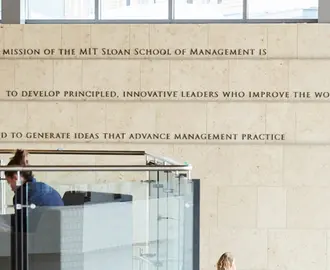
The MIT Sloan mission—developing principled, innovative leaders who improve the world—deeply resonates with me. At Metron we strive to improve the world in two ways. First, I’ve got more than 200 families who depend on Metron and what I’m doing at Metron. Every employee is a shareholder, and this has created a sense of shared responsibility and pride that drives our success. If the company does well, they do well. People come to Metron; most never leave. There are many at Metron who have generated significant wealth through our employee profit-sharing and the growth of company stock. But if you ask them, most will say they love Metron because of the mission, the chance to have a meaningful impact solving some of the toughest problems around and the ability to work with a fantastic, world-class team. This mission and team focus has enabled us to consistently deliver game-changing technology to our clients that make them safer and more effective in very dangerous situations. Our ability to do that in a principled and ethical way is the second way I believe we improve the world.