What you’ll learn: A study on how visitors behaved at the Van Gogh Museum showed that spatial design decisions are closely linked to patterns of movement and engagement and that, counterintuitively, visitors might interact with more exhibits in response to more congestion. A new predictive model can forecast visitor movement through a museum to help illuminate how physical and digital spaces shape engagement.
The Van Gogh Museum sits on the northwest side of a grassy quadrangle in Amsterdam. Visitors walk in, pay for admission, and start their travels through the collection. They engage with certain rooms and artworks while ignoring or bypassing others. They seek out highlights. They get fatigued and leave.
“Museum fatigue” — physical and cognitive fatigue that causes a sharp drop in visitor attention — has been extensively studied and documented, and yet it has rarely been examined using large-scale behavioral data. Using data from the museum’s multimedia guided tours, MIT Sloan assistant professor PhD ’17, analyzed visitor pathways to elucidate how physical and digital spaces are associated with differences in engagement.
In particular, the research showed that although visitors often deviate from the curated path, museum design choices — including the arrangement of artworks and the spatial layout — can help explain observed patterns in visitor behavior. And, counterintuitively, moderate congestion was associated with higher levels of engagement.
“This project brought data and analytical methods to a sector that hasn’t traditionally drawn on these resources,” Aouad said, referring to cultural institutions like museums. “Given the progress in digitization and AI processing capabilities, we can now help practitioners think through questions around curation and design.”
Though this specific project is centered on museums, Aouad noted that it is part of a larger agenda in which he and two collaborators — Abhishek Deshmane, from the Georgia Institute of Technology, and Victor Martínez de Albéniz, PhD ’04, from the University of Navarra — are exploring ways to better understand and increase the quality of engagement across a range of experiences in physical and digital environments, from cultural to retail settings.
Modeling visitor behavior
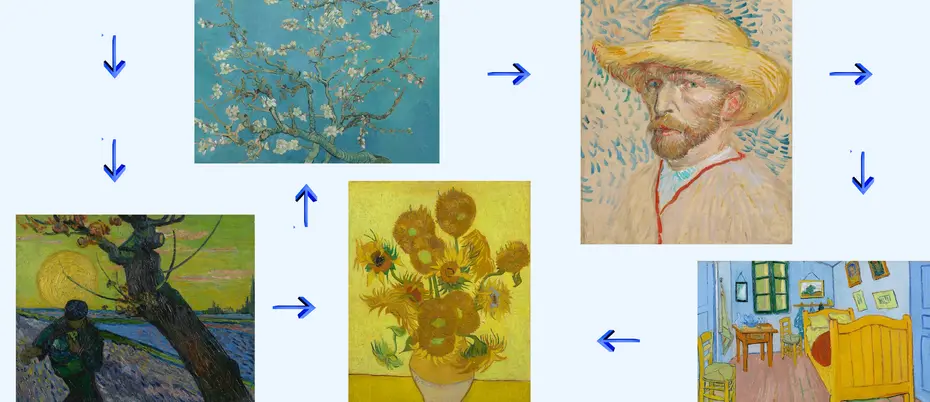
The researchers gathered data from multimedia guided tours used by approximately 1.2 million visitors to the Van Gogh Museum between 2019 and 2021. The tours include information about some of the key artworks and relics in the museum. While the tour data does not include real-time tracking information, it does indicate which paintings visitors chose to learn about. That data provided information about visitor engagement with specific artworks, as well as a coarse-grained reconstruction of visitors’ paths through the museum.
Researchers gathered data from multimedia tours used by 1.2 million visitors to the Van Gogh Museum between 2019 and 2021.
The researchers’ most fundamental finding is that, “perhaps unsurprisingly, visitor behavior is very tightly related to proximity of artworks, to how the museum chooses to display things,” Aouad said. Artwork proximity tends to predict what people look at, meaning they are more likely to sequentially view two paintings in the same room than they are one painting on the first floor followed by a painting on the third floor.
The researchers were also able to use the data to build a predictive model of visitor behavior and test it against two case studies: first, comparing their model’s predictions against a novel set of museumgoers; and, second, comparing the model with visitor paths after maintenance and construction forced the museum to rearrange its layout. In both cases, the model was able to accurately forecast patterns of visitor movement through the museum.
Aouad is careful to point out the model’s limits: The researchers are neither claiming to have identified causal effects nor explaining precisely why a given layout produces particular visitor behaviors. But he did describe two mechanisms that may be at work.
One is attraction: Some masterpieces appear to draw visitors to particular rooms of the museum. And the second is retention — certain artworks’ ability to retain visitors who are otherwise at risk of leaving the museum.
“We think this project can provide a methodology for museums to think more operationally about how the architecture of space relates to engagement,” Aouad said.
‘Museum fatigue’ and the benefits of congestion
Visitor attention declined after visitors passed through the initial galleries on the first of three floors, the study found. Identifying when fatigue begins allows curators to think creatively about ways that strategic and well-planned design might sustain engagement for a longer time. For instance, as visitors become fatigued, they tend to head directly for the most renowned artworks; playing with the spacing of those could allow museums to increase the amount of time visitors stay and provide a more complete narrative.
The researchers also found, counterintuitively, that a moderate level of congestion in the museum was associated with increased engagement. The research offers several hypotheses that may explain this result:
- Queue forming can be a signal of quality, like at popular restaurants. Crowds signify interest and demand.
- “Congestion can provide a kind of natural regulation for the flow of visitors,” Aouad said. When COVID-19 restricted the number of visitors, people moved quickly — “frictionlessly,” as Aouad put it — through the galleries. A bit of congestion may slow their pace.
- If visitors are interested in masterpieces but find them crowded, they may bide their time by wandering off to engage with lesser-known artworks.

Strategy, Survival, and Success in the Age of Industrial AI
In person at MIT Sloan
Register now

Broader implications
Aouad notes that this work raises questions and opportunities for any sector, digital or physical, in which the goal is to engage visitors through a “pathway experience” — such as retail stores. While each setting has nuances, they share common themes such as the cost of physical distance between objects, short attention spans, and the value of digital recommendations.
But Aouad emphasized that museums alone are worthy of further study. “There is this whole world of cultural institutions that provide informal education on important issues,” he said. “A billion people go to museums every year, and we are a long way from understanding the nuance of these experiences. Data and modeling can complement curatorial knowledge, opening a dialogue about how spatial and digital design can shape engagement.”
Designing Layouts for Sequential Experiences: Application to Cultural Institutions
Ali Aouad, PhD ’17, is an assistant professor of operations management at the MIT Sloan School of Management. His research interests are at the intersection of operations, computer science, and economics. His academic work focuses on algorithms and decision processes with applications covering supply and demand management, and market design, as well as public and societal operations. Abhishek Deshmane is an assistant professor of operations management at the Georgia Institute of Technology whose research focuses on the operations of cultural markets. Victor Martínez de Albéniz, PhD ’04, is a professor in the operations, information and technology department at IESE Business School whose work focuses on supply chain management.