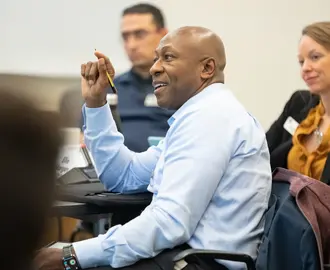
Andrea Guendelman is a serial entrepreneur, CEO of Speak_, and a member of the MIT Executive MBA Class of 2021.
Why did you decide to pursue an MBA at the stage of your career you did? What motivated you, and why the MIT EMBA?
I was motivated by who I was working with, a founder named Isaac Saldana, EMBA ‘19, an investor and co-founder of mine. He had sold a company, IPO'd a company, and he decided to go back for an MBA at MIT. And I thought, “If Isaac, who sold a company, thought this was useful, I need to do it, too.” He was a role model to me, and I wanted to do what he did.
What's one lesson from the MIT EMBA that has most changed how you lead?
I’ve been an entrepreneur for a long time—kind of a solo entrepreneur. I had teams, but I thought it was very interesting to learn the dynamics of working in groups. The most effective groups in the EMBA were the ones where people found the thing they did well and contributed in a way that felt almost planned but wasn’t.
One of the things I learned was that when you're leading in a group, you need to let people’s talents shine. Do what you’re good at and let others do the same.
Andrea Guendelman, EMBA '21
The mission of MIT Sloan is to develop principled, innovative leaders who improve the world. How does your work—or you yourself—connect with that mission?
I've been a social entrepreneur all my life, meaning I’ve worked to solve problems I thought were important. Before anyone talked about diversity and inclusion, I created a network for Latinas. Then it grew to underrepresented talent. Then we created programs to help first-time job applicants pass interviews at companies like Amazon. I placed hundreds of people.
Everything I’ve done has been driven by a mission. Before that, I was a lawyer, and I had no mission, and I didn’t like it. Now I'm finding my new mission. I’ve been in HR tech for a long time, and now I want to support entrepreneurs.
I’m currently developing a project called ChileConservation.com, focused on protecting land in Chile by connecting conservation-minded investors with meaningful experiences in nature. The idea is to help people not just invest in land, but build a relationship with place—supporting preservation while creating opportunities for education, community, and low-impact travel.
With your experience as a social entrepreneur, how do you balance mission and business as you scale an inclusion-driven or social-impact-driven company?
I started as an entrepreneur because of my social mission. I saw opportunity with Latinas. When I lived in New Mexico and then moved to Boulder, CO, I didn’t see them in any tech companies. I was infuriated, and that fueled everything.
But once you start getting investment, you have to compromise because you need to survive. Once you hire people who depend on you, it’s no longer about what you personally want. It’s about what the market and investors will fund.
One of your recent social entrepreneur endeavors was the creation of Speak_. What gap in hiring did you see that inspired its creation?
It started as Wallbreakers and became Speak_. Around 2018, companies said they wanted diversity and more non-typical candidates. But they also said those candidates weren’t passing interviews.
We dug into why. Many state schools—great universities—weren’t teaching students how to interview. Their communities also didn’t have interview knowledge because their graduates weren’t working at top tech companies. We realized that if we taught computer science students how to interview the way companies expected, we’d get more hires. And yes—our program was incredibly successful. It didn’t teach coding; it taught how to think and answer interview questions. We ended up being the sole provider of entry-level diversity hiring for Amazon for two years because our conversion rates were so high.
How do you think AI will reshape hiring or industry over the next five to 10 years?
I think AI is making it very hard to distinguish what’s right from what’s wrong. For industries that hire at massive scale, AI is helpful. But for other roles, I think AI has created the opposite effect.
Candidates can apply to thousands of jobs instantly using AI. Companies are flooded with resumes. It becomes impossible to find the needle in the haystack. So companies are going back to referrals and networks more than ever. It affects meritocracy; you need to know someone.
How can we ensure AI enhances rather than replaces human creativity and empathy in day-to-day work?
AI is a great tool. It will replace some things: entry-level tasks done by auditors, lawyers, marketers, etc. That doesn’t mean change is bad. It means talent will be rearranged. People will have to be more adaptable.
Human beings are survivors—our survival skills are changing. Young people are affected, but those who move fast will also win. AI isn’t bad; it will reshape things, and we need to use it for our benefit.
What guidance would you give to emerging entrepreneurs navigating an AI-accelerated world?
Embrace it. With AI, you can code faster, iterate faster, launch a company with less capital. Developers are still expensive, but less so.
But you don’t have to build an AI company. You will use AI the way you use the cloud—because you have to, but you can still build a real-world services company.
What's one piece of advice you have for those interested in the MIT EMBA?
Go with a purpose. If you're an entrepreneur, get involved with the entrepreneurship center, investors, and people who can help you grow a startup. If you want to become an entrepreneur, take those classes.
If you're aiming for corporate advancement, be intentional with networking. People who were intentional did very well. Remember: you're not only going there to study—you’re going there to create networks. Both matter.