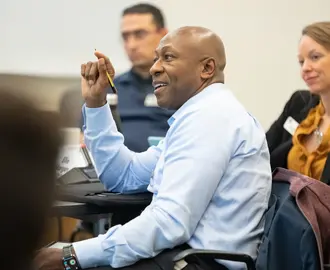
Jim Dunn, EMBA ‘16, is no stranger to pushing boundaries. With a career spanning more than 30 years in human resources and a resume that includes serving as Chief Human Resources Officer (CHRO) for some of the nation’s largest healthcare organizations, Dunn had already achieved what many executives aspire to. But in 2014, despite his extensive leadership experience and an impressive collection of advanced degrees—three doctorates and multiple master’s degrees—he felt something was missing.
The MIT Executive MBA became a transformational experience, giving him not just financial expertise but the confidence to expand his leadership scope and, eventually, start his own business. Today, Dunn is the President and CEO of LD Human Capital Consulting, a firm he named in honor of his mother, Lillian Dunn.
What made you decide to pursue an Executive MBA at MIT Sloan at that stage of your career?
At the time, I had already been a Chief Human Resources Officer multiple times across different organizations, but I had never taken a formal finance or accounting course. I’d heard people say that to truly have a seat at the table, you need to be an executive who happens to lead HR, not just an HR executive. I wanted that deeper financial knowledge, and I knew MIT would deliver the rigorous curriculum I was looking for.
My undergrad and master’s degrees were in chemistry and occupational epidemiology, so I had a science background, but I wanted something more practical for the business world. My doctorates were in education, hospital administration, and leadership development, which gave me a broad perspective on leadership, but the MIT EMBA was the missing piece that would tie everything together. I didn’t consider any other programs because I knew that MIT’s brand and academic rigor were unmatched.
Jim Dunn, EMBA '16
What was your experience like once you started the program?
Honestly, it was humbling. Six months in, I found myself questioning if I belonged. The finance and accounting courses kicked my butt. I even went to one of the administrators and said, “I don’t understand why you admitted me. This feels like it’s in a different language.” They assured me I wasn’t alone and encouraged me to keep going.
I had a little bit of imposter syndrome at the beginning. I was surrounded by engineers, surgeons, and business professionals. In my cohort, there were only two from HR, and at times I wondered if I could keep up. I will never forget one meeting at work where I caught an error in a financial report and pointed it out. The CFO looked at me and said, “Oh, look at the HR guy down there trying to be smart. I dare you to question my numbers.” I just responded, “Let’s go through the numbers together.” Sure enough, the numbers didn’t add up. That’s when I knew the hard work was paying off. I wasn’t just an HR leader anymore—I was a strategic business partner who could speak the language of finance and operations.
Can you give us an example of how you applied what you learned at MIT in real-time?
One of the most powerful courses I took was Negotiations and Influence, and it had an immediate impact on my work at Parkland Health. At the time, I was the Chief Human Resources Officer, and we were constantly in battles with local government officials over our budget. Parkland Health is the safety-net hospital for Dallas County, so we relied heavily on funding from the county commissioners. My CEO and I would go down to the commissioner’s court every two weeks to fight for those dollars. It was combative and stressful.
After taking the negotiation course, I realized our approach was all wrong. We were walking into those meetings defensive, expecting a fight. We had already handed the power over to the commissioners before the conversation even started. I sat down with my CEO and said, “Let’s rethink this. Our strategy is too defensive, and we need to apply some of the principles I just learned at MIT.” At first, he laughed and said, “Oh, now you’re bringing MIT in here!” But he was open to trying something new.
We worked through a practice exercise I had learned just a few days earlier in class. We focused on defusing the tension and framing our requests in a way that aligned with the commissioners' priorities rather than coming at them with demands. When we went back to the commissioner’s court the following Tuesday, the results were night and day.
We secured the funding we needed, and from that point on, our relationship with the commissioners improved dramatically. That experience solidified for me how valuable real-time learning can be. I didn’t just absorb information at MIT—I applied it immediately, and it made a difference.
What inspired you to transition from being a W-2 employee to starting your own company?
One of the biggest shifts for me after the MIT EMBA program was the realization that I could step out on my own. Before that, my professional identity was very much tied to the organizations I worked for. My brand was my title and the organization’s reputation, not my own.
Watching many of my classmates take the entrepreneurial route gave me the confidence to do it. I had been thinking about it for years, but it wasn’t until 2023 that I decided to take the leap. I launched LD Human Capital Consulting, which was named after my mom Lillian Dunn. Within 14 months, we had already surpassed my initial income goals.
Any advice for those considering the MIT EMBA?
Don’t be intimidated by the challenge. You’ll feel out of your depth at times, but that’s where the growth happens. Lean into the discomfort and trust the process. The relationships you build and the skills you gain will be worth it. And most importantly, don’t be afraid to apply what you learn right away—you’ll be surprised at how quickly it makes a difference.