

What you’ll learn:
- AI can do more than automate work. It can expand what workers are capable of doing, making their expertise more valuable.
- MIT economists Daron Acemoglu, David Autor, and Simon Johnson identify five types of technologies that affect workers, but only one — new task-creating technology — is unambiguously pro-worker.
- Firms that use AI to expand human capability rather than to replace labor may gain a competitive advantage.
A data center technician’s job involves more than just inspecting equipment or responding to alarms. Today, they have to interpret streams of operational data, spot early signs of risk, and make decisions across systems. And with the support of artificial intelligence — surfacing relevant information, flagging potential hazards, and guiding next steps in real time — they can take on more complex tasks with greater confidence.
That kind of support points to a different way of thinking about AI at work: not simply as a tool for doing the same tasks with fewer people but as a way to help people handle work that is becoming more complex, data-rich, and consequential.
This distinction sits at the center of a growing debate about how companies should use AI. Much of today’s corporate AI adoption is aimed at automation. The goal is to do existing tasks faster, cheaper, or with fewer people. But in the February 2026 paper “Building Pro-Worker Artificial Intelligence” from the Brookings Institution’s Hamilton Project, MIT economists David Autor, and argue that AI can also move in a different direction — one that extends human judgment, creates new tasks, accelerates skill acquisition, and raises the value of human expertise. (Acemoglu and Johnson won the Nobel Memorial Prize in Economic Sciences in 2024, along with James A. Robinson.)
Pro-worker AI is AI that expands worker capabilities and makes human skills, judgment, and expertise more valuable, Johnson, an MIT Sloan professor, explained.
“Pro-worker AI means deploying AI in a way that increases the demand for human expertise,” he said. “People become more valuable, their expertise becomes more valuable, and you pay them more as a result.”
Not every productivity gain is pro-worker: A technology can make a company more efficient while reducing the need for expertise, narrowing a job role, or shifting more value from labor to capital. The authors define pro-worker AI as AI that moves in the opposite direction: It expands what workers can do and makes their expertise more important to the work.
Many companies, however, are not yet reaching that level of ambition. “Replacing people with machines is just too easy,” Johnson said. “It’s the path of least resistance that does not require much management imagination.” And this easier path may also leave value on the table.
Pro-worker AI starts with deciding how the technology will be designed, deployed, and integrated into work. Productivity gains alone do not determine whether an AI system benefits workers; what matters more is the path to those gains: whether AI reduces the need for human expertise or helps to make that expertise more valuable.
What counts as pro-worker AI?
The Brookings report offers a framework for understanding how different technologies affect workers, identifying five broad categories: labor-augmenting, capital-augmenting, automating, expertise-leveling, and new task-creating technologies. Only new task-creating technologies are “unambiguously pro-worker,” the authors write, because they create demand for new forms of human expertise rather than make existing expertise less necessary.
Technologies that look similar on the surface can have very different consequences for work. A labor-augmenting tool might help a worker do a current task more quickly. An automation tool might move that task from the worker to a machine, and an expertise-leveling tool might allow a less-experienced worker to do something that previously required a specialist’s skills. That can benefit some workers by opening up new opportunities or making their skills more valuable, but it can also reduce the scarcity value of the specialists who previously performed that work.
For example, the report points to pulse oximeters: A medical technician can use the device to quickly read a patient’s blood oxygen level, a task that once required a phlebotomist, lab technician, and doctor or nurse. That shift can make technicians more capable while also changing the demand for other forms of expertise. That’s why the authors do not classify it as unambiguously pro-worker.
New task-creating technologies are different because they expand the range of valuable work that humans can do. In electrical work, for example, technologies such as Ethernet networks, fiber-optic cabling, and occupancy-aware heating and lighting systems increased the complexity of modern buildings and created demand for specialized expertise to plan, install, and maintain those systems.
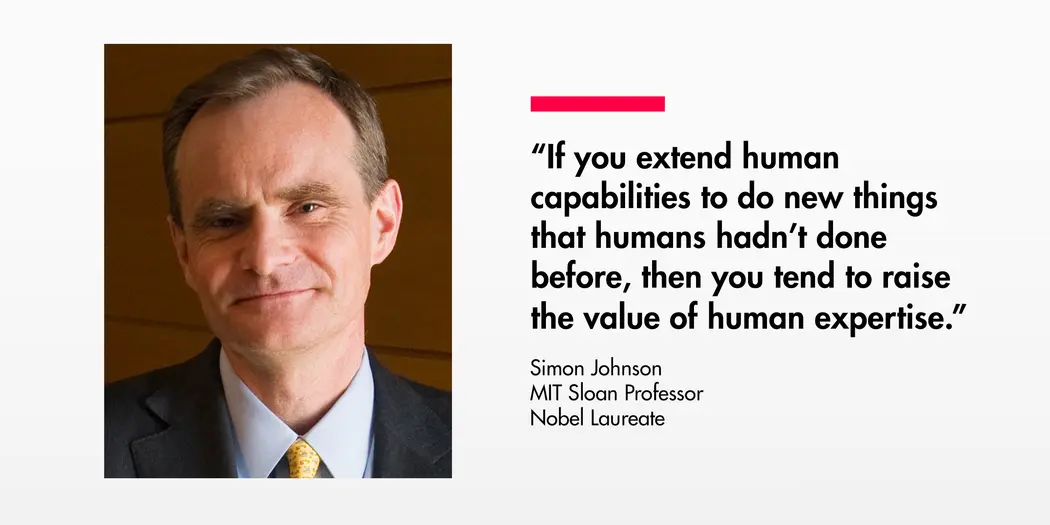
Johnson said that is the key test for AI: “If you extend human capabilities to do new things that humans hadn’t done before, then you tend to raise the value of human expertise.”
Patent examination is an example of what this can look like in practice. The U.S. Patent and Trademark Office incorporated AI-based search tools into prior art search software, enabling examiners to find conceptually related documents more quickly and more precisely than traditional keyword-based search methods. The researchers’ assessment is cautious: If the tool only helps examiners do the same work faster, it may primarily reduce the amount of examiner time needed for a given task, creating a labor-saving efficiency gain. But if it allows them to perform deeper analysis and better evaluate applications, it can make their specialized judgment more valuable.
That nuance is important for business practitioners. Asking whether AI “helps people” can obscure the longer-term effect on work itself. A tool might support employees in a narrow sense while still reducing the value of their expertise over time. A more useful test is whether the technology creates new opportunities for workers to apply judgment, build expertise, and take on more valuable tasks.
That makes pro-worker AI partly a technical challenge and partly a management challenge, Johnson said. Leaders must decide what kind of work they want AI to enable.
“The outcome depends on what [leaders] want to do with AI and the vision that they have for what you can do with AI,” he said.
What is the business case for pro-worker AI?
Understanding how pro-worker AI benefits businesses begins with taking a different view of productivity, Johnson said. Automation often improves productivity by lowering the cost of doing existing work. That can be valuable, but it’s not the only way technology creates business value. New task-creating technologies raise productivity by expanding what people can productively do, allowing companies to meet new needs, solve more complex problems, and deliver services or experiences that were previously too difficult, expensive, or impractical, he said.
“Do you want to amaze your customers and expand what they can expect from you, or do you want to putter along doing the same things as before?” Johnson asked. “AI creates potential for breakthrough customer experiences, which is where companies should focus.”
Schneider Electric has designed an AI tool to support electricians and electrical engineers as they troubleshoot machinery and circuitry. The tool draws on images, hardware information, and a database of documented problems to suggest next steps for field technicians. According to the report, engineers use the tool to cut the average time needed to complete maintenance reports in half. But the pro-worker case is not simply that the tool saves time; it also helps workers apply their expertise more effectively in the field.
The Schneider example also points to a broader business case for pro-worker AI. As AI tools become more widely available, competitive advantage may come less from the technology itself and more from how work is redesigned around it. Companies that use AI only to compress existing processes may see efficiency gains, while companies that use it to expand what employees can do may find new ways to serve customers, improve quality, and unlock expertise.
That doesn’t mean that every AI system should avoid automation, however. Automating some tasks can make goods and services cheaper, safer, or more accessible. The issue is whether automation becomes the default objective for AI deployment, especially in areas where human judgment, context, and discretion remain central to firm performance.
“Companies may miss out on a lot of opportunities if they don’t take a pro-worker approach,” Johnson said. “An automation-first path could create problems across the labor market if companies are not hiring people or increasing the value of workers’ skills.”
This also shifts how AI investments are evaluated. A narrow business case might focus on time or labor costs saved. A pro-worker business case asks additional questions about the new capabilities AI will create, the new work employees will be able to perform, the expertise that will become more valuable, and how use of the technology will change the quality of the product, service, or customer experience. The researchers argue that these questions matter because AI’s collaborative potential remains underdeveloped.
Organizations that make workers more capable — not just faster — will be better positioned to innovate, retain talent, and build forms of expertise that competitors cannot easily copy, Johnson added. “I think businesses need to understand that AI has real transformative potential, but if you’re just replacing people with machines, you’re not going to fully realize that potential,” he said.

Leading the AI-Driven Organization
In person at MIT Sloan
Register Now

Designing AI to expand human capability
Pro-worker AI begins with choices made inside organizations, but its wider adoption may also depend on changing the incentives that guide AI research and investment. Johnson and his colleagues point to public investment in areas such as healthcare and education, stronger government capacity to evaluate AI, grant-making that supports worker-centered tools, tax changes that reduce incentives to favor capital over labor, antitrust enforcement, worker voice, intellectual property protections for worker expertise, and changes to occupational licensing.
Business practitioners, however, don’t need to wait for policy changes to act. The direction AI takes inside organizations depends on choices they make now: how work will be redesigned, what AI systems will be asked to optimize for, and whether workers will be treated primarily as costs to reduce or as sources of expertise to extend.
That starts with asking questions at the beginning of AI initiatives about whether a system will allow employees to do something more valuable than before, whether it makes human judgment more useful or less necessary, and whether it reduces a role or creates new responsibilities, capabilities, and paths for learning.
“The priority is finding new things for humans to do and finding new ways to expand human capabilities across levels of education and skill,” Johnson said.
Next steps:
- Read the full Brookings Institution report: “Building Pro-worker Artificial Intelligence”
- Watch “Pro-Worker AI: What Is It, and How Do We Do It?” a panel discussion from the November 2025 launch of the MIT Stone Center on Inequality and Shaping the Future of Work.
- Listen to “Can AI Behave Responsibly?” from “Power and Consequences,” a podcast hosted by Simon Johnson and MIT Sloan professor of the practice Gary Gensler.
- Read “Power and Progress: The Mini-Comic!” adapted from Johnson and Daron Acemoglu’s book of the same name.
About the expert:
Simon Johnson is the Ronald A. Kurtz (1954) Professor of Entrepreneurship at the MIT Sloan School of Management, where he is head of the Global Economics and Management group. At MIT, he is also co-director of the James M. and Cathleen D. Stone Center on Inequality and Shaping the Future of Work and a research affiliate at Blueprint Labs. With Gary Gensler, Johnson hosts “Power and Consequences,” a podcast on policy, technology, and economics.
In December 2024, Johnson received the Nobel Memorial Prize in Economic Sciences jointly with Daron Acemoglu and James A. Robinson “for studies of how institutions are formed and affect prosperity.”