
How organizations can capture value from digital colleagues
What you’ll learn:
- Digital colleagues are AI-enabled systems that collaborate with people to perform complex work by combining multiple AI tools with enterprise rules and data.
- According to research from MIT Center for Information Systems Research, organizations that redesign workflows, clarify accountability, and rethink roles will see the most value from digital colleagues. So far, this accounts for fewer than 20% of organizations.
For many organizations that adopt generative AI, the first phase centers on individual productivity: faster drafts, quicker summaries, better search, and employees experimenting with AI assistants.
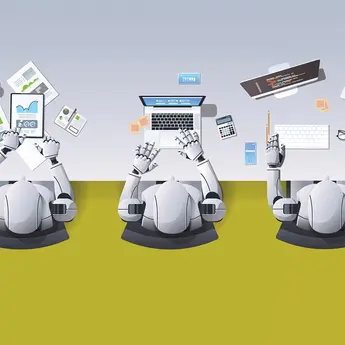
A new research briefing from the MIT Center for Information Systems Research argues that as artificial intelligence systems become more capable, companies will need to think beyond individual tools and begin managing AI as a “digital colleague” — part of how teams, workflows, and business processes operate.
In “Leveraging Digital Colleagues for Enterprise Value,” MIT CISR researchers and define digital colleagues as AI-enabled systems that collaborate with people to perform complex work. These systems combine multiple AI tools with enterprise rules and data. They can perform tasks autonomously, act as discussion partners, learn from interactions with humans, operate within governance boundaries, and seek human approval for consequential decisions.
Unlike AI assistants that primarily support individual tasks such as drafting, summarizing, searching, or analyzing information when prompted, digital colleagues become part of the work itself. Integrating them effectively requires leaders to redesign workflows, clarify accountability, rethink roles, and determine where human judgment remains essential, the researchers found.
Digital colleagues are already moving from experimentation into enterprise use. MIT CISR surveyed 132 enterprises in September 2025 and engaged executives in interactive sessions from late 2025 to early 2026 to understand how companies are deploying and governing digital colleagues and where they are capturing value.
Their research can be used to inform organizational decisions about where digital colleagues should be used, how quickly to scale them, and how to govern their work.
Where value is emerging from digital colleagues
Right now, value from digital colleagues comes mostly from efficiency, productivity, and consistency improvements rather than from new revenue streams.
The report identifies four areas where digital colleagues are already creating value:
- Automation and efficiency, particularly in repetitive administrative and reporting work.
- Knowledge management, drafting, and retrieval, where digital colleagues can synthesize large volumes of enterprise documents and create summaries.
- Decision support, including benchmarking, policy guidance, opportunity identification, project recommendations, and actions taken within guardrails.
- Customer and employee assistance, including call center and internal service functions.
Many of these uses are internal: Companies are applying digital colleagues to make existing work faster, more consistent, or easier to scale. Some enterprises are beginning to use digital colleagues in customer interactions, the researchers write, but most still measure value in terms of productivity gains and consistency improvements rather than new revenue streams.
That gap creates a strategic challenge. Survey respondents had modest near-term expectations for the effect of digital colleagues on revenue per employee. Over a three-year period, however, expectations rose sharply: Seventy-five percent of respondents predicted an average 25% increase in revenue per employee over that time. The median expected increase was 15%.
Reaching that level of value will likely require more than efficiency gains, according to the researchers. Organizations may need to rethink business models, pricing approaches, and how work moves across functions. They may also need to decide how much of the productivity gains created by digital colleagues should benefit customers — through lower prices, faster service, better experiences, or higher-quality products.
What high-performing enterprises do differently
MIT CISR’s analysis identified three capabilities associated with stronger value capture from digital colleagues:
- Redesigned workflows: Companies that layer digital colleagues into existing processes may capture incremental productivity gains. Companies that redesign workflows around them can change how work is performed, where decisions are made, and how humans and AI systems collaborate. About 22% of the surveyed enterprises reported major workflow redesigns.
- Redefined roles and performance metrics: Once digital colleagues become part of the workforce, leaders need to decide who owns their work, how their performance is measured, where accountability sits, and when human approval is required. Nine percent of surveyed enterprises had begun to formally integrate digital colleagues into workforce strategy.
- High levels of use: Enterprises that use digital colleagues more extensively learn more about where the systems create value, what barriers slow adoption, and what organizational changes are required to scale them. Thirty-four percent of the enterprises surveyed were actively using digital colleagues, while another third were testing their viability.
The enterprises that have made substantial progress on those capabilities remain the exception — fewer than 20%, according to the report. Those organizations expect to capture the most value from digital colleagues by evolving their business models.
Agentic AI: Business Implications and Applications
In person at MIT Sloan
Register now

Planning for digital colleagues
Digital colleagues affect how work is designed, how value is measured, how risk is governed, and how employees experience their jobs. They also raise questions about human accountability. Because legal and ethical frameworks for nonhuman actors are still developing, the researchers emphasize that humans must remain responsible for digital colleagues’ work, particularly when decisions will have meaningful consequences.
For business leaders, pilots alone will have limited value. The enterprises best positioned to benefit from digital colleagues will be those that redesign work, establish clear governance, measure value rigorously, and align such systems with strategic goals.
Peter Weill is a senior research scientist at the MIT Sloan School of Management and chairman of the MIT Center for Information Systems Research. His work explores future trends, such as digital business models, IT investment portfolios, and AI maturity models, to help organizations maintain a competitive edge.
Stephanie Woerner is a principal research scientist at MIT Sloan and the director of MIT CISR. She studies how companies use technology and data to make more effective business models, as well as how they manage associated organizational change, governance, and strategy implications.