
Key Takeaways
- Between 2009 and 2023, SVB's assets grew nearly twentyfold while its business model remained mostly unchanged.
- The bank's deposits came almost entirely from startups, were largely uninsured, and paid little or no interest.
- Those deposits were invested in long-dated securities highly sensitive to interest rates from the outset, a sensitivity the bank tried to increasingly keep out of reporting.
- Regulators and supervisors had repeated occasions to intervene, but acted only once the losses had materialized.
For its entire 15-year life as a regional bank, SVB held the same risky bet. The risks were visible the whole time, yet supervisors reacted only once losses had materialized. SVB's collapse is less a story of hidden danger than of a supervisory system that polices process rather than risk.
When Silicon Valley Bank (SVB) failed in March 2023, it was the 16th largest bank in the United States and held $208 billion in assets. Within days, First Republic and Signature Bank, also among the thirty largest US banks, experienced runs and were eventually shut down. As regional bank stocks fell and recession concerns mounted, the Federal Reserve and Treasury responded with full depositor protection at the failed banks and extraordinary lending facilities.
SVB's failure prompted several studies. The US government's investigations — the Federal Reserve's Barr report and two Government Accountability Office (GAO) reports — focused on supervisors' failure to escalate actions quickly and earlier reductions in prudential oversight [1]. The academic literature, in turn, has focused on SVB's risk-taking, [2] the interaction of monetary tightening and self-fulfilling runs [3] and disclosure of duration risk [4].
In contrast to this literature, we take a longer historical view of the risks SVB accumulated over the 15 years from the time it crossed the $10-billion-asset threshold — when the Federal Reserve moves a bank into regional supervision, with tighter oversight and more senior examiners — until its failure [5]. We examine whether appropriate supervision and regulation could have prevented the failure and the extraordinary interventions that followed.
Rapid Growth, Unchanged Risk Profile
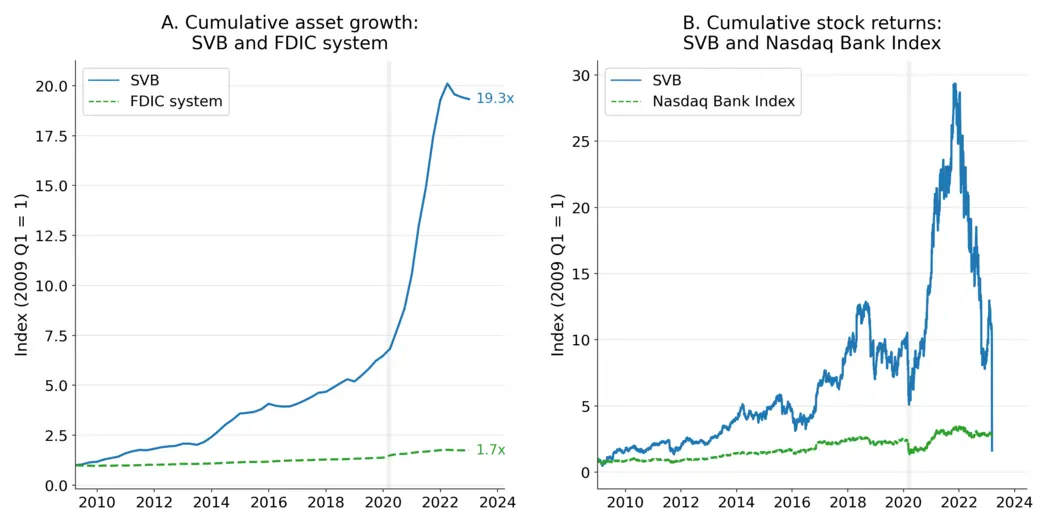
Figure 1: Cumulative Asset Growth and Stock Returns: SVB vs. Benchmarks; Source: FDIC Quarterly Banking Profile, FFIEC Call Reports, CRSP, Bloomberg
From the first quarter of 2009 to its failure in 2023, SVB's assets grew from $11 billion to $212 billion — an almost 20-fold increase, dramatically faster than the 70% growth other FDIC-insured banks experienced. From 2009 to November 2021, when SVB's stock price reached its all-time high, the bank's equity yielded a total return of 2,745%, compared to 319% for the Nasdaq Bank Index.
Such explosive growth should have led bank management, the board, and bank supervisors to significantly increase their focus on risk monitoring. But SVB's risk profile remained aggressive throughout, and there is little evidence that SVB actively chose — or that regulators considered forcing the bank — to alter it. As we will see, these excess returns arose in part from a persistent high-risk profile in which long-term securities were funded by largely uninsured demand deposits.
Table 1: SVB Balance Sheet and Loan Composition, 2008, 2009, and 2012
| 2008 | 2009 | 2012 | |
|---|---|---|---|
| ($ Billions) | ($ Billions) | ($ Billions) | |
| Cash and cash equivalents (FF,RP) | 2.4 | 3.5 | 1 |
| Investment securities | 1.8 | 4.5 | 12.5 |
| Total loans | 5.5 | 4.5 | 8.9 |
| Total assets | 10 | 12.8 | 22.8 |
| Noninterest-bearing deposits | 4.4 | 6.3 | 13.9 |
| Interest-bearing deposits | 3.1 | 4 | 5.3 |
| Total equity | 1 | 1.1 | 1.8 |
| Loan Concentrations | |||
| Technology | 2.7 | 2 | 4.4 |
| Private equity | 1.1 | 0.9 | 1.7 |
| Life sciences | 0.6 | 0.5 | 1.1 |
| Premium wine | 0.4 | 0.4 | 0.1 |
| Total commercial loans | 4.5 | 3.6 | 7.6 |
Source: Annual reports
Already in 2009, SVB held $6.3 billion in demand deposits, mostly business accounts that were non-interest-bearing and largely uninsured. Against these stood only $4.5 billion in loans, concentrated in technology and private equity, and $4.5 billion in investment securities, largely long-maturity mortgage-backed securities (MBSs) and agency securities. This balance sheet composition, unusual for a relatively small bank, would be scaled up, almost unchanged, until SVB's failure in 2023.
Uninsured and Concentrated Deposits
SVB specialized in providing banking services to startups in technology, life sciences, and private equity. These firms are unusual depositors: They receive financing in large tranches, from venture capital funds or an eventual IPO, and then draw the funds down until the next round.
This concentrated deposit base exposed SVB to two distinct risks. First, large uninsured depositors, particularly those in the coordinated and sophisticated startup community, are highly prone to engaging in runs should they lose confidence in their bank's solvency. Second, even without a run, a downturn in startup financing would mechanically drain deposits as firms burned through their cash.
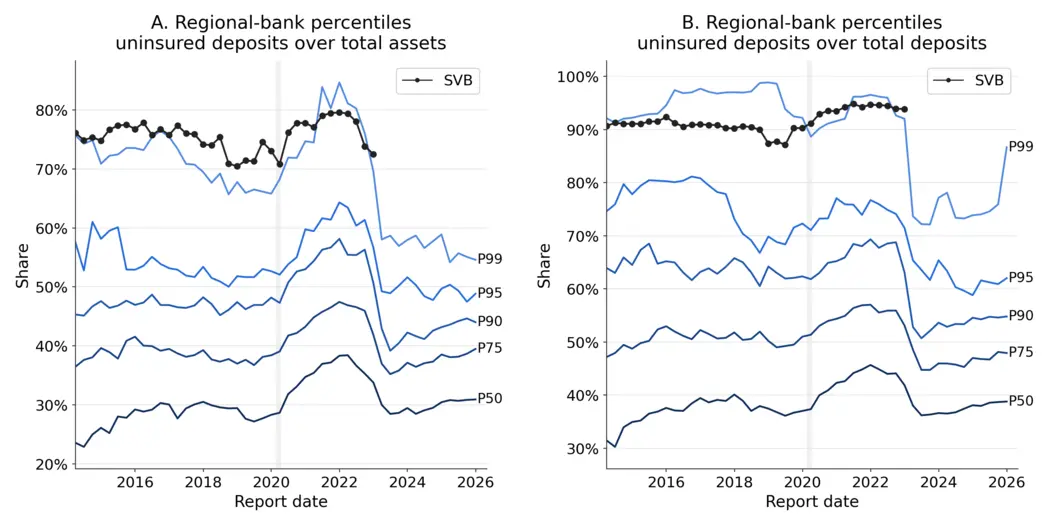
Figure 2: Uninsured Deposits Relative to Regional-Bank Peers; Source: FFIEC Call Reports
This fragility is visible in data. Relative to all other regional banks with assets in the $10 billion-$250 billion range, SVB sat near or above the 99th percentile of uninsured deposits, as a share of both total assets and total deposits, for the entire decade before its failure. The runnable funding structure was clearly not a development of the final years.
Long-Duration Securities and Held-to-Maturity Accounting
On the other side of the balance sheet, SVB invested an outsized amount of its deposits in long-duration securities, mostly agency securities and MBSs. Though these securities carried little immediate repricing risk, given the historic lows at which rates sat after the global financial crisis, such positions constituted a large and visible interest rate bet (implicitly betting rates would not normalize) that had been in place from the outset.
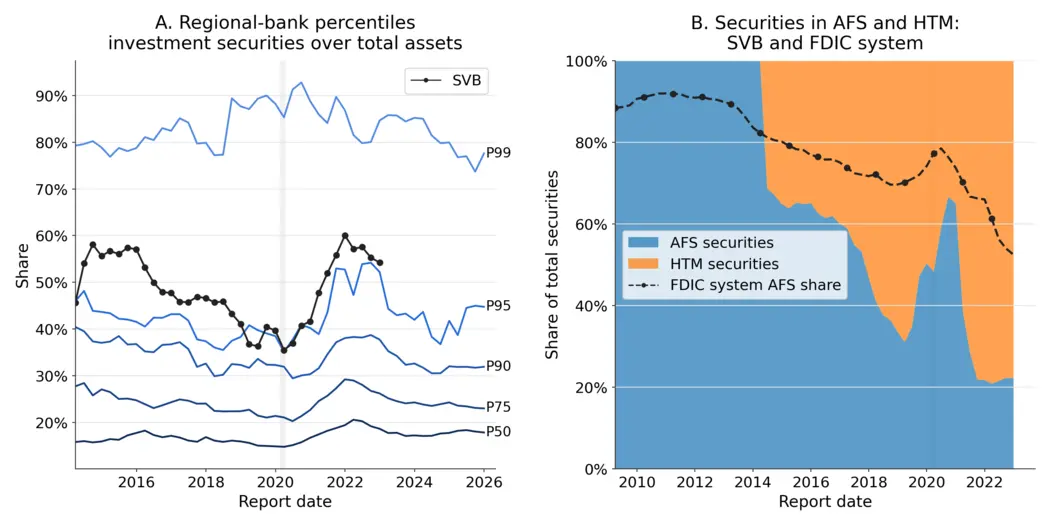
Figure 3: Investment Securities and AFS/HTM Mix; Source: FFIEC Call Reports, FDIC Quarterly Banking Profile, Bloomberg
In 2014, the bank also started moving large amounts of these securities from available-for-sale (AFS) into held-to-maturity (HTM) accounts. HTM securities are carried at amortized cost instead of fair value, so losses do not flow through to earnings or capital, but they cannot be hedged, and any sale forces repricing of the entire portfolio at fair value.
Management provided little explanation for this shift, but the timing coincided with the Fed's discussions of ending quantitative easing and normalizing rates. Indeed, from 2014 onward, SVB moved steadily into HTM, well beyond the industry average and largely tracking the Fed's rate cycle. By the time of its failure, only roughly 20% of SVB's securities remained AFS, with large “concealed” losses.
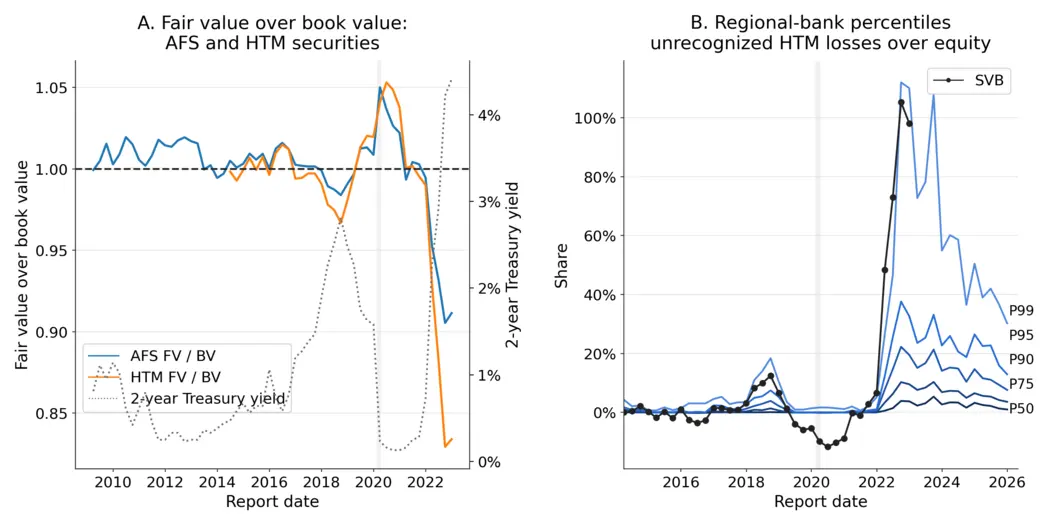
Figure 4: Securities Valuations and Unrecognized HTM Losses; Source: FRED, Annual reports, Bloomberg, FFIEC Call Reports
When rates rose before the pandemic, the bank's unrecognized HTM losses as a share of equity were already above the 95th percentile — before rates were again cut during COVID, temporarily restoring the portfolio's value. As the Fed tightened in 2022-23, SVB's unrecognized HTM losses eventually surpassed its entire equity.
These risks were not assumed in the bank's final two years; SVB was fortunate to have grown its securities portfolio during a period of unusually low interest rates, but the sudden rate normalization of 2022-23 led these long-standing risks to materialize.
Could Regulators and Supervisors Have Reacted Earlier?
Bank supervision is normally difficult to assess from the outside, as exam findings and ratings are not public. For SVB, the Barr report made this record available from 2017 onward. However, from 2017 through 2021, SVB was rated satisfactory or strong on every component of the CAMELS supervisory assessment (comprising capital adequacy, asset quality, management, earnings, liquidity, and sensitivity to market risk). Its liquidity was rated strong throughout despite more than 90% of its deposits being uninsured and most of its investment securities sitting in HTM accounts at risk of full repricing in case of any sale. The bank's management and composite ratings were downgraded to less than satisfactory only in August 2022, less than eight months before its failure. Yet earlier opportunities to address SVB's risks had not been lacking.
The rapid shift into HTM beginning in 2014, coinciding with most of the bank's deposits being uninsured, itself represented a natural trigger for a review of the interest rate risk of the bank's portfolio. Later, each annual exam from 2017 onward could have provided an occasion to downgrade the bank's ratings to reflect its risk profile.
Related Articles
Moreover, had stress tests and liquidity requirements been applied to the bank, as Dodd-Frank entailed for banks with more than $50 billion in assets, these exams would likely have required more forceful actions. But regional banks, SVB being one of the more vocal among them, lobbied against the standards, and Congress raised the threshold for their application to $250 billion in 2018, leaving the Fed to determine what prudential measures to apply to banks with assets between $100 billion and $250 billion. The Board of Governors adopted a "tailored response" in 2019, but its transition provisions exempted SVB from the aforementioned requirements.
Additionally, in 2021, SVB filed an application to acquire Boston Private Financial Holdings. Given the parties' respective sizes, the Board of Governors was required to assess whether the merger raised financial stability concerns before approving it. Despite Boston Private sharing several characteristics with SVB, including its portfolio of large, uninsured deposits from a wealthy customer base, the merger was approved unconditionally, exacerbating the existing problems.
By early 2022, SVB's stock price was already falling, interest rates were rising, and its HTM losses were mounting. Even at this late stage, the option for a formal enforcement action was still available.
Lessons from a Supervisory Failure
SVB held the same risky bet — long-duration securities funded by concentrated, uninsured deposits — for its entire life as a (fast-growing) regional bank. The risks were visible throughout, yet supervisors reacted only once losses had materialized. SVB's failure and history highlight a more fundamental problem with how the banking supervisory process works in the United States: It focuses on process rather than risk and pushes for remediation only when risks manifest themselves instead of when they are taken on by the bank.

Insights on finance and policy, from MIT.
Subscribe to our newsletter
SIGN UP
- 1. "Review of the Federal Reserve’s Supervision and Regulation of Silicon Valley Bank (Barr Report)" (Board of Governors of the Federal Reserve System, April 2023); "Bank Regulation: Preliminary Review of Agency Actions Related to March 2023 Bank Failures" (Government Accountability Office, May 11, 2023); and "Bank Supervision: More Timely Escalation of Supervisory Action Needed" (Government Accountability Office, March 6, 2024).
- [2] Parker, J. A., “Silicon Valley Bank and the Changing Structure of Banking,” Competition Policy International, August 2023; and Metrick, A., “The Failure of Silicon Valley Bank and the Panic of 2023,” Journal of Economic Perspectives 38, no. 1 (Winter 2024): pp. 133-52.
- [3] Jiang, E. X., G. Matvos, T. Piskorski, et al., “Monetary Tightening and U.S. Bank Fragility in 2023: Mark-to-Market Losses and Uninsured Depositor Runs?” Journal of Financial Economics 159 (September 2024).
- [4] Golding, E. L., and D. Lucas, “Preventing Another SVB: The Case for Mandatory Duration Gap Disclosure,” MIT Golub Center for Finance and Policy, January 2024.
- [5] Rosengren, E., and N. Comati, “Failure of SVB Oversight: Reacting to Incurred Losses Versus Risks Taken,” MIT Golub Center for Finance and Policy, June 2026.
Related Posts