The Hidden Lever
"Trust was the thing underneath all the levers, the quiet requirement that had to exist before any of the others could work."
By: Gisele El Far, Growth Stage Program Intern, MIT Kuo Sharper Center
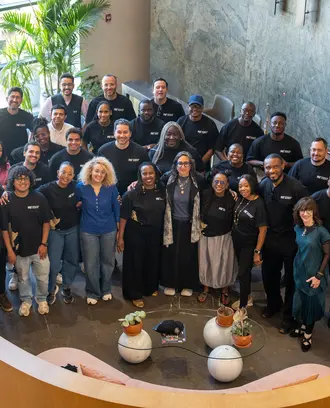
This past June, the MIT Kuo Sharper Center ran its Growth Stage Program in Cairo, a five-day intensive designed for founders navigating the transition from early traction to scale as part of the center’s New Calculus for Global Prosperity framework. I was there as an intern, and part of my role was to produce the only written account of each session. The program officially had ten “levers” of scale for reframing growth in Africa: customers, technology, market, operations, ecosystem, capital, regulation, solving a challenge, talent, and leadership. But by the end of the week, it was obvious that everyone was really talking about something else entirely: trust.
The first clue came from Hassan Fayed. He built an AI agronomist called Orth, which tells farmers what to plant and when, using satellite data and a huge database of agricultural products. He could have made it even more advanced with drones and specialized hardware, but he refused. Most farmers couldn’t afford those tools, and even if they could, they wouldn’t trust a system that required equipment they didn’t know how to use. “If farmers see ROI, they will buy,” he said. The real risk wasn’t imperfect data. It was asking a stranger to gamble their entire season on a tool built by someone they’d never met. So he kept it simple. Not for technical reasons, but for human ones.
Once I noticed that pattern, I couldn’t unsee it.
Ronaldo Mouchawar built Souq.com before the Middle East had reliable delivery or online payments. The company’s biggest problem wasn’t logistics. It was that customers didn’t believe their orders would arrive, and vendors didn’t believe they’d get paid. So Souq built its own delivery network and its own payment system long before it had meaningful volume. It wasn’t a strategy trend. It was survival. You can’t run a marketplace if no one believes the marketplace is real.
Ahmed El Naggar’s family has exported produce since the 1960s. When someone asked how he chooses new markets, he didn’t mention market size or margins. He said he only enters a country if someone there is willing to vouch for him. He keeps all members of the trust chain intact, even the middlemen most founders try to cut out. He joked about having to attend three funerals in a week, but the point underneath wasn’t a joke. Loyalty has a cost, and he pays it.
Dina Sherif talked about governance, but her message was the same. Companies don’t usually die because they lack capital. They die because people inside them can’t tell the truth without being punished for it. Governance isn’t paperwork. It’s whether honesty is survivable.
Walid Hassouna admitted that in the early days of his fintech, they pushed boundaries and asked for forgiveness later. But eventually the market matured, regulators matured, and trust became the real currency. Even the Egyptian Exchange’s decision to list his company locally was about proving that Egyptian firms didn’t need to leave the country to be taken seriously.
This trust permeates into the teams leaders build. Fadi Ghandour, who built Aramex, said that trust inside the company had to exist before trust outside. He reminded us that, “the fight is always outside. It is never inside.” A team that spends its energy on internal politics has very little energy left for the customer. The circle of trust he built inside Aramex was never an end in itself. It was the foundation that made every promise to a customer, regulator, partner, or team member credible.
And then there was Imran Sayeed, who reframed geography itself. Africa’s instability, he argued, isn’t a weakness. It’s a kind of fluency. People who’ve built inside uncertainty have resilience and a network no outsider can copy. Global relevance starts with people who already believe in you, not with infrastructure.
By the drive home from the final session, my notes made the pattern embarrassingly clear. Ten levers, ten speakers, ten different ways of saying the same thing: everything big starts with someone trusting something small. And the people who scale anything meaningful are the ones who never forget that, which is why I keep thinking about Fayed’s choice. He deliberately made his product less powerful because trust mattered more than precision. It wasn’t a technology decision. It was a human one.
Trust wasn’t on the agenda that week. It wasn’t a lever you could check off. It was the thing underneath all the levers, the quiet requirement that had to exist before any of the others could work.
When El Naggar asked if we were ready to attend three funerals in a week, the room laughed. I didn’t. I knew exactly what he meant. I grew up with that same way of thinking from my father and recently after starting my own small business. Through trust gained from building relationships of integrity, I'm reminded of the slow, patient work of showing up until someone believes you.
As entrepreneurs and investors continue capturing value on the continent, they will encounter and implement all ten levers. However, they are likely to learn that those levers of scale do not work unless trust is present. It’s only through investing in human capital, internally and externally, that entrepreneurs in Africa can build trust networks that scale equitable opportunities.
Stuck in a traffic jam in Cairo while going through my notes, I was struck with the idea that this was the thing people build long before they build companies.
Related Posts