MBAn teams win honors for projects with Conagra Brands and The Typhoon Project from10th Annual Capstone Showcase
Two MIT Sloan student groups have won the prestigious Master of Business Analytics Capstone of the Year award, honoring students whose visionary contributions optimize business operations for leading companies.
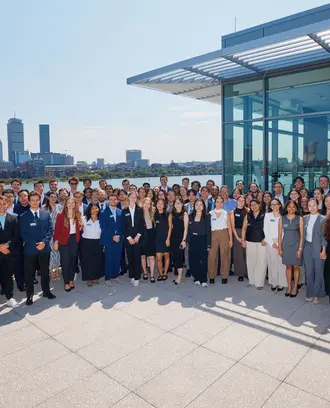
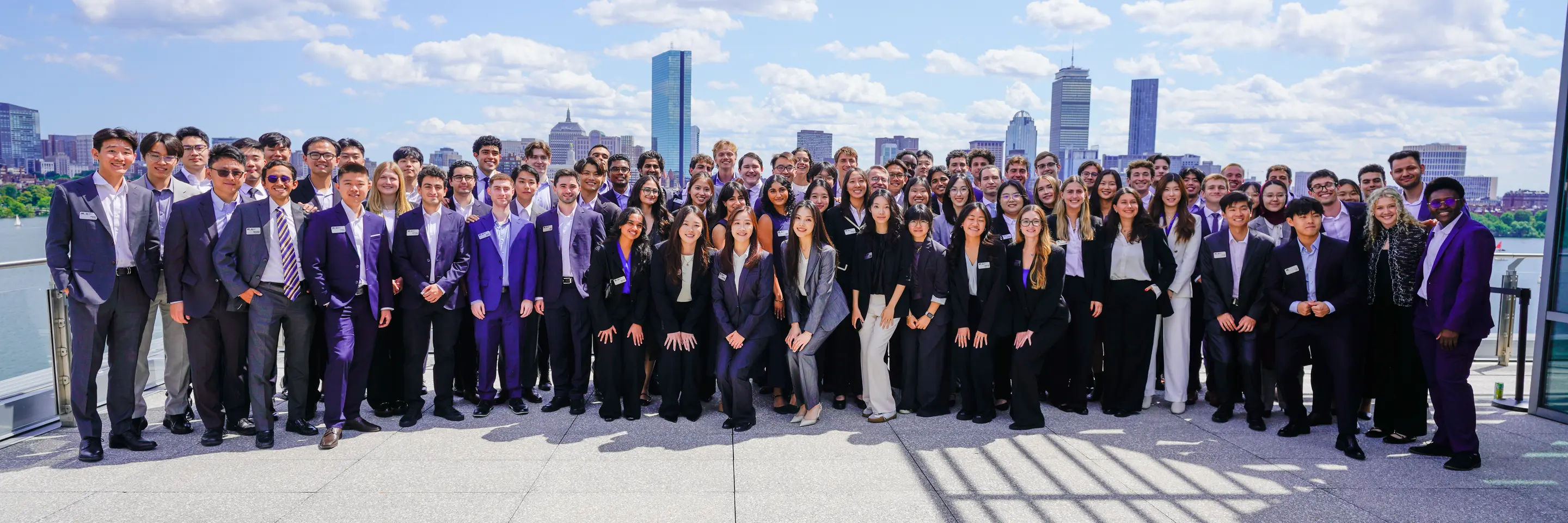
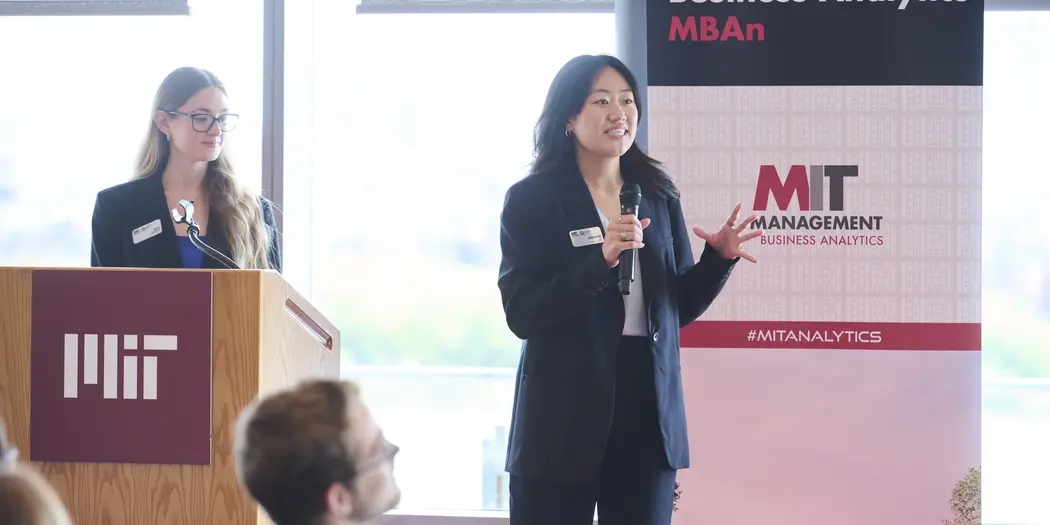
The Analytics Capstone Project is a seven-month required course in which Master of Business Analytics students collaborate with industry partners to tackle real-world data challenges. The winners presented their projects during the 10th Annual MIT Analytics Capstone Showcase, the culmination of the one-year master’s program.
Conagra Brands
Production schedulers at branded food company Conagra Brands confront costly choices every week: which products to manufacture and when. A single factory can face more than 200 million feasible weekly scheduling scenarios, making manual optimization impractical. Schedules can take more than 5 hours to create.
Students Jacob Lebovitz and Theodore Skondras Mexis streamlined that process with two scalable tools: an optimization model that generates more efficient production schedules and an agentic AI layer that lets nontechnical plant workers describe scheduling wrinkles in natural language, without coding knowledge.
The solution was deliberately data-light and modular: instead of requiring highly detailed plant data, it used a smaller set of inputs such as materials, demand, run rates, and changeover times. That made it easier to deploy in manufacturing environments where data can be incomplete, and easier to scale across plants. Combining the optimizer with an AI agent let each plant add its own details without rebuilding the system from scratch.
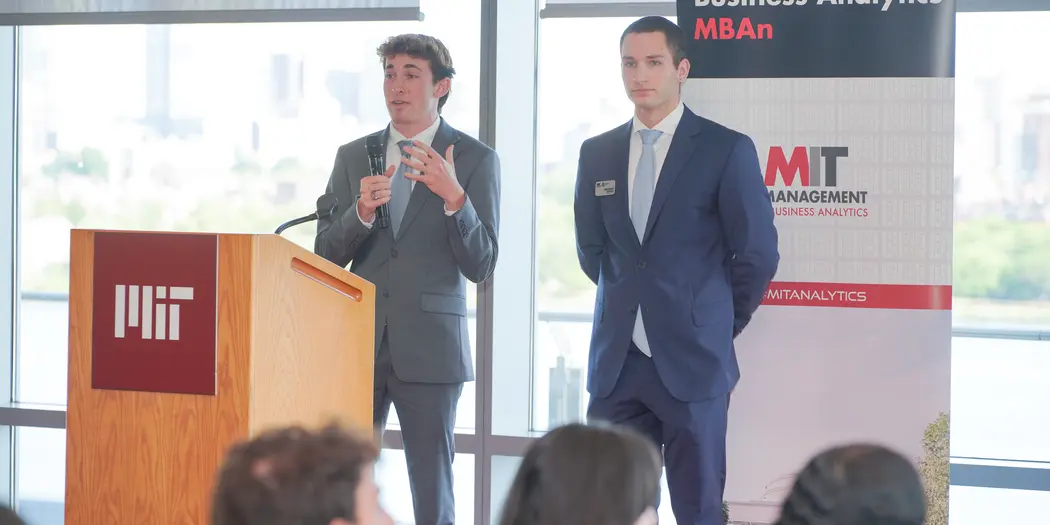
Team Conagra Brands: Jacob Lebovitz, left, and Theodore Skondras Mexis, right
“This project combines optimization with agentic AI, and the combination of these two knowledge areas really makes the difference in a business case,” Skondras Mexis said.
In the past, Conagra’s scheduling process relied on spreadsheets and the expertise of experienced schedulers. They would manually construct production plans that could then change if materials were delayed or circumstances changed, a time-consuming process. Different products could require equipment swaps, allergen-related cleaning and sanitation, and inspections before production could resume.
The team’s results were substantial. Back-testing the model on nine FY26 schedules reduced average weekly changeover time by 53%. The team estimated approximately $100,000 in annual savings at the pilot plant, potentially rising to about $8.5 million annually if comparable results are achieved across 30 Conagra plants.
Conagra has since turned the students’ work into a company initiative. The new application is now operating at an inaugural plant, with deployment at a second location underway.
“Theo and Jacob delivered far more than an academic project. They developed a solution that’s already creating value in our manufacturing network while tackling one of the most complex aspects of production planning,” said Paige Boncosky, digital product manager at Conagra Brands.
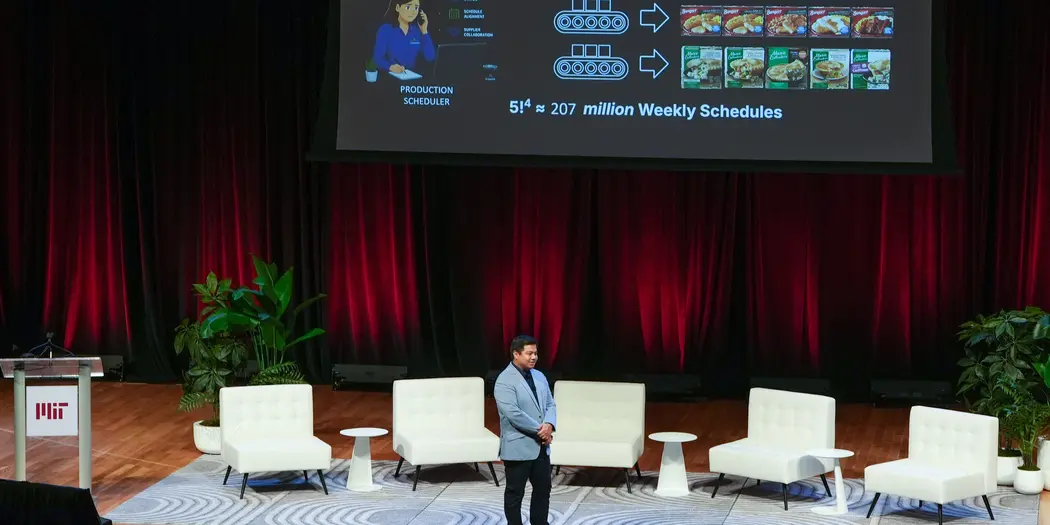
RL Rosqueta, Conagra Brands
“Pairing optimization with agentic AI puts real decision power in the hands of the people who plan our lines, and because it’s built to scale, we can extend it across our network,” added RL Rosqueta, Vice President of Planning and Digital Capabilities at Conagra Brands.
For the team, it was exciting to see their analytics reshape a busy factory floor in real time.
“You see the impact in front of you in the production line, whether that means creating products more efficiently or making people’s lives easier and saving them time,” Skondras Mexis said.
The Typhoon Project
The Grecian coastline is beautiful, and The Typhoon Project aims to keep it that way. Since 2019, the marine environmental operation has removed more than 25.8 million pieces of waste from Greece’s nearly 5,000 remote beaches, operating year-round.
The Typhoon Project, an initiative of the Athanasios C. Laskaridis Charitable Foundation, turned to MIT students Jocelyn Ju and Bria Weisblat to maximize its crucial work. The pair built CleanSweep, a platform that uses years of Typhoon cleanup data — the largest such data set in the Mediterranean — to predict where litter is most likely to accumulate and to generate more efficient routes to remote beaches.
In the past, routes were planned manually, and 35-person crews would sometimes travel to beaches where there was little or no trash to collect. With CleanSweep, historical back-testing showed a nearly 70 percent reduction in days spent visiting beaches without waste and a nearly 30 percent increase in efficiency. The team estimated that CleanSweep could reduce annual costs by about $550,000 while collecting the same amount of waste.
“The goal of CleanSweep was to help direct ACLCF to beaches and islands that had high waste so that their resources were used in a more efficient manner,” Weisblat said.
Team The Typhoon Project: Bria Weisblat, left, and Jocelyn Ju, right
First, their system calculates a score for each beach based on its likelihood of becoming polluted and the amount of time since its last cleanup. An optimization model weighs the benefit of visiting each beach against the distance required to reach it, crafting routes around high-value stops.
They added another key safeguard once Typhoon reaches a destination: Before sending a cleanup crew ashore, workers can fly a drone over the beach and feed the image into a computer-vision model, which checks whether waste is actually present and whether a crew should disembark. The model achieved 89 percent accuracy and 95 percent precision in testing.
After spending valuable time in Greece with the Typhoon crew, the pair also ensured that the system will be able to take variables like weather and currents into account, with input from sailors.
“We specifically made the dashboard adaptable because we understand that there are nuances that don’t come across in data. With maritime travel, things are always pivoting. When we were actually on-site, it was really interesting: We got to talk to the captain and appreciate their expert knowledge,” Ju said.
The foundation sees immediate value in CleanSweep, as Typhoon continues its mission around the Greek coastline.
“What impressed us was that Jocelyn and Bria took years of real-world operational data and translated it into a practical decision-making tool,” said Athanasios Besios, a foundation project manager.
For the team, the project was rewarding because it paired sophisticated analytics with visible environmental improvement.
“We got to work with such cutting-edge tools, with the goal in mind of making the world a better place. People do their best, most impactful work when they’re working toward something they truly care about,” Weisblat said.
About the MIT MBAn Program
The MBAn program is an intensive, one-year STEM-designated degree that equips students with expertise in data science, machine learning, optimization, and business problem-solving. Taught by world-class faculty at the intersection of business and analytics, students gain practical experience through hands-on projects and a seven-month Capstone with industry partners. Graduates emerge ready to lead data-driven teams in fields such as consulting, finance, technology, and health care.
This year, the MBAn program celebrated its 10-year Anniversary, with the Business Analytics & AI Summit on October 2, 2026, bringing together industry leaders, alumni, faculty, students, and consortium members to shape the future of data analytics and artificial intelligence.
For more information about the MBAn program or to host a capstone project, please contact BusinessAnalytics@mit.edu