
Key Takeaways
- Thomas Drechsel uses historical calendars to reveal striking differences in how U.S. presidents have engaged with Federal Reserve officials over decades.
- His research links presidential pressure on the Fed, including Nixon’s demands for easier monetary policy ahead of his 1972 reelection, to subsequent inflation.
- The findings highlight how political engagement can threaten Fed independence, while closer ties with Congress may strengthen accountability and institutional support.
Economists largely agree that central bank independence is conducive to a stable macroeconomic environment, but this institutional arrangement can come under threat when politicians seek to influence monetary policy. In the US, this has been exemplified by President Donald Trump’s repeated attacks on the Federal Reserve and demands for lower interest rates. Even in the absence of explicit threats, however, the Fed is ultimately accountable to Congress, which creates a complex relationship between technocratic decision-makers and elected politicians.
Related Articles
In two recent research papers, I systematically analyze the daily calendars of former US presidents and Fed chairs. These calendars are accessible in archival records and provide a new and unconventional data source to study economic questions. How top leaders allocate their time is indicative of their priorities. Who they interact with reveals whose decisions they may want to influence and who might have an impact on their own actions.
This research covers two distinct dimensions. First, the calendars of former presidents, from Franklin D. Roosevelt to Barack Obama, allow me to uncover new evidence on how different US administrations have put political pressure on the Fed. Second, the calendars of modern Fed chairs Ben Bernanke, Janet Yellen, and Jerome Powell reveal an increasing engagement of the Fed with Congress.
US presidents and political pressure on the Fed—a multidecade analysis
The daily diaries of former US presidents are available through the presidential libraries. They consist of a detailed itemized log of how each president spent each day in office. I collected these schedules and converted them into a database to carry out a systematic analysis.
Figure 1 plots the number of personal interactions, including meetings and phone calls, that each president had with any officials from the Federal Reserve System. Note that most of these interactions were with the Fed chair, but the president sometimes met with other officials such as the president of the New York Fed.
The striking pattern documented by the figure is the variation over time. Some presidents rarely met with anybody from the Fed, while others sought frequent interactions. Bill Clinton was in office for 8 years and had only 6 personal interactions with the Fed. Richard Nixon, during his five-and-a-half years in office, met 160 times with Fed officials, most notably then chair Arthur Burns.
Figure One
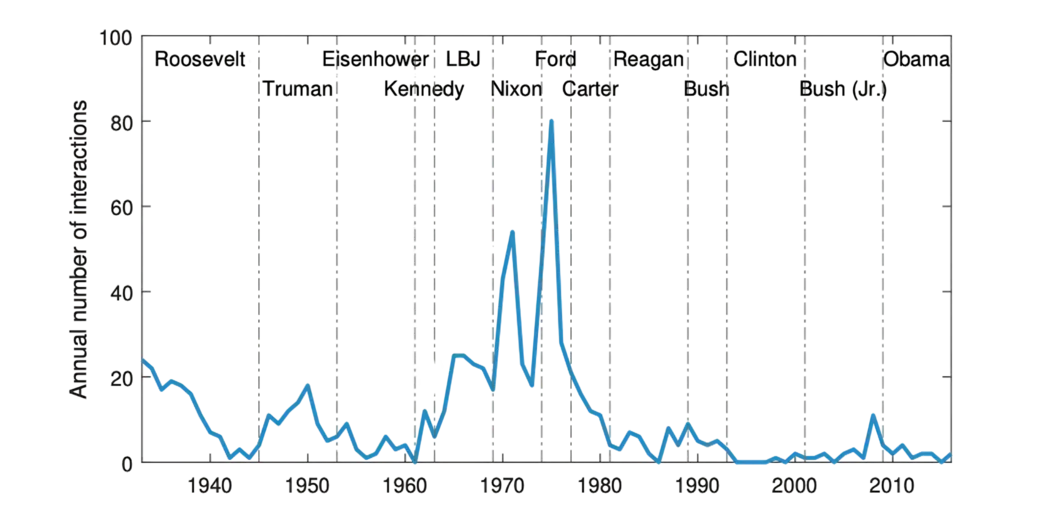
Figure 1 | Annual number of personal meetings and phone calls between US presidents and officials from the Federal Reserve System. Source: Presidential libraries and Drechsel (2025): “Political Pressure on the Fed.”
The presidential calendars do not provide the content of the meetings but can be complemented with other sources. In the case of President Nixon, for example, the “Nixon tapes” make clear that he used personal meetings with Chair Arthur F. Burns to demand easier monetary policy during his reelection bid in 1972.
I show in my research paper that when the personal interaction data are combined with standard macroeconomic data in a more formal statistical analysis, prominent political pressure episodes, such as the Nixon reelection drive, have generated subsequent inflation in the US economy.
Fed chairs and the US Congress—recent trends
As the Nixon episode illustrates, interactions between the executive and the Fed can become problematic when they turn into pressure over monetary policy. However, the Fed was created by Congress and is ultimately accountable to the legislative branch. So what do we know about personal interactions between Congress and the Fed?
To answer this question, we can turn to the daily calendars of former Fed chairs. These are provided by the Board of Governors. The Fed chairs’ calendars are less detailed and do not have as complete coverage further back in time as the presidential calendars do. However, if we focus on the period spanning the terms of Bernanke, Yellen, and Powell, the calendars can be screened for meetings with lawmakers.
Figure 2 shows the number of meetings a given Fed chair had with members of Congress in each quarter. This is also broken down by party affiliation. Two patterns stand out. First, the meetings are generally roughly split between Democratic and Republican lawmakers. Second, and more strikingly, we can observe an upward shift in meetings with Congress exactly when Jerome Powell took office. For example, Powell met with US Senators more than twice as often as his predecessors.
Figure 2
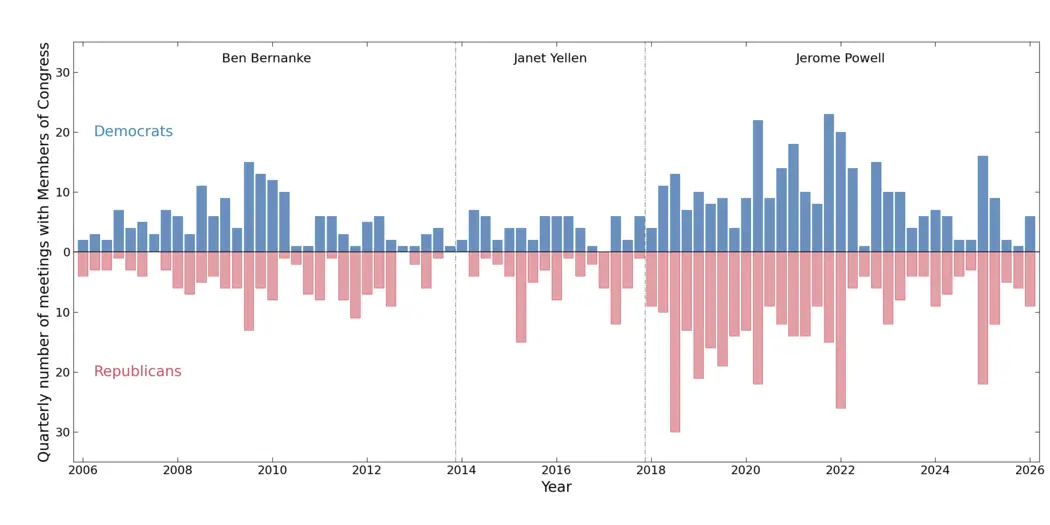
Quarterly number of personal meetings between the Fed chair and members of the US Congress. Source: Federal Reserve System and Drechsel and Tsakadze (2026): “Inside Central Bankers’ Calendars: How Do Fed Chairs Allocate Their Time?”
One interpretation of Figure 2 is that Bernanke and Yellen came from academia while Powell’s background is more closely connected to politics and government. Consequently, Powell might have more naturally engaged with leaders on Capitol Hill. Rather than indicating a deeper pattern or deliberate strategy, his greater time spent with congresspeople could reflect Powell’s career background.
Another interpretation is that Powell expected pressure from the White House and acted strategically to build support in Congress to protect the Fed’s independence. This interpretation has been given by some observers. After all, some important senators, such as Thom Tillis, came to Powell’s defense when Trump tried to fire him.
What lies ahead?
In May 2026, Kevin Warsh was sworn in as the new Fed chair, amid renewed debate around the relationship between the White House and the Federal Reserve. How his interactions with the administration and Congress evolve will reveal how the balance between central bank independence and political engagement develops.
My analysis of calendar data can be useful to identify episodes of political pressure on the Fed but also indicates that engagement by the Fed with lawmakers may strengthen accountability and institutional support. Studying how politicians and Fed officials interact provides a new window into their complex relationships.
References:
- Drechsel, Thomas (2026). “Political Pressure on the Fed.” Review of Economic Studies, forthcoming.
- Drechsel, Thomas, and Dali Tsakadze (2026). “Inside Central Bankers’ Calendars: How Do Fed Chairs Allocate Their Time?” Working paper.
About the Author

Thomas Drechsel
Associate Research Professor, Johns Hopkins University
Thomas Drechsel is an Associate Research Professor of Economics at Johns Hopkins University, a member of the NBER and CEPR, and an Associate Editor of the Journal of Monetary Economics. He received his PhD from the London School of Economics in 2019. His research focuses on monetary policy, credit markets, and macroeconomic fluctuations. His work has appeared in leading economics journals, including the Review of Economic Studies and AEJ: Macroeconomics.

Insights on finance and policy, from MIT.
Subscribe to our newsletter
SIGN UP
- Authors’ Disclosures: The authors report no conflicts of interest.
- The views expressed in this article are those of the authors and do not necessarily reflect the views of the MIT Golub Center for Finance and Policy, MIT Sloan, or the Massachusetts Institute of Technology.
Related Posts