Key Takeaways
- In his keynote address, Darrell Duffie argued that shrinking the Fed’s balance sheet is a question of which liabilities to reduce, rather than which assets to sell.
- Banks hold large reserve buffers to manage daily payments, making it difficult to reduce reserves without disrupting money markets.
- Duffie outlined four policy options, identifying tiered interest rates on reserves as the most powerful way to reduce reserve balances while maintaining bank liquidity.
In spring 2026, Kevin Warsh, now Federal Reserve chairman, argued that the Fed’s balance sheet has grown too large. Yet after after bottoming out at about $6.5 trillion in December 2025, it is growing again.
In his dinner keynote on October 29 at this year’s MIT GCFP Annual Conference, Darrell Duffie, Distinguished Professor of Management and Professor of Finance, Emeritus, at Stanford Graduate School of Business, argued that the question is not which assets the Fed should sell to shrink its balance sheet, but which liabilities it needs to get rid of.
Among the central bank’s main liabilities, the only real lever is bank reserves—the roughly $3 trillion of deposits that commercial banks hold at the Fed—and reducing them is mostly a matter of plumbing.
The plumbing problem
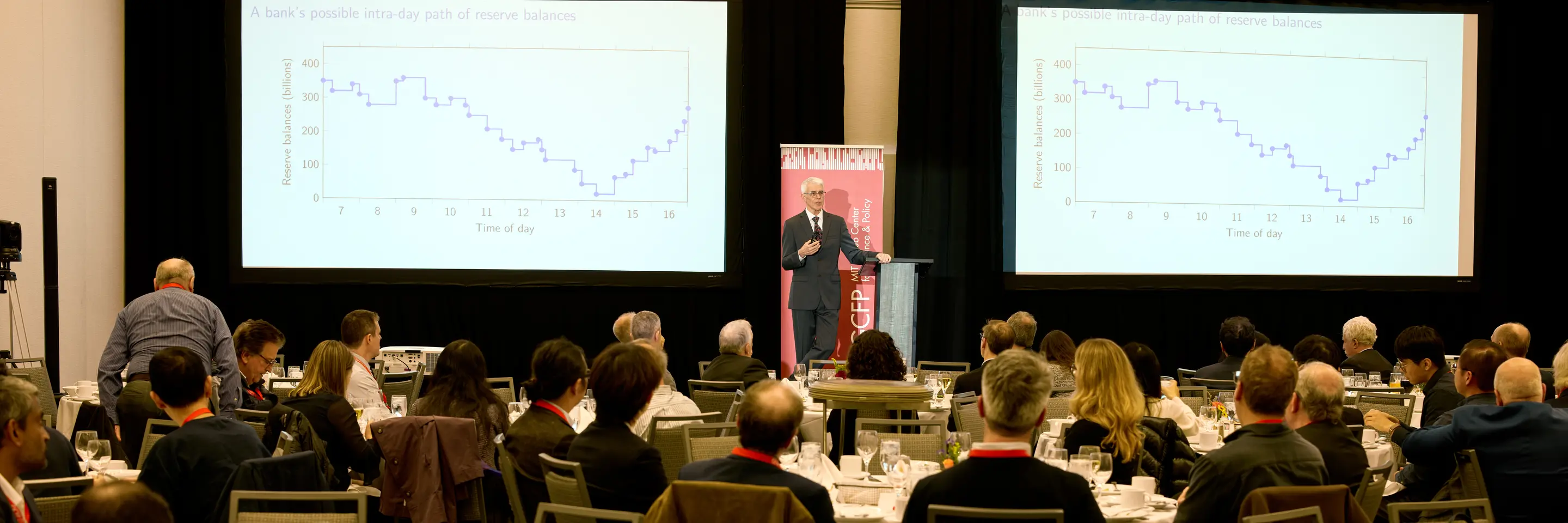
Banks begin each day with a balance of reserves, which then rises and falls with the payments flowing in and out. They do not usually want that balance to go below zero: They can overdraft their accounts at the Fed, but doing so carries a stigma since regulations require them to be self-sufficient for liquidity.
As a result, banks hold large buffers, and a bank that expects its balance to run close to zero will lend its reserves in the repo market only at a rate above what the Fed pays on them. When many banks are in that position at once, repo rates drift above the Fed’s target, disrupting money markets. The question, then, is how banks can manage their payments with fewer reserves without causing that disruption.
MIT GCFP 13th Annual Conference: Keynote Address
Darrell Duffie, the Adams Distinguished Professor of Management and Professor of Finance, Emeritus, presents on how the Fed could might handle their balance sheet.
Four tools, easiest to hardest
If the Fed were to aim for a smaller balance sheet with ample reserves, there are four policies it could consider:
The first is to offset shocks to the supply of reserve balances with open market operations. By supplying additional reserves on days when they suddenly dry up, such as certain quarter ends, the Fed could make the path of reserves smoother and let the system safely run on a lower level. However, this would reduce reserves only by something on the order of $100 to $200 billion—not that impactful of a share against the current $3 trillion.
The second policy is to encourage banks to overdraft or borrow from the Fed when they run short. It could do this by changing its liquidity regulations to signal that going below zero is acceptable. Before the financial crisis, the largest banks overdrafted a lot, and the Fed encouraged it; since the post-crisis self-sufficiency requirement went into force, they have essentially stopped. The Fed is now encouraging banks to return to overdrafting, but that legacy stigma remains.
The third policy is to add a liquidity savings mechanism to Fedwire, the Fed’s payment system: a netting operation that would let banks cancel offsetting payments against each other and so rely on fewer reserves. Given the size and relevance of the US payment system, adopting such a mechanism would take a lot of work and care.
The fourth policy—and by far the most powerful—is to tier the interest rate paid on reserves. Today, the Fed pays full interest on all of a bank’s balances, so banks often hold far more reserves than they need. The Fed could instead pay the full rate only on a portion of the balances and a lower rate beyond that. Banks would immediately shed their extra balances. Under the right assumptions, Duffie argued, the optimal schedule has just two tiers, and tiering could reduce reserves the most without making banks any less liquid.
Running the system short of reserves would be a mistake: The Fed does not want banks scrounging for money. The measures Duffie laid out would keep banks as liquid as they are today while lowering the reserves they need, letting the Fed run a smaller balance sheet.
Explore additional insights from our 13th annual conference
Featured Expert

Darrell Duffie
Adams Distinguished Professor, Stanford Business School
Darrell Duffie is a Research Fellow of the National Bureau of Economic Research and a Fellow of the American Academy of Arts and Sciences. Duffie is a past president of the American Finance Association and chaired the Financial Stability Board’s Market Participants Group on Reference Rate Reform. Duffie is a past president of the American Finance Association and chaired the Financial Stability Board’s Market Participants Group on Reference Rate Reform.

Insights on finance and policy, from MIT.
Subscribe to our newsletter
SIGN UP
- The views expressed in this article are those of the authors and do not necessarily reflect the views of the MIT Golub Center for Finance and Policy, MIT Sloan, or the Massachusetts Institute of Technology.
Related Posts