Cesar Ortiz’s, EMBA ’16, career began in the structured world of accounting, but his ambitions stretched far beyond the balance sheets. Starting as a CPA at PricewaterhouseCoopers (PwC), he quickly advanced, auditing the largest financial institution in Puerto Rico, where he was born and raised. Yet, even as he built a successful career in finance, he felt a growing need to expand his skill set beyond technical expertise.
By the time he turned 40, Ortiz had climbed the corporate ladder to a senior executive role at Oriental Bank. But something was missing. He decided to enroll in the MIT Executive MBA, which broadened his perspective on risk management, leadership, and driving innovation within a financial institution.
What made you decide to pursue an Executive MBA at MIT Sloan?
I had thought about getting an MBA years ago. I was working for PricewaterhouseCoopers, and my partner told me, “You know what? You're going to learn more working in the field than getting an MBA.”
At PwC, I managed audits for the largest financial institution in Puerto Rico. At that time, I was only 29 years old. So I put the MBA on hold and pursued a law degree instead. But the MBA was always in the back of my mind, so when I turned 40, I wanted to do something different with my life. I was leading risk and finance teams at a senior level, but I wanted to transition from a technical expert to a strategic leader.
I was looking at other executive MBA programs, and a friend told me about the MIT EMBA. It was a newer program, but it had the rigor, network, and global perspective I was looking for. I applied, and it was one of the best decisions I ever made. It wasn’t just about the prestige. It was about the problem-solving approach that MIT is known for. I wanted to be surrounded by people who could challenge my thinking and help me become a better leader.
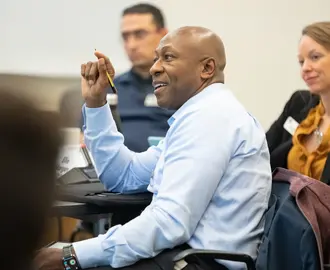
Cesar Ortiz, EMBA '16
How has the MIT EMBA program helped you in your career?
The biggest shift was in my mindset. Before, I had an accounting mindset; everything had to be precise, structured, and by the book. I approached problems from a purely technical perspective with data, compliance, risk models. At MIT, I realized that business isn’t always black and white. The program taught me to think holistically about business challenges. Now, when I assess risk, I don’t just look at financial metrics; I think about strategy, operations, and even behavioral factors that influence risk-taking.
For example, during one of my leadership courses, we discussed how executives often focus too much on quantitative risk assessments and not enough on human factors. That changed how I lead my team. Now, I make sure we’re not just analyzing numbers but also considering leadership dynamics, decision-making behaviors, and company culture.
Can you share an example of how you applied what you learned at MIT in your job?
During my time at MIT, we were dealing with compliance challenges at the bank. Regulatory issues had created bottlenecks in our processes, and it was affecting our ability to grow. Before MIT, I would have tackled it strictly from a legal and accounting standpoint. But the EMBA helped me see it differently, as a process improvement challenge.
One of the most valuable lessons came from Organizations Lab (O-Lab) and System Dynamics. Instead of treating compliance as a static set of rules, I analyzed our workflows, identified bottlenecks, and mapped out a strategy to make our processes more efficient. We implemented a risk-based prioritization model that streamlined investigations, optimized resources, and improved oversight. Within two years, we resolved our compliance issues, reduced operational inefficiencies, and strengthened our regulatory standing, which allowed us to expand and operate with greater agility.
How did the MIT EMBA influence your approach to solving business challenges?
One of the biggest takeaways was understanding that leadership is about being present, about going and seeing the problem firsthand. That lesson came from O-Lab, where I learned that I couldn’t just rely on reports. I had to observe, “go see”, talk to people, and really understand what was happening on the ground before making decisions. This principle played a key role in one of the most impactful business changes I implemented. We had a $1 billion portfolio in auto lending, and we grew it to $2 billion by focusing on the right KPIs. It wasn’t about interest rates; it was about understanding what would move the needle. I went back to what I learned in O-Lab: go, see, observe, and understand the real issues.
I started visiting dealerships and talking to the sales reps, not just the managers. That’s when I learned something critical. I realized that we didn’t have a finance problem; we had a process problem. We didn’t need a new system. We needed a workflow fix. That one change made us the go-to bank for auto loans.
This was exactly what MIT taught me. It’s not just about looking at the numbers; it’s about understanding the system, the people, and the triggers that drive behavior.
Has your definition of success changed since the MIT EMBA?
Before the EMBA, I thought success was about titles and salary. I wanted to be a managing director, a senior executive, I measured success by climbing the corporate ladder. But after MIT, my perspective changed. Now, success is about impact. I want to do something significant for the community, something that leaves a mark beyond just professional achievements. I want to use my position to help my organization serve the community more effectively.
Ten years after the EMBA program, I don’t want to just go through the motions of my career. I want to have a purpose in what I do. That’s why I’ve been involved with organizations like the Boys & Girls Club, not just to build my resume, but because I want to do something in my community. I’ve also become more intentional about making sure the bank serves a broader purpose beyond just financial success. The EMBA program reinforced that leadership is about more than numbers; it’s about creating lasting impact in the communities we serve.