
Denis Lussault, EMBA ‘20, has always been wired for entrepreneurship. Throughout his career, he has thrived in fast-moving, high-growth environments, taking on leadership roles in startups and emerging technologies. His background in engineering and product development gave him the technical expertise to build and scale innovative solutions, but as he took on more business and strategic responsibilities, he recognized that there were gaps in his formal knowledge.
The MIT EMBA not only gave him the tools to lead and scale organizations but also introduced him to his future business partner. Today, as Chief Product Officer at Kadeya, he is helping revolutionize the beverage industry with a closed-loop vending system that eliminates single-use plastic waste.
Why did you choose to pursue an EMBA at MIT Sloan?
There were several reasons. First, I was coming from France, and my family had just decided to stay in the U.S. long-term. I felt that having an American degree would help me advance my career and open more opportunities in the U.S.
That said, I didn’t want another engineering degree. By that point in my career, I had already transitioned from engineering into business activities, but I knew there were blind spots in my knowledge, particularly in finance, strategy, and operations. I wanted to consolidate everything I had been doing in business over the past seven years and develop a stronger foundation in areas I had learned informally on the job.
At the MIT info session, I felt like I had found my people. The way the faculty engaged with the audience, the way they structured the discussions, and the type of people in the room, it all felt right. At other schools, I never felt the same connection. I can’t fully explain it, but the decision to apply to MIT was very instinctive. That’s why I only applied to MIT and nowhere else.
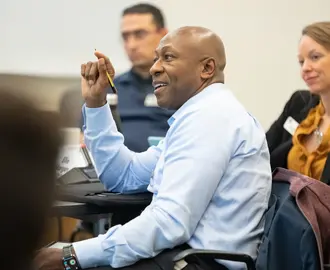
Denis Lussault, EMBA '20
How did the MIT EMBA program prepare you for your current role at Kadeya?
There’s actually a bit of MIT Sloan class history behind this. Manuela Zoninsein, the founder of Kadeya, was in my class, and the company wasn’t even called Kadeya at that time. She was working on the idea as part of IDEA Week, using the course to explore potential customers, market needs, and user behaviors. While I was working on a different project at the time, I was watching the development of her idea from the sidelines and became familiar with it from the start.
A few years later, Manuela called me and said she was still working on the company. By then, it had advanced significantly, but they had reached a critical stage. They were out of the R&D phase and needed to build a commercial strategy and align product development with funding. That’s when I stepped in.
My current role is Chief Product Officer. I'm in charge of the product strategy, the product roadmap and the product development. The coursework in finance, pricing strategy, and dynamic work design helped me bring clarity and structure to the next phase of Kadeya’s growth.
What lessons from the EMBA program have you applied most in your work?
One of the most valuable frameworks I use every day is Dynamic Work Design, a concept taught by Nelson Repenning. This approach is all about understanding in detail how an enterprise functions, whether it's a big-picture strategy or a small tactical process. The goal is to visualize how things work, identify inefficiencies, and create structured improvements.
A core principle I apply from this class is “Go See and Assess.” When there’s a problem, I don’t rely on secondhand reports or assumptions; I go to the source, observe what’s actually happening, and make decisions based on reality. At Kadeya, we apply the same mindset when building our product. Instead of assuming we know what our customers need, we go to them, test our ideas in pilot projects, and adjust based on real-world feedback.
How has the EMBA helped you shape Kadeya’s long-term vision and business strategy?
One of the most important things I bring to Kadeya is structuring the vision into an actionable roadmap. As Chief Product Officer, my role isn’t just about building the product; it’s about aligning where we want to be in five years with what needs to happen today to get there.
Kadeya is a hardware-heavy business, so we’re not just scaling software. We’re developing physical systems that require engineering, manufacturing, supply chain management, and long-term investment. My job is to break that down and ask: What are the reasonable steps to get there? What should we build now versus later? Who do we need to hire? What’s the business plan that makes this sustainable?
At MIT Sloan, I learned how to create the frameworks that allow leadership teams to make the right decisions. I’m constantly structuring business strategy, technical development, and funding timelines in a way that ensures we stay on track.
How does your work at Kadeya align with MIT Sloan’s mission to develop principled, innovative leaders who improve the world?
For me, this has been a personal journey. After graduating, I initially took a similar role in the same industry I had worked in before—moving materials and optimizing logistics. But after some time, I started asking myself: am I really following the values I learned at MIT?
I realized that my work was just moving more pallets and creating more emissions, and that wasn’t the kind of impact I wanted to make. That’s when I decided to shift my focus toward impact-driven companies, whether that meant nonprofits, impact funds, or mission-driven startups like Kadeya.
Kadeya is exactly the kind of company that has the potential to create lasting change. This is the kind of 100-year company that could completely change the beverage industry by pioneering a new way of distributing drinks without single-use plastic bottles.
Without MIT Sloan, I wouldn’t have met Manuela, and I wouldn’t be at Kadeya today. The most impactful thing I gained from the program, beyond the knowledge and skills, was the people I met and the ecosystem I became part of.