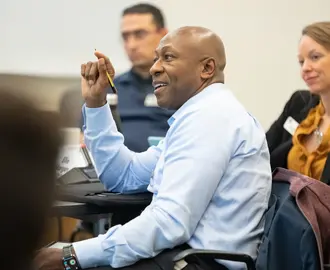
When Jawad Ahsan, EMBA '14, enrolled in the MIT Executive MBA, he was a seasoned finance executive at GE with a strong trajectory. He had held leadership roles across various divisions and was eager to broaden his perspective beyond finance and corporate structure.
After completing the MIT EMBA, Ahsan decided to leave GE and took on the role of CFO at Market Track, a private-equity-backed company which eventually sold to Vista Equity Partners. Then, Ahsan served as CFO of Axon, the company behind the TASER device and a rapidly growing leader in tech-enabled public safety solutions. While at Axon, where he helped scale the company significantly, he began seriously considering a shift to entrepreneurship after investing in and advising early-stage companies.
It was at MIT Sloan where he began to uncover a deeper understanding of the kind of leader he wanted to be, the impact he wanted to have, and what truly mattered most in his career and life.
After Axon, Ahsan founded 10mK, a private investment fund supporting early-stage tech companies. Today, he's Chief Operating Officer and Chief Financial Officer of Lila Sciences, a Cambridge-based company building the world’s first scientific super intelligence, pairing frontier AI with autonomous, robotics-driven labs to accelerate discovery across life sciences, chemistry, and materials science. He credits the MIT EMBA with expanding his mindset, sharpening his leadership skills, and ultimately, giving him the confidence to chart his own path—and now to help build one of the most ambitious companies in Boston.
Jawad Ahsan, EMBA '14
What made you decide to pursue an Executive MBA, and why MIT Sloan?
I knew early on that I wanted to pursue an MBA. When I joined GE in 2001, my plan was to complete their leadership development program, stay for a couple of years, and then go to business school. But each time a new opportunity came up, whether it was a new job, a promotion, or a new division, I felt like I was learning more on the job than I could in a classroom. I kept choosing the job ahead of me over business school.
That continued for over a decade until I reached a turning point. I became CFO of a GE division that we spun off into a joint venture with Microsoft. The whole process—standing up a company, working with bankers, lawyers, consultants, and partners on both sides—made me realize just how much I didn’t know. GE was a great training ground, but I could see its limits. That's when I knew it was time to go get my MBA.
When I started researching programs, I knew I didn’t want to over-specialize in finance. I already had a strong finance background. What I needed was general management training, systems thinking, and leadership development. That's what drew me to MIT.
How did your experience at MIT Sloan shape your leadership style?
One of the biggest things it did for me was change how I thought about leadership. Before the program, I had leadership instincts. I had been promoted and done well. But I had always relied on hard work and results, just keeping my head down and waiting for the tap on the shoulder.
At MIT Sloan, I was exposed to new ways of thinking, especially around influence versus authority. I learned how to be persuasive and get alignment from people who didn’t report to me. That became really important in my work, especially as I moved into executive roles and needed to work across functions. MIT helped me become more intentional as a leader.
It also gave me a ton of confidence. I left the program feeling fearless. I could walk into any room with investors, board members, senior executives and feel like I belonged there. That mindset shift changed how I carry myself as a leader. Before, I might have second-guessed whether I belonged in certain rooms. Now I walk in knowing I do.
What role did MIT Sloan play in your decision to leave Axon and launch 10mK?
I didn’t come into MIT thinking I wanted to be an entrepreneur; I thought I wanted to be a CEO someday. But over time, that shifted. Through the program, I started to reflect more intentionally on what I wanted out of my life and career.
As I got further into my career, I started to see that the larger a company gets, your job as an executive shifts from building momentum to managing momentum, and I'm more excited by building momentum. I'm hugely drawn to a nebula of creative potential and a blank slate, where I get to apply my skills and leadership to drive success from an ambiguous, often ambitious goal.
I wanted to create a vehicle that allowed me to be more focused and intentional in supporting founders who are solving hard problems and making a real difference. Our team is very intentional about investing in founders who aren't just looking for a check, but need and want us to help them think through their business models, understand their product-problem fit, and build sustainable companies that scale.
The name "10mK" itself stands for 10 million Kelvin, the temperature at which stars are born. It's a metaphor for helping ventures ignite into something powerful and transformative. It’s the same instinct that eventually brought me to Lila.
You're now Chief Operating Officer and CFO of Lila Sciences. What drew you to it, and what is it teaching you?
Lila is the most ambitious thing I’ve ever been part of. Our vision is to reach into the future to pull forward scientific breakthroughs to solve humanity’s greatest challenges today. The mission is to build a scientific superintelligence-AI paired with autonomous, robotic labs that can design and run experiments and make discoveries, not just analyze data that already exists. If it works, it changes how science itself gets done across medicine, energy, and materials.
What drew me was the intersection of two things I've always cared about: a genuinely mission-driven company and a real moment of transformation. The roles where I've done my best work have all been inflection points—standing up a joint venture at GE, guiding Market Track to an exit, helping re-IPO Axon and scale it from roughly a billion dollars in market cap to more than 13 billion. Lila is that kind of moment, at the earliest possible stage.
And this is another area where I have hugely benefited from the MIT EMBA. The general management focus of the program made me think beyond being a "finance person." I truly view myself today as an operator capable of driving impact across any area of the business, and MIT Sloan gave me the frameworks, context and confidence to do this effectively. As COO and CFO, I'm building the financial and operational foundation of a company that’s scaling fast—and it has to be built to last, because our ambition here is measured in decades, not quarters.
How have your post-EMBA choices aligned with MIT Sloan's mission to develop principled, innovative leaders who improve the world?
When you go to my personal website, the very first thing you see is my North Star: building and developing high-performing teams that drive transformative societal impact. That mindset, that focus on doing meaningful work that improves the world, was crystallized for me at MIT Sloan.
I do consider myself a principled leader, and I care deeply about making the world a better place. That's true whether I'm backing founders through 10mK or helping Lila accelerate the science that improves lives. Everything I put my energy into now is tied to impact. That's what MIT Sloan’s mission means to me: not just being successful, but using that success to make a difference. It gave me the language and the frameworks to think about leadership as a responsibility—not just to shareholders, but to teams, communities, and the broader world.