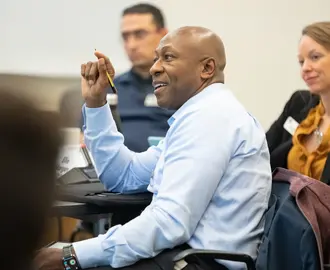

After more than two decades of public service—on submarines, in Afghanistan with a Special Operations Task Force, in the intelligence community, and at the White House as Director for Cybersecurity and Operations Policy—Robert Bair, EMBA '23, reached a pivotal moment in his career. With his time in uniform winding down, he recognized that transitioning from the public to the private sector would require new skills and a broader perspective. Although his experience spanned cyber operations, strategic leadership, and policy advising, he saw the need to better understand the language and mechanics of business.
Bair had been interested in MIT EMBA for years. First introduced to the campus as a DARPA Fellow in the late 2000s, he consistently felt drawn to the Institute's mission and community. Though career demands and deployments delayed his application, he remained focused on eventually joining the EMBA program.
Since graduating in 2023, Bair has made a successful leap into the private sector. He now holds a C-suite role in cybersecurity, serves as a venture partner at a veteran-focused VC firm, and advises multiple startups with ties to the MIT ecosystem. His post-EMBA journey reflects not only professional growth but also a shift in values. Where once he might have taken opportunities based on availability or compensation, he now prioritizes alignment with purpose and long-term impact.
Robert Bair, EMBA '23
Why did you decide to pursue an EMBA at MIT Sloan?
With more than two decades of military service and national security leadership, I knew I needed to expand my perspective to make a successful transition into the private sector. I’d served on submarines, with a special operations task force, cyber missions, and ultimately the National Security Council, but I realized that I didn’t fully understand the language of business; finance, operations strategy, and commercial frameworks were still foreign to me. I had always admired MIT from afar, having visited the campus as a DARPA fellow back in 2008. Though I showed interest in the EMBA program as early as 2011, with my military career and moves, it was never a convenient time to start the program. In 2021, the timing was finally right.
I felt very comfortable on the operations side, but there were gaps in my business knowledge. I had a bit of imposter syndrome going on, and wasn’t comfortable being a career government operator around finance. When you're in the government the roles I’ve been in, it felt like we either had unlimited funds or no funds, just depending on how the budget cycle plays out for the year. I didn't get caught up in the day-to-day minutia of finance.
No one’s going to ask me to be their CFO, but now I feel much more comfortable reading a 10-K or advising a startup on financial strategy. That was one of the areas I specifically wanted to improve upon. I also wanted to learn the language of business. In government, I spoke in military acronyms and had exposure to processes that didn’t translate well. I wanted to be able to speak the language of the people I’d be working with, whether it was marketing, finance, or operations.
What role has the MIT EMBA network played in your career?
I stay in close touch with a core group from my cohort; we’re constantly checking in on career opportunities, facilitating introductions, and personal matters. We’ve helped each other with job offers, investment decisions, even navigating family health emergencies. That kind of support system is rare. Through the network, I became a venture partner at a veteran-led VC fund. I’ve also joined several startups as an advisor, many of which came directly from connections I made through Sloan or MIT. Whether it's commercial partnerships or life advice, the EMBA community is always there.
How did the EMBA program change the way you approach complex, real-world problems?
One of the most valuable frameworks I took from the MIT EMBA was the “Three Lenses”, looking at challenges through the strategic, political, and cultural lenses. That model gave me a much broader, more tactical view of problem-solving, especially in my national security work.
Before MIT Sloan, viewing those narrowly as just a cybersecurity challenge wasn’t the best way to do it. What the three lenses taught me was: hey, this is a technology challenge, but it’s also a people and processes challenge. It’s also a critical infrastructure challenge.
Looking at it through those different lenses was helpful, especially when crafting policy around how to respond to those kinds of events. We need to think about what the long-term mitigation strategy should be and how to think about it from an international affairs perspective. There are many ways to look at complex problems, and the EMBA program helped shape the way I did that.
How did the MIT EMBA lead to your involvement in venture capital and startup advising and how have you applied what you learned?
During the program, a friend who had done an internship with a venture capital firm reached out and said, “Hey, they’re looking for folks with experience in defense. You should apply.” I wanted to learn more about venture, so I joined the fund as an intern and worked on several projects. After the internship, they asked me to stay on as a partner, and that’s when I started getting involved with portfolio companies in advisory and board roles.
That experience, along with what I learned in the program, gave me the tools to bring something valuable to those founders. A lot of them are young and haven’t seen what operational failure looks like. I’ve seen that. And I also picked up the business acumen at MIT to complement my government and operations background. It’s a learning experience on both sides.
One specific moment stands out. One of the startups I was advising was raising seed capital and had a single investor willing to fund the entire round. They were really excited. But I said, “That’s great, but you only have a single investor, and you’re only getting access to that single investor’s network.” I told them, “You’re concentrating your risk. You’re assuming this one investor is going to be the best partner for you.”
What I advised, drawing from what we learned in our risk and diversification discussions, was to take capital from multiple investors if they had that option. That way, you not only reduce your risk consolidation, but you also gain access to a much broader network.
I said, “You also want to create some FOMO. When you’ve got multiple investors interested, people start asking, ‘Why did they invest? What am I missing?’ But if only one investor is in, people start to wonder, ‘Why isn’t anyone else in?’” That’s a subtle but important point in early-stage fundraising.
Did they listen? One did. One didn’t. And right now, the one that went with a single investor is really struggling to raise their next round. That advice, that lens on risk, that came straight out of what I learned at MIT.
What advice would you give to veterans or public servants considering the MIT EMBA?
Your government or military career will end at some point. And as veterans, we’re lucky to have had unique and awesome experiences. Whether you were jumping out of airplanes, flying them, or driving ships, those are things very few people ever get to do.
But at some point, all that comes to an end, whether you're retiring as a four-star general or separating as an enlisted E6. What an EMBA program gives you is perspective and opportunity. It opens doors on the post-service side and expands your view in ways that complement the skills and experience you already gained in uniform.
It’s not about starting over; it’s about building on what you’ve already done. And MIT Sloan does that exceptionally well. It’s a no-brainer if you’re in a position to do it.
Connect with an MIT EMBA Admissions Advisor and take your next step!