In tomorrow’s AI economy, what’s the role of humans?
MIT Sloan School of Management researcher Christian Catalini found that AI can now produce complex work at near-zero cost, but the time it takes a human to check that work is fixed by biology.
Faculty
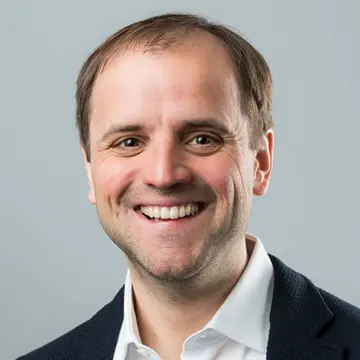
Christian is the founder of the MIT Cryptoeconomics Lab, and a Research Scientist at MIT Sloan. Previously, he co-founded Lightspark, and was a co-creator of Diem (formerly Libra), Chief Economist of the Diem Association, and Head Economist of Meta FinTech.
Christian was previously the Theodore T. Miller Career Development Professor at MIT, and Associate Professor of Technological Innovation, Entrepreneurship, and Strategic Management at the MIT Sloan School.
Christian's research focuses on blockchain technology and cryptocurrencies, and he previously worked on the economics of equity crowdfunding and startup growth, and the economics of scientific collaboration.
He holds a PhD from the University of Toronto (Rotman School of Management), and MSc (summa cum laude) in Economics and Management of New Technologies from Bocconi University, Milan.
His research has been featured in Nature, Science, the New York Times, the Wall Street Journal, the Economist, WIRED, NPR, Forbes, Bloomberg, TechCrunch, the Chicago Tribune, the Boston Globe, VICE news and the Washington Post among others.
Christian has presented his work at a variety of institutions including Harvard University, MIT, Yale University, London Business School, New York University, UC Berkeley, Stanford University, the Federal Reserve Bank, the US Treasury, the U.S. Securities and Exchange Commission, the Commodity Futures Trading Commission, the World Bank, the IMF, the White House OSTP, and a number of central banks and regulators.

Catalini, Christian, and Joshua S. Gans, MIT Sloan Working Paper 5347-18. Cambridge, MA: MIT Sloan School of Management, June 2025.
Catalini, Christian, and Xiang Hui, MIT Sloan Working Paper 5564-18. Cambridge, MA: MIT Sloan School of Management, January 2025.
Roche, Maria P., Alexander Oettl, and Christian Catalini. Management Science Vol. 70, No. 12 (2024): 8245-8264.
Catalini, Christian and Jai Massari. TechREG Chronicle, June 2024.
Catalini, Christian. Forbes, April 2024.
Catalini, Christian. Forbes, February 2024.
MIT Sloan School of Management researcher Christian Catalini found that AI can now produce complex work at near-zero cost, but the time it takes a human to check that work is fixed by biology.
A new paper explores how seeing economic value from artificial intelligence hinges on closing the gap between what AI can do and how humans can verify its outputs.
Research scientist Christian Catalini said: "We should probably not worry about the sci-fi model turning evil and trying to take over our systems, but about the consequences of not foreseeing how high-performance AI systems will interpret human instructions."
Artificial intelligence could transform the economy faster than any previous technology, and policymakers must move equally quickly to figure out how to respond, a group of economists and researchers are warning. The statement, titled "We Must Act Now,"was signed by nearly 200 people, including 15 Nobel laureates. MIT Sloan signatories are Institute Professor Daron Acemoglu, professor Sinan Aral, assistant professor Michiel Bakker, research scientist Christian Catalini, Professor Emeritus Bengt Holmström, professor Simon Johnson, professor Thomas W. Malone, professor Scott Stern, and principal research scientist Neil Thompson.
The company, Energy Substantiation, wants oil suppliers to help support a digital token tied to physical crude. On top of pulling liquidity away from products that already exist, the company will have to ensure that blockchain ownership is legally enforceable in the offline world, said research scientist Christian Catalini. "For the market to be truly efficient, the bridge between online and offline record should have minimum counterparty risk. Otherwise you're not trading the actual underlying asset, you're essentially trading an IOU," he said.
With the use of Artificial General Intelligence (AGI), the cost of automation falls exponentially toward zero, but the human cost of verification remains biologically limited. This structural divergence, documented in the paper "Some Simple Economics of AGI" by research scientist Christian Catalini and co-authors, completely redefines how you should think about your startup in the age of artificial intelligence.
This online program draws on the work of leading MIT faculty and cryptoeconomics expert, Professor Christian Catalini, to examine blockchain technology from an economic perspective. You’ll be offered a foundational overview of how blockchain technology works, in order to demystify the technology and to understand its possibilities and limitations. Over the course of six weeks, you’ll be guided to understand blockchain technology beyond the fundamentals, and to appreciate its application and promise in the context of your own organization.
The AI Adoption: Driving Business Value and Impact 6-week course from MIT Sloan equips you to move from AI awareness to AI transformation throughout your organization. You'll map AI technologies to your critical business challenges and opportunities, navigate adoption barriers, and build sustainable co-creation practices that amplify human capability rather than replace it.