Entrepreneurship
4 ways to navigate entrepreneurship in the age of AI
What you’ll learn:
- As AI shrinks the cost and time required to research markets, build products, and test hypotheses, founders should focus on reaching and retaining paying customers.
- AI can make go-to-market strategies far more precise by identifying new customers, burgeoning trends, and emerging warning signs.
- In an AI-enabled startup, humans should act as future-forward architects, supplying the judgment, relationships, creativity, and experimentation that machines can’t replicate.
MIT Sloan School of Management professor of the practice Bill Aulet believes there’s never been a better time to be an entrepreneur.
Why such human optimism, in this era of artificial intelligence? Because AI can help an entrepreneur sharpen their judgment, develop products, test hypotheses, research markets, and experiment — lowering the barrier to starting a company. Aulet sees AI as an increasingly essential tool in the entrepreneurial arsenal, not something to fear.
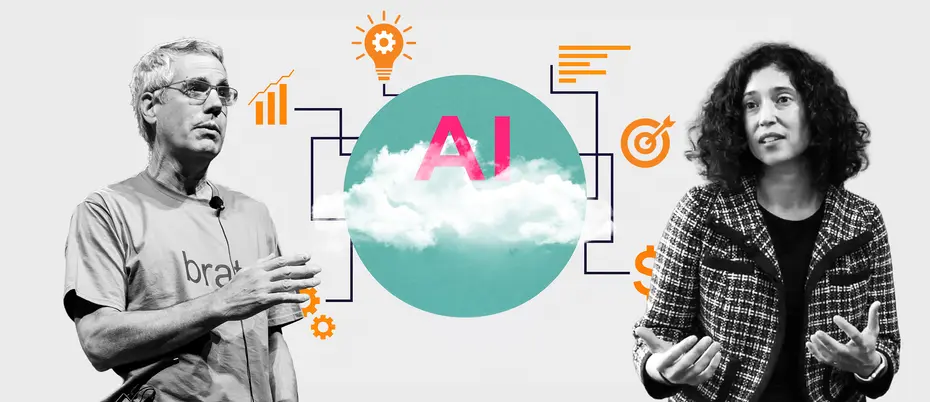
Aulet, who is managing director of the Martin Trust Center for MIT Entrepreneurship, and senior lecturer Jenny Larios Berlin led a recent webinar on how entrepreneurs can combine AI with Aulet’s 24-step Disciplined Entrepreneurship framework to move from concept to market faster and more effectively.
The pair are part of a team that leads the Entrepreneurship Development Program for MIT Sloan Executive Education.
Here are four takeaways from their talk.
Don’t mistake speed for productivity
AI has shrunk the cost and time required to test an idea. Founders can research markets, build products, and test hypotheses at speeds that would have been unthinkable even a few years ago.
But generating more ideas through quick experimentation can create the illusion of progress, when founders should instead be focusing on finding customers.
“There’s a difference between playing business and building a real business. … The question is still ‘Do you have a paying customer? Are you profitable? Do you actually have product-market fit? Do you have channel-market fit?’ And that question is becoming more elusive because it’s so easy to move quickly,” Larios Berlin said.
Aulet argued that AI’s prevalence makes thoughtful customer development even more valuable.
“This idea that ‘because I make a product, I’m an entrepreneur’ is rubbish,” Aulet said. “Today, it’s so cheap to make products. You can make an e-commerce site literally in a few hours using Shopify. That doesn’t mean you have a customer.”
Think like an entrepreneur to thrive with AI
Entrepreneurs are accustomed to operating amid uncertainty: spotting change, forming hypotheses, testing, adjusting. Those habits will be even more valuable as AI reshapes jobs and organizations.
That’s because fast-growing companies are increasingly recruiting two types of employees, Larios Berlin said: deep subject-matter experts, and highly adaptable people who combine interpersonal skills with AI knowledge.
“A lot of what we’re trying to figure out in this AI age is how to be more relational but also how to be more team-oriented to address problems and be really fast and nimble with response to scaling strategies,” Larios Berlin said.
Employees in the middle — neither experts nor AI-adaptive — are most at risk.
“If you’re in the middle and think you’re comfortable, that’s where you’re going to get [squeezed],” Aulet said.
The strongest competitor is a human who knows how to use AI
When IBM’s Deep Blue defeated chess master Garry Kasparov in the 1990s, many people saw it as proof that machines had surpassed humans. Kasparov proposed a rematch in which he could use a computer too, but IBM declined, recognizing that a skilled human aided by technology could potentially outperform the machine alone.
The lesson: The strongest competitor isn’t AI or a human. It’s a human who knows how to use AI.
“You are not going to lose to AI — unless you don’t use it at all,” Aulet said. “You’re going to lose to someone who knows how to use AI better than you.”
Creative workers in particular may feel threatened by AI’s knack for instantly generating marketing campaigns or mottos. They shouldn’t worry, Larios Berlin said. AI can only absorb, synthesize, and package old information. That shifts the human role toward acting as a future-forward architect: deciding what to build, what to ask, and where to go next.
In this scenario, the advantage belongs to people who use AI to accelerate analysis while supplying the judgment, relationships, creativity, and experimentation machines just can’t replicate. “Every cook has a chef’s knife, but you’re still the chef,” Aulet said.

Entrepreneurship Development Program
In person at MIT Sloan
Register Now

Competitive advantage comes from owning the customer, not owning the AI
When products can be built cheaply and quickly, competitive focus shifts from product-market fit to channel-market fit — that is, how a startup should reach and retain customers. Should the company use direct salespeople, inside sales, advertising, product-led growth, customer success, or some combination?
Companies need to keep testing new hypotheses about how they sell and scale rather than relying on a static customer relationship management platform, such as Salesforce, Aulet said.
AI can make go-to-market strategy far more precise by spotting new customers, emerging trends, and warning signs in metrics like customer acquisition cost and lifetime value. And companies can see when a sales channel is becoming too expensive or ineffective and adjust quickly.
But channel strategy is only half the equation, Aulet said. Calling yourself an AI company is fast becoming meaningless, as virtually all companies do or will use AI; saying so is akin to saying a company “uses technology.”
Nor does Aulet recommend trying to build another foundational AI model. He suggested thinking of models from companies such as OpenAI or Google as utilities: broadly available tools helping companies build value.
The durable advantage lies elsewhere. “Whoever owns the customer owns the gold,” Aulet said.
Companies that use AI to deeply understand their customers can identify a meaningful problem, solve it, build trust, discover the next problem, and solve that one, too. AI can speed the process, but successful companies will wield this power to understand customers better and continually adapt around them.
All of which means that AI is not on track to replace humans in the entrepreneurial process anytime soon.
“At the end of the day, the answer doesn’t reside in Claude. You still have to come up with the questions. You still have to come up with insights, then ask the next question,” Aulet said.
Bill Aulet is managing director of the Martin Trust Center for MIT Entrepreneurship and a professor of the practice at the MIT Sloan School of Management. He is the author or co-author of “Disciplined Entrepreneurship,” “Disciplined Entrepreneurship for Climate and Energy Ventures,” and the forthcoming “Disciplined Entrepreneurship Finance for Founders” and “Disciplined Entrepreneurship — The Revenue Engine,” among other titles.
Jenny Larios Berlin is an entrepreneur in residence at the Martin Trust Center and a senior lecturer at MIT Sloan. She was the co-founder and chief operations officer for Optimus Ride, an autonomous-mobility MIT spinout acquired by Magna in 2022, and co-founder of limeSHIFT, a socially driven creative agency.
The next Entrepreneurship Development Program from MIT Sloan Executive Education meets January 17 – 22, 2027 in Cambridge, Massachusetts.