‘AI gravity’ is pulling you toward dependency. Here’s how to push back
What you’ll learn:
- When workers become overreliant on AI, there’s a risk of significant skills collapse.
- Workers may fall victim to “AI gravity” — the constant pressure to outsource more thinking to AI in order to become more efficient.
- Individuals and organizations can take specific actions to protect cognitive capital and preserve institutional knowledge, says MIT Sloan School of Management professor Eric So.
As businesses pull out all the stops to integrate artificial intelligence tools into mainstream workflows and business practices, they may be overlooking the longer-term implications of widespread AI use on institutional knowledge and critical thinking.
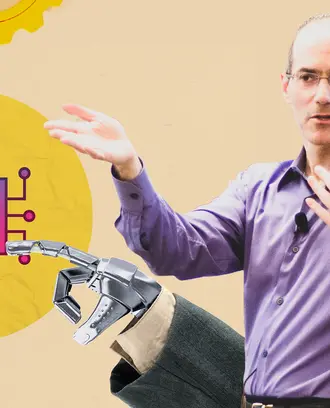
a professor of global economics and behavioral science at the MIT Sloan School of Management, believes that AI is changing the way people’s brains operate, creating a trap where users become overly dependent on the technology, with potentially serious ramifications for business.
“We are increasingly deferring tasks that our brains are meant to handle to AI systems that think for us, write for us, and create on our behalf,” said So, presenting recently as part of the MIT Sloan speaker series, “AI + X: How AI Is Changing Management Practice.”
“Each time we engage in this sort of cognitive outsourcing, we’re participating in dramatic societal change” — one that shouldn’t be taken lightly, said So, who addresses those changes in depth in his forthcoming book, “The Collision: What AI Does to Us.”
“We need to do as much as we can to preserve our capabilities, to recognize when these tools are wrong, to understand when they are missing something, and to be able to take action when these systems fail,” he said.
3 factors leading to worker overreliance on AI
So cited three behavioral trends that are leading to an overreliance on AI, with possible lasting repercussions.
- More powerful and proficient AI amplifies the human instinct to conserve mental energy. This sets up a strong desire to use the technology for as many tasks as possible instead of tackling work independently.
- Societal pressure to succeed at all costs encourages individuals to increase their use of AI as a means of mimicking expert human performance and getting a leg up.
- As it becomes more difficult to detect when peers are using AI tools, the demand for enhanced productivity becomes difficult for individuals to resist, especially when they’re trying to stand out among the competition.
“The combination and confluence of these factors lead to ‘AI gravity’ — the constant pull and push to outsource more of our thinking to AI in order to become more efficient,” So said.
When workers become overreliant on AI, there’s a risk of significant skills collapse, which could eventually undermine individual learning patterns and derail business goals, he said.
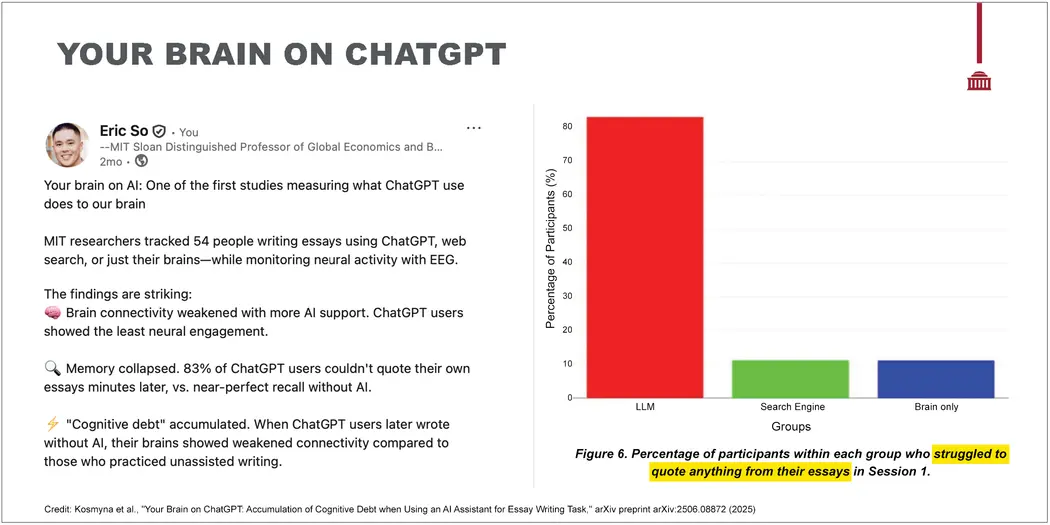
In a preliminary MIT Media Lab study, 83% of participants who wrote essays using ChatGPT couldn’t quote a single sentence from what they’d submitted moments earlier. “It passed from the computer screen onto the homework assignment without ever entering their brain,” So said.
More broadly, those effects can mean that tacit institutional knowledge — the material people learn from experience and years of practice — is at risk, especially among the younger members of the workforce. “As we lose practice with the hands-on work and problem-solving that build deep expertise, we naturally lose some of that skill associated with it,” So said. “It’s a real threat to organizations that thrive on continuity.”
How to protect cognitive capital in your organization
So makes the case that businesses need to be intentional about preserving their institutional cognitive capital, by taking strategic action to raise awareness of the issues and effectively recalibrate AI use.
He shared four recommendations for managing AI gravity — for individuals and their teams alike:
- Value the struggle. Modern society is obsessed with making things easier, but So contended that powering through cognitive friction results in more productive outcomes. Mentally grappling with a difficult challenge, he suggested, is a formative step for humans in building critical thinking and problem-solving skills. When AI removes that process, valuable skills can atrophy in individuals, which causes the collective enterprise to suffer. Left unchecked, the value of institutions, training, and educational degrees can fall, he said.
- Value who you are without AI. There are many moments that happen outside the digital sphere that are going to require skills beyond AI, such as a client meeting that forces reps to think on their feet, or a job interview where it’s necessary to read the room in a way AI is just not capable of. These moments all depend on nonaugmented capabilities. Organizations need to build policies and programs that help build these skill sets and reinforce their importance, So said. On an individual level, encourage employees to identify and enhance the signature skills that define their value, such as communication, reasoning, and negotiating prowess.
- Reinvest your cognitive surplus. AI saves time, but that’s far from its only benefit. The real transformation comes from reinvesting the time savings associated with outsourcing rote tasks to higher-value initiatives, such as developing skills or new processes. AI should not just be a means to do existing work faster; rather, it should serve as a springboard for unlocking new possibilities and work patterns, So said.
- Make AI your cognitive trainer. AI systems can deliver customized tutoring that enhances education rather than degrade cognitive abilities. AI models like ChatGPT and Claude can be prompted to function as tutors that don’t provide answers but instead work alongside users to problem-solve. Encourage use of these resources through awareness, training, and leading by example.
AI Executive Academy
In person at MIT Sloan
Register Now

Avoiding cognitive outsourcing
AI itself isn’t the real danger. It’s the mindset it promotes among users who unwittingly become “ventriloquist dummies” for the technology, So said.
“To thrive in the age of AI, we have to distinguish between the tools we use and the capabilities we possess,” he said. “If we can’t think without these machines, I would argue we are not thinking at all.”
“AI + X: How AI is Changing the Management Practice” is a faculty speaker series presented by the MIT Sloan Office of Teaching and Learning and MIT Open Learning. The series offers the MIT Sloan community a practical, cross-industry perspective on how AI is shaping real management decisions. Members of the MIT community can access further series resources here.
Eric So is the Sloan Distinguished Professor of Global Economics and Behavioral Science at the MIT Sloan School of Management, faculty co-director of the AI Executive Academy, faculty chair of MIT Sloan's PhD program, and lead faculty for the MIT Sloan Generative AI for Teaching and Learning hub. His current research portfolio spans interconnected topics, including artificial intelligence, behavioral economics, human-computer interactions, and regulatory policy. His book “The Collision: What AI Does to Us” will be published in October 2026.