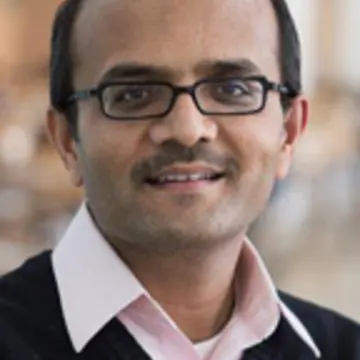
Chintan Vaishnav’s work is about design at scale: designing technologies, socio-technical systems, and policies that enable innovation to improve lives. He is a Senior Lecturer at MIT's Sloan School of Management where he teaches Product Design and Development.
Vaishnav’s career has spanned industry, academia, and government. He began as a researcher at Bell Laboratory, working on large-scale, highly fault-tolerant networks. His experience designing complex technological systems led to a broader question: How can technologies be situated in the economic, social, and political systems to achieve the desired outcome—most importantly, solutions to wicked challenges such as hunger, poverty, healthcare, agriculture, and education at a societal scale? This theme became the foundation of his interdisciplinary work at MIT, where he earned graduate degrees in technology and policy and engineering systems.
At MIT, Vaishnav has both studied and practiced the design of socio-technical systems. His research in technology policy has examined the conditions under which technological disruptions occur and how governments can achieve regulatory objectives without suppressing innovation — a puzzle arguably more relevant in the age of Artificial Intelligence. His work has addressed the implications of Internet-based technologies for markets, regulation, and society, and has resulted in advising organizations including the White House Office of Science and Technology Policy, the Federal Communications Commission, and the Telecom Regulatory Authority of India.
In 2012, Vaishnav became the founding Academic Director of MIT’s Tata Center for Technology and Design, where he developed a template for teaching graduate researchers how to deeply understand the challenges of resource-constrained environments, rigorously research and design scalable solutions for them, and practically implement solutions through business and policy entrepreneurship. His own research at the Center has created extremely affordable soil and water quality solutions. To commercialize the water quality work, he has co-founded a startup, Earthface Analytics. A replica of the MIT Center has been built at IIT Bombay, where he is a Visiting Professor.
In 2021, Vaishnav moved from designing individual technologies and socio-technical systems to designing an innovation ecosystem on a national scale. He was appointed mssion director of the Atal Innovation Mission (AIM), the Government of India’s flagship initiative for building a culture of innovation and entrepreneurship. Serving also as an additional secretary to the Government of India, he worked across schools, universities, startups, incubators, industry, communities, and government to build the institutions and infrastructure through which innovation could emerge and scale.
Among AIM’s signature initiatives were Atal Tinkering Labs—maker and innovation spaces established in 10,000 schools across approximately 90% of India’s districts, reaching more than 11 million students. The effort brought design, making, experimentation, and entrepreneurship into the educational experience of a generation of young Indians. At the other end of the innovation spectrum, his work encompassed startups, emerging technologies, deep-tech entrepreneurship, and the policy environment required to support them.
During India’s G20 Presidency in 2023, Vaishnav chaired the creation of the Startup20 Engagement Group, establishing a new international policy platform to bring the perspectives of startups and entrepreneurs into the global economic dialogue. His government experience gave him a firsthand view of innovation not simply as the creation of new technologies, but as the outcome of interactions among talent, infrastructure, institutions, capital, markets, communities, and policy — particularly in the context of creating new jobs.
These experiences have shaped Vaishnav’s current intellectual interest in innovation ecosystems as objects of design. His work spans the full continuum of innovation—from grassroots creativity and education, through entrepreneurship and markets, to deep technology and frontier innovation—and asks how the systems connecting these elements can be deliberately shaped. India has provided an especially consequential setting for this work: a large, diverse, and rapidly changing society in which technological and institutional innovations can be developed and deployed at extraordinary scale.
At MIT Sloan, Vaishnav brings these experiences back into an academic setting. His work connects lessons from India with broader questions about technology, innovation, entrepreneurship, management, and public policy, including the governance of emerging technologies. His teaching and research are grounded in the premise that some of the most consequential challenges of our time cannot be solved by technology alone: they require the design of the systems in which technology operates.
Vaishnav holds a BS and MS in electrical and computer engineering, an MS in technology and policy, and a PhD in engineering systems from MIT. He also holds a BA in Indian classical music from Gandharva Mahavidyalaya in India.