Choose the human path for AI
To realize the greatest gains from artificial intelligence, we must make the future of work more human, not less.
Richard M. Locke, John C Head III Dean, MIT Sloan
Americans today are ambivalent about AI. Many see opportunity: Sixty-two percent of respondents to a recent Gallup survey believe it will increase productivity. Just over half (53%) believe it will lead to economic growth. Still, 61% think it will destroy more jobs than it will create. And nearly half (47%) think it will destroy more businesses than it will create.
These are real concerns from an anxious workforce, voiced in a time of great economic uncertainty. There is a diffuse sense of resignation, a presumption that we are building AI that automates work and replaces workers. Yet the outcome of this era of technological advancement is not yet determined. This is a pivotal moment, with enormous consequences for the workforce, for organizations, and for humanity. As the latest generation of artificial intelligence leaves its nascent phase, we are confronted with a choice about which path to take. Will we deploy AI to eliminate millions of jobs across the economy, or will we use this innovative technology to empower the workforce and make the most of our human capabilities?
I believe that we can work to invent a future where artificial intelligence extends what humans can do to improve organizations and the world.
A new choice with prescient antecedents
As the postwar boom expanded the workforce in the 1950s, organizations were confronted with a choice about how to most effectively motivate employees. To guide that choice, MIT Sloan professor Douglas McGregor developed Theory X and Theory Y. The twin theories describe opposing assumptions about why people work and how they should be managed. Theory X assumes that workers are inherently unmotivated, leading to a management style based on top-down compliance and a carrot-and-stick approach to rewards and punishments. Theory Y presumes that employees are intrinsically motivated to do their best work and contribute to their organizations, leading to a management style that empowers workers and cultivates greater motivation.
McGregor’s work informed my research on supply chains in the 2000s, when firms were taking manufacturing to places with weak regulation and low wages in hopes of cutting production costs. Yet my research revealed that some supply chain factories were using techniques we teach at MIT about lean manufacturing, inventory management, logistics, and modern personnel management. These factories ran more efficient and higher-quality operations, which gave them higher margins, some of which they could invest in better working conditions and wages.
When an organization makes a choice like this, it pushes against prevailing wisdom about the limitations of the workforce. Instead, the firm employs innovations in both management theory and technology to expand the capabilities of its workforce, reaping rewards for itself and for its employees.
“Machines in service of minds”
Researchers at MIT today are urging us to make such a choice when steering the development of artificial intelligence. Sendhil Mullainathan, a behavioral economist, argues that questions like “What is the future of work?” frame the future in terms of prediction rather than in choice. He argues that it is right now — as we build the technology stack for AI and as we redesign work to make use of this newly accessible technology — that we need to choose. Do we follow a path of automation that simply replaces some amount of work humans can already do, he asks, or do we choose a path that uses AI as (to borrow from Steve Jobs) a “bicycle for the mind”?
In his own work, Mullainathan has shown why we should choose the latter: With colleagues, he has developed an algorithm that can identify patients at high risk of sudden cardiac death. Until now, making such a determination with the data available to physicians has been nearly impossible. Rather than automating something doctors can already do, Mullainathan chose to create something new that doctors can use to better treat patients.
That type of choice sits at the center of “Power and Progress,” the 2023 book by MIT economists and Nobel laureates Daron Acemoglu and Simon Johnson that argues for recharting the course of technology so that it effects shared prosperity and complements the work of humans. Writing later with MIT economist David Autor, the pair argued that the direction of AI development is a choice. As they put it, leaders and educators must choose “a path of machines in service of minds.”
What does that mean in the context of the workforce and the workplace today? How do we create organizations and roles that travel this path?
Part of the answer lies in research from MIT Sloan professor Roberto Rigobon and postdoctoral researcher Isabella Loaiza. The pair conducted an analysis of 19,000 tasks across 950 job types, revealing the five capabilities where human workers shine and where AI faces limitations: Empathy, Presence, Opinion, Creativity, and Hope. Their EPOCH framework puts us on a path toward upskilling workers with a focus on what they call “the fundamental qualities of human nature.” Think of the doctors in Mullainathan’s work above. With AI, they can better predict which patients are at high risk of sudden cardiac death. And the doctors remain essential as decision makers and caregivers, using insights from AI to focus on better patient outcomes.
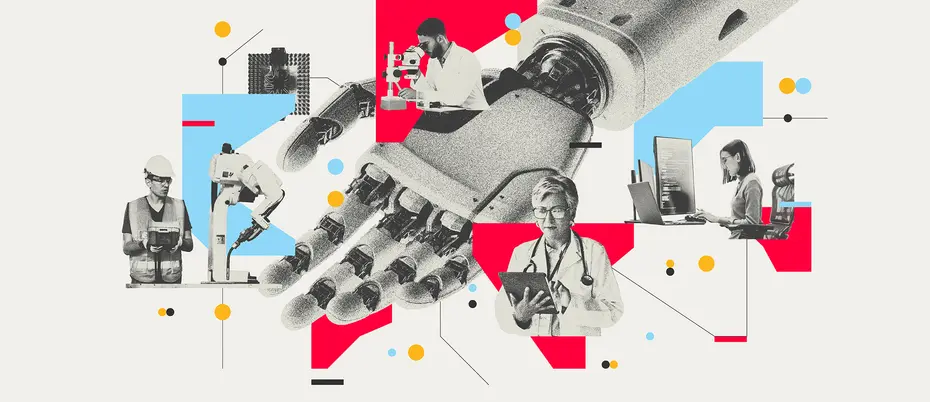
Researchers across MIT and MIT Sloan are examining the indispensable role of humans in the implementation of artificial intelligence across many other disciplines and industries, some of which are detailed in the sidebar.
Teaching our students, ourselves, and the world
At MIT Sloan, centering human capabilities in the implementation of AI means that we must all be fluent with these new tools. It means educating not just our students but also our faculty and staff members. We must create a foundation we can build upon so we can all do better work in finance, marketing, strategy, and operations, and throughout organizations. Here are three ways we have begun:
- In Generative AI Lab, one of MIT Sloan’s hands-on action learning labs, teams of students are paired with organizations to employ artificial intelligence in solving real-world business problems.
- This past summer, we formed a committee of faculty members who are already planning how to weave AI throughout the curriculum, with a focus on training students in ethical and people-focused implementation of the technology.
- At MIT Open Learning, MIT Sloan associate dean Dimitris Bertsimas and his team have developed Universal AI, an online learning experience consisting of modules that teach the fundamentals of AI in a practical application context. The pilot of this offering was recently rolled out to a wide-ranging group of organizations — including MIT students, faculty, and staff members — so they can learn more about AI and its applications and, most importantly, provide feedback. This will allow us to go beyond educating just ourselves and our students. We will shape an offering that can scale much further and help us to collectively choose a path that is informed by the MIT research I’ve described above. Universal AI will be available to learners, educators, and all types of organization around the world in 2026.
Continuing a tradition of pathfinding and inventing the future
Job loss and de-skilling are not inevitable outcomes of the growth of artificial intelligence in organizations. But it’s where we’ll end up if we don’t make a deliberate choice to follow the best path we find.
From Theory X and Theory Y to Rigobon and Loaiza’s insightful EPOCH framework, to the new educational paradigms possible through initiatives like Universal AI, MIT and MIT Sloan have a history of following paths to an exciting and productive future of work that not only includes humans but makes the most of our humanity. We must all work together to invent this future. The range of possibilities is greater than we think.
Richard M. Locke is the John C Head III Dean at the MIT Sloan School of Management. A scholar of international labor standards and comparative political economy, Locke began his appointment as dean in July 2025. This also marked his return to MIT, where he previously served as the Class of 1922 Professor of Political Science and Management and the Alvin J. Siteman Professor of Entrepreneurship for 13 years, as well as MIT Political Science department head and MIT Sloan’s deputy dean. Locke began his career as an assistant professor of international management at MIT in 1988.
Prior to his deanship appointment at MIT Sloan, Locke served as the dean of Apple University, which focuses on internal leadership and management education for Apple, Inc. Before this, Locke was Brown University’s provost, a position he held for nearly eight years.
AI Executive Academy
In person at MIT Sloan
Register Now