
What you’ll learn:
- Today’s flight paths are more direct, which cuts fuel use and reduces emissions, but they may concentrate noise in some neighborhoods.
- Changes in flight paths and traffic patterns led to increases in airplane noise in some areas and decreases in others.
- Noise exposure of residential properties affects property prices. Future airport design and urban planning decisions should take those effects into account.
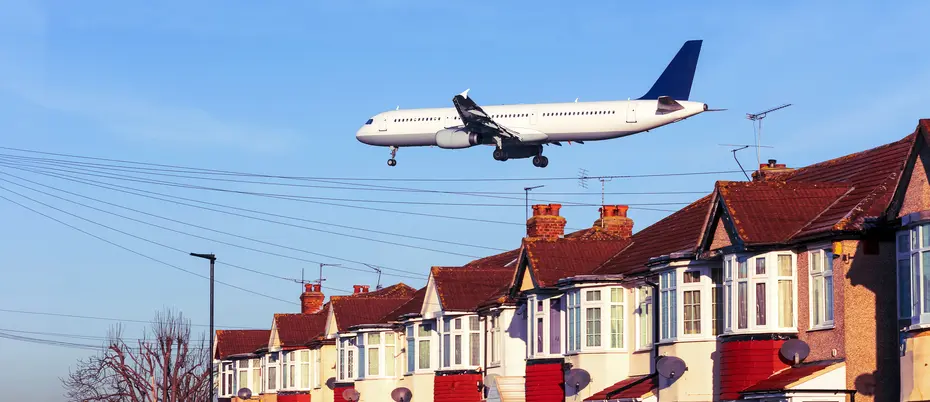
Aircraft noise is more than an irritant to people who live near flight paths — it also devalues their homes. When aircraft noise rises by 1 decibel, on average nearby homes shed 0.6% to 1% of their value, according to a new study co-authored by faculty director of the MIT Climate Policy Center and a professor of energy economics at MIT Sloan.
Around major airports in Boston, Chicago, and Seattle, redesigned flight paths concentrated air traffic along narrower corridors, raising aircraft noise in some neighborhoods and lowering it in others.
According to the study, which was co-authored by Florian Allroggen, R. John Hansman, Jing Li, Xibo Wan, and Juju Wang, changes in noise exposure affect local neighborhoods’ house valuations. The results highlight the need to incorporate localized environmental costs into aviation and urban land-use policy.
How the shift happened
Noise exposure around airports changes over time as new and quieter aircraft are introduced and air traffic grows. But over the past two decades, another shift happened: Beginning in 2006, U.S federal regulators introduced new procedures relying on satellite-based navigation, allowing planes to fly more direct and more precise paths; this increased airspace capacity and reduced fuel use and emissions.
The result of these performance-based navigation procedures was air traffic that was more concentrated upon arrival and departure. Some neighborhoods found themselves under busier flight paths while others saw fewer planes overhead. In some locations, runway configuration changes lead to even more substantial shifts.
Between 2011 and 2016, sustained aircraft noise in some neighborhoods around Boston Logan International Airport increased by about 3 dBA, with aircraft noise rising by as much as 8 dBA–10 dBA in a few neighborhoods and decreasing by up to 2 dBA in others. In areas near Chicago’s O’Hare airport, noise fell by up to 10 dBA or increased by as much as 6 dBA.
Because routes were changed for operational reasons and not because of housing demand, researchers had a rare chance to isolate the effect of noise changes on property values from socioeconomic factors.

AI Executive Academy
In person at MIT Sloan
Register Now

What the market priced in
The researchers analyzed about 86,000 home sales between 2011 and 2016 in neighborhoods surrounding the three airports. They linked each sale to detailed characteristics of the property and neighborhood, flight-path data, and noise estimates, allowing them to see how sale prices responded at a location when noise levels rose or fell.
A consistent pattern emerged across all three cities. After controlling for overall price trends and house characteristics, each additional decibel of average annual aircraft noise reduced home values by roughly 0.6% to 1%.
To put that into context, with average home prices near Boston Logan at roughly $450,000 in 2011, a 5-decibel increase implied a potential loss in value of about $13,000.
The researchers tested different measures of exposure — including the number of loud flights and how noise levels varied across days — and found that average sound levels had the strongest effect on prices. In other words, what matters most is the steady hum of engines, not the occasional flyover.
All income groups do not respond to aircraft noise the same way. In all three cities, higher income was linked to a stronger preference for quieter surroundings. In the study, every $1,000 rise in median household income was associated with a 0.8% to 1.6% increase in the strength of that preference.
Why it matters for business and policy
The findings suggest that decisions on flight routes, runway design, and urban planning should account for the impact on nearby neighborhoods. Housing markets provide an effective means to track preferences.
There is a clear trade-off, the authors conclude. Performance-based navigation procedures offer numerous benefits — including increased airspace capacity, more direct flight paths, reduced fuel consumption, and lower emissions, they write. But “such benefits must be weighed against potential costs, which would include any increases in noise exposure for residents of communities surrounding airports.”
Christopher Knittel is a professor of energy economics at MIT Sloan, the associate dean for climate and sustainability, and faculty director of the MIT Climate Policy Center and the MIT Center for Energy and Environmental Policy Research.
Florian Allroggen is the executive director of the MIT Laboratory for Aviation and the Environment and a senior strategic adviser in the MIT Department of Aeronautics and Astronautics.
R. John Hansman, SM ’80, PhD ’82, is a professor of aeronautics and astronautics at MIT and the director of the MIT International Center for Air Transportation.
Jing Li, SB ’11, is an assistant professor of economics at Tufts University.
Xibo Wan is a postdoctoral associate in the Department of Agricultural and Resource Economics at the University of Connecticut.
Juju Wang, SB ’17, SM ’19, is a graduate researcher at MIT.