‘AI helped me turn MIT lab technology into an at-home product for parents’
Summary: Researcher Max Jara Fornerod saw an opportunity to commercialize MIT diagnostic technology. An AI tool trained on MIT Sloan’s Disciplined Entrepreneurship framework helped him define a highly specific first customer: working parents in rural or suburban areas.
When Max Jara Fornerod began to explore ways to commercialize portable DNA detection technology, his challenge wasn’t that the science had no applications: It was that it had too many.
As an MIT postdoctoral researcher in chemical engineering, Fornerod used portable DNA detection technology to identify prostate cancer biomarkers in urine.
Encouraged by Ariel Furst, principal investigator at the Furst Lab and an associate professor of chemical engineering at MIT, Fornerod saw that the technology, which is similar to at-home glucose measuring for diabetics, had potential applications across hospitals, restaurants, animal health, and at-home diagnostics — essentially, anywhere where bacteria and viruses thrive and need to be easily identified.
But that flexibility made it difficult to answer a question fundamental to early-stage startups: Who’s the ideal customer? What’s the ideal first market?
“We needed to ask, ‘Where do we start? Where can our technology and passion make a difference?’” Fornerod said.
JetPack accelerates market analysis
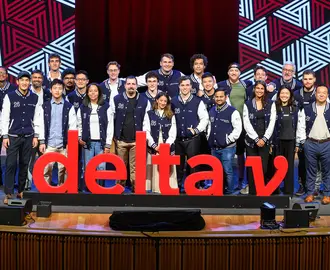
With a likeminded team that includes Furst; Audrey Atkinson, MBA ’26; and Domingo Concha, MBA ’24, Fornerod entered the Martin Trust Center for MIT Entrepreneurship’s delta v accelerator program in 2025.
At first the team relied on brainstorming, whiteboards, and internal debate to identify potential industries and applications. They mapped use cases but still struggled to choose a clear direction.
Then the team turned to the MIT Entrepreneurship JetPack, an AI tool developed by the Trust Center, to help them jump-start the market-segmentation process. Built on a large language model and trained on the 24-step Disciplined Entrepreneurship framework championed by Trust Center founder Bill Aulet, JetPack is designed to accelerate — not replace — founder decision-making.
“JetPack helped us a lot when we were stuck, when I ran out of ideas, when I was tired. It helped me to get to think out of the box, to see things that I wasn’t seeing with my team,” Fornerod said.
The team used JetPack and interviewed potential customers to evaluate potential markets based on need, accessibility, and willingness to pay and then built detailed customer personas.
Parents emerged as an early potential market. “There are millions of parents with kids who have a pressing need or a willingness to pay for an at-home detection product,” Fornerod said.
And thus was born Sensopore, an at-home diagnostic device to help families test for everyday illnesses like strep throat, get connected with a telehealth doctor, and have prescriptions shipped to their door, reducing clinical visits.
Suburban parents as a beachhead market
As they landed on an initial target market, there was just one catch: None of the founders were parents themselves. “JetPack helped us to define the personas related to our product: who would buy it, use it, and influence others to buy it,” Fornerod said.
One example: The group initially assumed that parents of newborns were an obvious target segment, but JetPack told a different story.
“We didn’t know how parents think, so we asked the AI,” Fornerod said. “And actually it was very clear that parents with newborns rely on their doctor. They don’t want to test their kids themselves.”
More experienced and busy parents, on the other hand, were more likely to choose to use an at-home test. “Parents who have more than one kid feel more confident,” he said.
That insight shifted the company’s focus toward parents with children over age 6. Within that demographic, JetPack further helped the team profile a beachhead market persona: working parents who live in suburban or rural areas and don’t have the capacity for a quick doctor’s visit.
Calculating costs needs some human oversight
Using JetPack, the team did encounter limitations. For example, quantitative outputs could be unreliable when the tool calculated the cost of customer acquisition, or COCA, one of the 24 Disciplined Entrepreneurship steps.
“The model and formulas are accurate, but the assumptions may not be precise because they depend on your specific field,” Fornerod explained. “For instance, it can assume a $20,000 budget for digital marketing, which could be insufficient for one industry but excessive for another.”
After gaining that understanding, the team continued to use JetPack as a guide but validated insights with real-world data.

Entrepreneurship Development Program
In person at MIT Sloan
Register Now

Next steps: Funding and fabrication
The team, which operates out of the Furst Lab in the MIT Department of Chemical Engineering, is preparing to raise pre-seed funding in late 2026, paving the way for a pre-submission meeting with the U.S. Food and Drug Administration — a typical, voluntary step for many medical device manufacturers.
After that, the team will work with manufacturers to fabricate their first product at scale. Childhood illness is just one use of an expansive technology; Fornerod and his team plan to develop many more use cases, and they expect to continue to rely on JetPack to do so.
“As long as we have access to the JetPack, we’ll continue using it to identify and evaluate the follow-on markets. Knowing the next market will help us determine the next sensors we should develop,” Fornerod said.
Read next: “Accelerate entrepreneurship with these AI tools from MIT”
The MIT Entrepreneurship JetPack tools, which are part of MIT’s Orbit website for entrepreneurs, are currently being used by entrepreneurship students at MIT and being piloted outside the Institute; there is a waitlist that prospective users can join.
JetPack is also available to participants in either of two MIT Sloan Executive Education courses:
Entrepreneurship Development Program
Entrepreneurship Development Accelerator