When Melissa Estok, EMBA ‘22, joined the MIT Executive MBA program, she brought with her decades of high-stakes leadership experience across international development, advisory consulting, and nonprofit management. She was looking to deepen her skills, validate her instincts with research-based practices, and sharpen her ability to lead complex organizations.
Throughout her career, Estok has led initiatives in volatile and polarized political environments, helped organizations navigate complex transformations, and built operational systems from the ground up. At MIT Sloan, she found a community of peers with shared purpose, professors who reframed how she thought about systems and strategy, and a curriculum that validated and elevated her leadership style.
What made you decide to pursue an EMBA, and why MIT Sloan?
I was already in a senior role as a partner and COO at Albright Stonebridge Group after spending many years working for NDI in a variety of countries. I had set up programs and offices from scratch, secured funding, hired staff, and built partnerships. Essentially, I taught myself how to run organizations based on instinct and field experience. When I returned to the U.S. and joined ASG, I applied those same instincts to help scale and organize a successful but structurally underdeveloped firm. We made it work and were successful, but I began to wonder: how much more could I understand about leadership and operations if I backed my instinct with deeper training?
I looked at a few options, but when I started talking with an admissions advisor from MIT Sloan, it just clicked. We were finishing each other's sentences. The program's ethos aligned with my values; smart people working together to make a positive impact in the world. I also appreciated how Sloan connects to the rest of MIT. It’s not a siloed business school; it’s part of a broader ecosystem focused on innovation, science, and technology. And it felt like the right community for someone in the mid-to-late stage of a mission-driven career who still wants to learn, grow, and give back.
Melissa Estok, EMBA '22
What were your first impressions when you got to MIT Sloan?
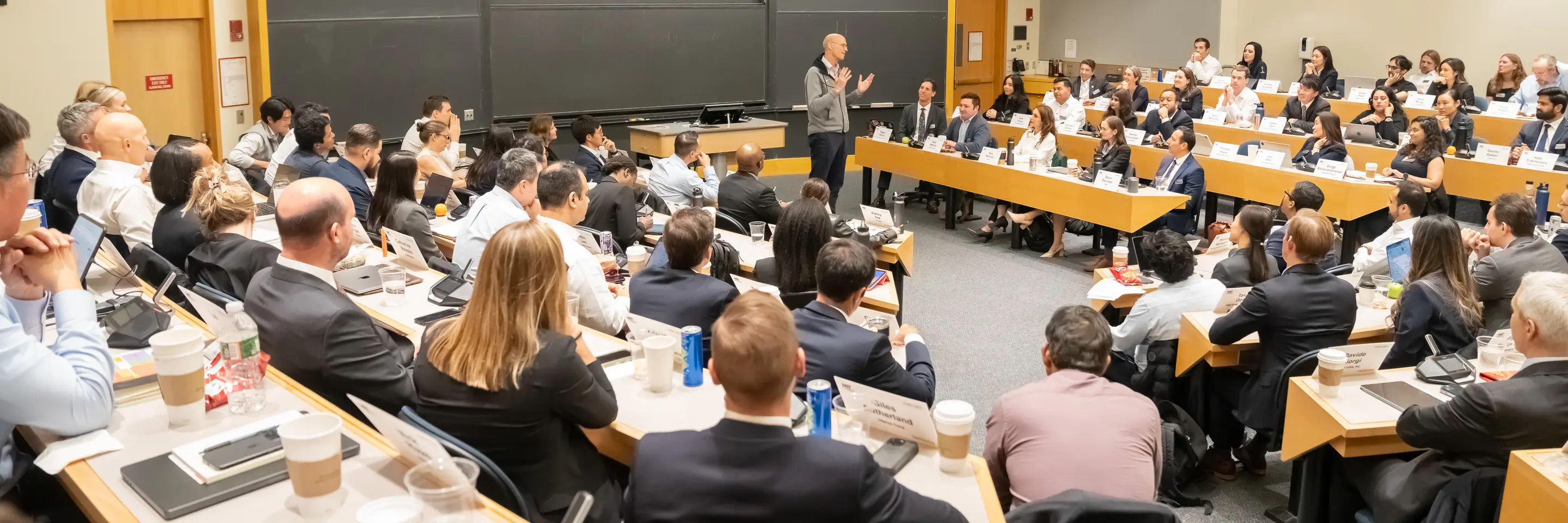
I remember one of my first classes. It was with Bob Gibbons, who we all affectionately called “lowercase Bob” because he always typed his name in lowercase. He taught game theory, and before the program even started, he asked us to write a case study using our own experiences to apply a game theory concept. I wrote about a difficult situation I was facing at my firm at the time. When class began, mine was one of the three he selected to walk through with the entire cohort.
That moment really hit me. I felt intellectually challenged for the first time in a long while, and it made me emotional. I welled up. I remember thinking, “Wow, I guess I’ve been bored.” It was invigorating to be in a room full of such smart, engaged, and mission-driven people. From day one, it felt collaborative, not competitive. People were talking not just about boosting their careers, but about doing it in ways that were good for their teams, for organizations, and for the world. It was exactly what I had hoped for.
What other courses or ideas from the program made a lasting impact?
Organizational Processes with Roberto Fernandez helped me look at structure and systems in a new way. I remember he showed us a classic four-box grid—performance on one axis, cultural fit on the other. He made it very clear that if someone is in the lower-left quadrant - low performance, poor cultural fit—they need to go. He also pointed out that being in the upper left quadrant—high performance, poor cultural fit—is also a red flag. As he put it: if you're an a------, you don’t belong on the team no matter how much it is perceived that you are the smartest person in the room.
That message landed hard. I had already started a reorganization at my firm, and hearing that validated my decisions. It gave me grounding and confidence, and it removed any lingering doubt related to moving a number of people out of the organization. It was difficult, but ultimately made us stronger, leaner, and resilient.
Another class that stuck with me was Leading Organizations by Elsbeth Johnson. She shared a model with concentric circles: the innermost circle was where leaders should operate on vision, strategy, and the big picture. The outer rings were the operational noise we often get lost in. That visual stayed with me. At the Brennan Center, I kept reminding myself: delegate the rest so you can lead where it matters.
Any personal transformation you experienced as a leader?
Yes, especially after Deborah Ancona’s course Discovering your Leadership Signature. It asked us to look back at how we were raised and socialized, how that shaped our leadership patterns. For me, that was a turning point. I stopped trying to be the "good girl" and focused on being clear, direct, and respected. At my farewell from the Brennan Center, the person I had been hardest on, the COO, got up and spoke about the profound impact I had on him. He talked about my authenticity, my transparency and the fact that I was very firm and honest, but I was also kind. That was one of the most affirming moments of my career. To me, that's a specific example of my development, my growth as a leader that directly links back to MIT.
Did the program change your perspective on your career?
It did. I went into the program with a lot of experience, but I came out with a new sense of purpose. The program validated what I was doing and helped me understand the science behind it. It also gave me language and frameworks to be more effective. Now, as I consider my next move, I’m thinking about how I can take everything I’ve learned and apply it at scale, whether through a CEO role, a board position, or a new initiative.
Related Posts