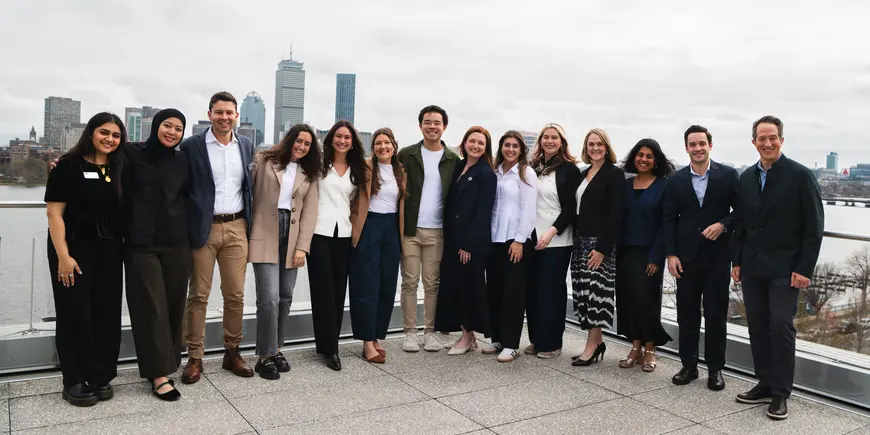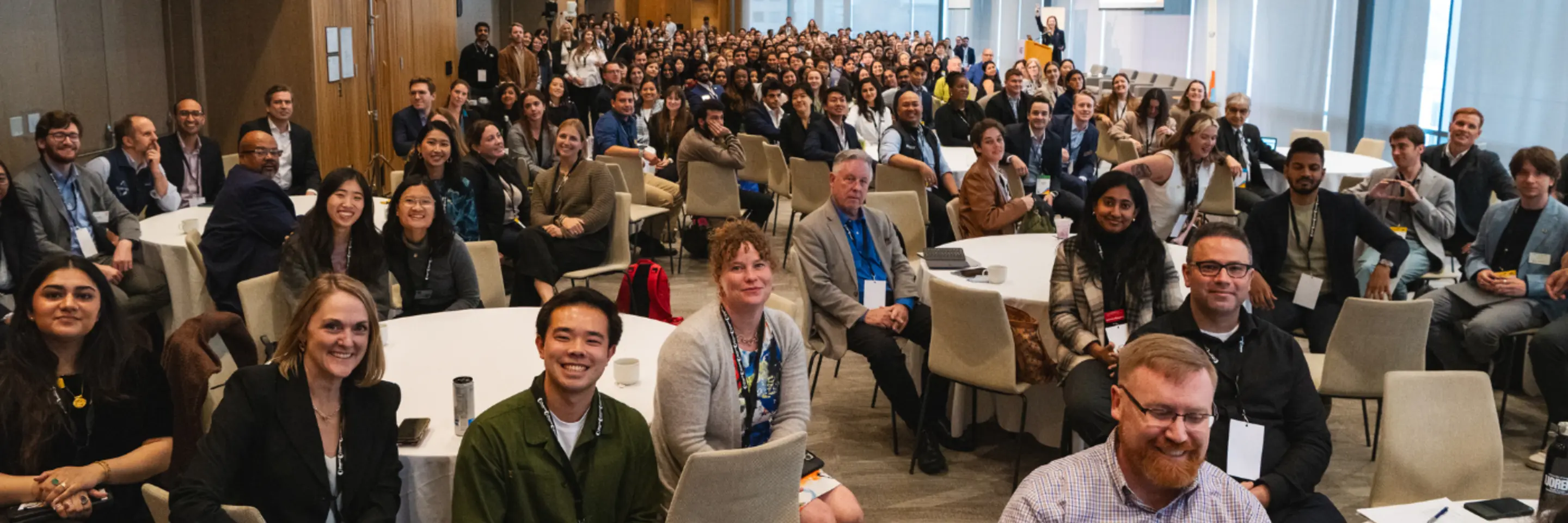
2026 ClimateCAP Fellows
Leading Through Complexity
Greenhushing. Carbon markets. Critical minerals. China. Iran. These are just a few of the hot topics tackled at this year’s ClimateCAP MBA Summit hosted by MIT Sloan in April. But the most valuable aspect of the gathering wasn’t any single topic, speaker, or session, but the space it created for a broad range of conversations to take place, even difficult ones where people—from all over the country and the world—did not always agree.
In breakout sessions, over lunch, in hallways, global business leaders, professors, researchers, and MBA students (many toting reusable water bottles) engaged in critical conversations about climate leadership in a time of growing polarization, disruption, urgency, and yes, opportunity.
This was an event where attendees ate vegetarian and took the stairs instead of the elevators, and where dialogue and debate around climate and sustainability weren’t an afterthought—they were the whole point.
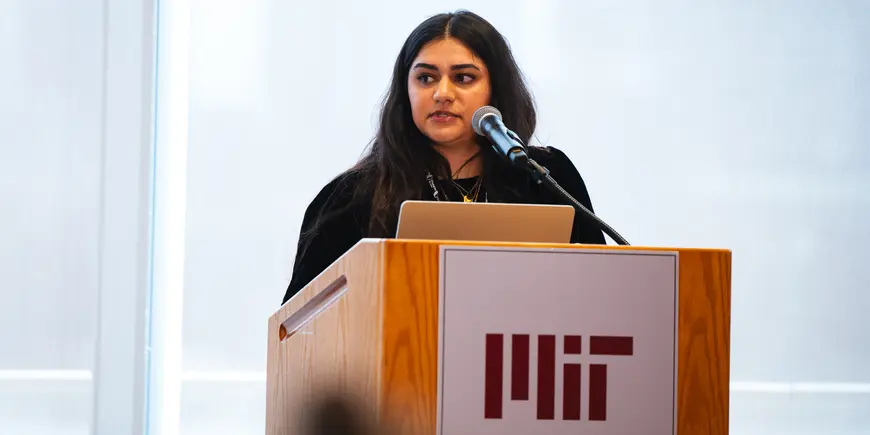
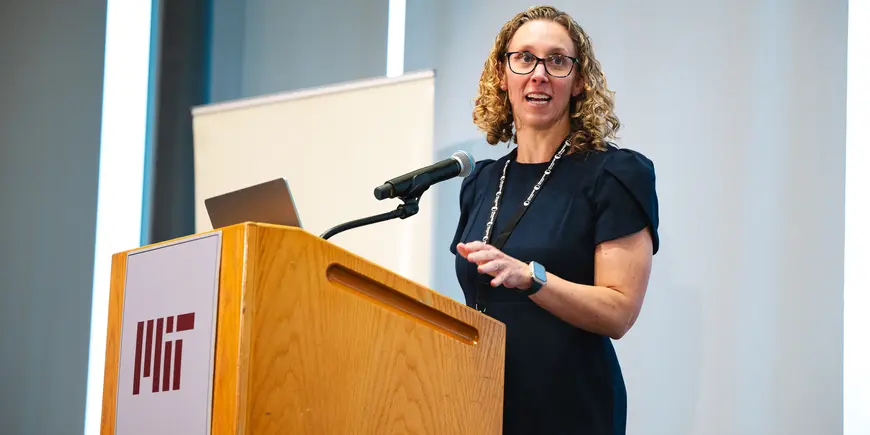
“We designed this conference as a space for honest and nuanced conversation,” said Jennifer Graham, senior associate director of the MIT Sloan Sustainability Initiative, in her opening remarks. “We want to go beyond simply asking: What should we do? We also want to ask: Where are the tradeoffs? What are the tensions? And how do we make decisions when priorities collide? The goal isn’t to leave with easy answers; it’s to leave better equipped to make hard decisions.”
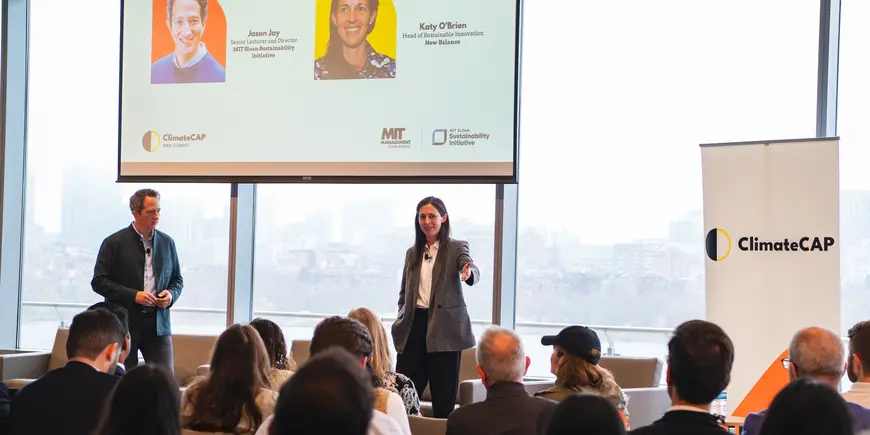
Jason Jay, director of the MIT Sloan Sustainability Initiative, and Katy O’Brien, SDM ’15, head of Sustainable Innovation at New Balance, had advice for attendees on how to approach potentially contentious conversations at the conference, and after.
“Don’t give in to greenhushing,” Jay said. “Engage with people, but listen to what they care about and engage with them on that.” It could be jobs, affordability, exciting new tech, cheaper energy, cleaner air and water, resilience to storms, less war over oil—whatever it is, Jay said, try to find common ground.
Hosted by MIT Sloan and run by the MIT Sloan Sustainability Initiative, the event was the largest (and first-ever carbon-neutral!) ClimateCAP MBA Summit, bringing together nearly 400 MBA students from more than 45 business schools. Over the weekend, what stood out most wasn’t any single idea or solution, but the convergence of many. With that said, six takeaways emerged. Here they are, in no particular order:
ClimateCAP MBA Summit 2026 Carbon Neutrality Report
Explore the methodology.
Explore the report
The Clean Energy Transition
Record high electricity demand and oil price shock could be catalysts to accelerate the renewable energy transition—a key to U.S. national security and economic prosperity.
Demand for energy is at an all-time high. Electricity demand is at levels not seen in the United States since 2005, and this increase does not even include predicted data centers demand, said Robinson Meyer, founding executive editor of Heatmap News. However, he added, this could translate into a potential positive for the clean energy transition.
“It’s already a tailwind for the battery sector; it could be a tailwind for any number of other electricity generating technologies,” Meyer said.
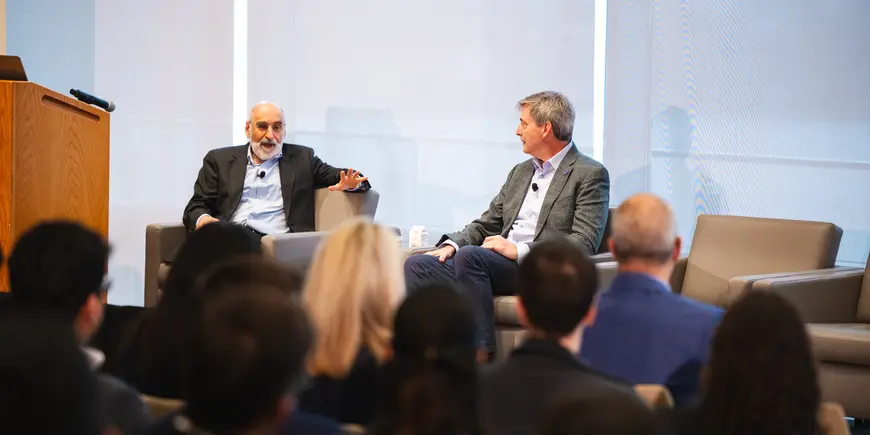
"The Current Climate Landscape" panel. From left to right: Chris Knittel, Catherine Wolfram, Michael Kearney, Robinson Meyer
With the war in Iran and the high price of oil top of mind, discussion naturally turned to that complex topic. Like it or not, the energy transition is inextricably linked to a global power struggle, panelists said. Who will control critical mineral supply chains? Who will process and refine those minerals? And ultimately, who will define the terms of the new energy economy? And moving forward, renewables are even more important to U.S. economic and security resiliency, which could be much more convincing arguments than climate alone.
Guest speaker Ryan M. Macpherson, MBA ’17, partner at AccelR8 Ventures, put a fine point on it: “The biggest threat to long-term national security and economic prosperity is the same thing that brings all of us here today to solve.”
“The war has really highlighted the focus on energy security, and that’s good for climate-tech and for the clean energy transition,” said Catherine Wolfram, William Barton Rogers Professor of Energy Economics, MIT Sloan School of Management. “The wind and the sun cannot be weaponized like fossil fuels can be weaponized. But the narrative I worry about, and I don’t think has gotten enough attention, is that this has put headwinds against policymakers who are trying to pass climate policy.”
Wolfram is a self-proclaimed “huge fan” of carbon pricing. “We still need policy,” she said. “We need to subsidize the green stuff and make more expensive and tax the brown stuff.”
Climate-Tech and Finance
The United States might be falling behind the rest of the world because of a lack of federal support for clean energy, but U.S. innovation and investment is the key to moving forward.
Despite the lack of federal policy and investment supporting a clean energy economy, the United States still has a super power—its proven ability to innovate.
Investors and innovators in this space should practice what professors teach their MBAs about game theory, said Wolfram. “If you’re not winning the game, redefine the game. The United States probably cannot catch up to China on critical minerals ... .but we’re really good at innovating, so maybe we can catch up on fusion or advanced geothermal.”
“In lieu of federal funding to de-risk further investment, it was exciting to hear about the creative and innovative ways that practitioners are continuing to fund green energy projects,” said Jan Kite-Powell, an MBA student at Northwestern’s Kellogg School of Management. “I would love to continue to explore the role of private sources of capital and creative financing in financing and progressing the green transition.”
“What struck me most was the revelation that Justice finance and DAF capital have deployed only 25% of assets under management, and that community development bank funds remain underallocated,” said MIT Sloan Fellow Alecia Asimigbe. “The conversation clarified that we're facing not just a funding gap, but an allocation gap. The capital exists, but deployment mechanisms are a bottleneck. This reframing changes how we should think about accelerating the energy transition. Finding bridges between the doers and those who support this kind of work is vital.”
Climate and Corporate Leadership
In business, doing well by doing good is possible—and profitable.
Mastercard aims to be net zero by 2040—without sacrificing growth. And it seems like an ambitious goal they’re on track to achieve. According to Ellen Jackowski, chief sustainability officer at Mastercard, in 2024, the company grew by 12%, with an impressive 7% reduction in their GHG emissions across Scope 1,2, and 3.
“The holy grail is to decouple growth from your emissions,” Jackowski said. “There are a few companies out there doing it, and we’re one of them.”
"Leading Corporate Climate Action: Real-World Lessons from Chief Sustainability Officers" Panel. From left to right: Jennifer Graham, Johanna Jobin, Ellen Jackowski
What does it take to translate climate goals into business decisions, navigate trade-offs, and lead in a time of complexity for corporate sustainability? Jackowski noted that it’s crucially important to pay attention to data and understand where markets are evolving. She was surprised to learn that 27% of Mastercard customer spending on online luxury apparel was on second-hand apparel, and of regular purchases, 5.4% was second-hand.
“This suggests that the market cares about sustainability, but also affordability,” she said, noting that translating this data internally can help drive growth and sustainability. “Part of the change we’re trying to drive change at Mastercard is saying to all our employees, you are all part of the impact team and the sustainability team.”
Johanna Jobin, global head of Environmental Sustainability & Compliance at Takeda, agreed. “You don’t have to be a chief sustainability officer to make a climate impact. Sustainability is embedded in every business function now.” Takeda aims to achieve net-zero GHG emissions related to operations, including scopes 1 and 2, before 2035, and for its entire value chain, including currently estimated scope 3 GHG emissions, before 2040.
Climate and Artificial Intelligence
AI’s biggest climate impact won’t be the electricity its data centers use; it will be the economic acceleration it creates—and the unintended follow-on consequences.
Data centers do have real local impacts on water, land, and grid capacity, and those issues need to be addressed. But the centers themselves do not present the biggest climate problem, said John Sterman, Jay W. Forrester Professor of Management, MIT Sloan School of Management, who presented a beta version of the successful En-ROADS climate simulation tool that included the impacts of AI data centers.
AI might be helpful in reducing carbon emissions, but it is too soon to tell. The technology is also predicted to significantly boost productivity across industries, but when productivity rises, so does consumption and investment, and with it, emissions. According to Sterman, that multiplier effect could dwarf the footprint of data centers themselves.
Here are some other thoughts on AI and data centers from our expert panelists:
“I don’t believe in some of the most fantastic predictions of how much electricity will go to AI,” said self-proclaimed techno-optimist Tom Taylor, president and CEO of the $10-billion Bezos Earth Fund. Taylor came out of retirement after 22 years at Amazon working on Alexa. “I think economics will protect us from massive price increases. And I think the hyper scalers understand; they do not want to be accused of making your bill go up.”
“AI is not yet, as of today, powerful enough to lead this transition itself,” said Sarah Kalloch, MBA ’16, a workforce strategy advisor. “It might be, and it might be tomorrow. But right now, people lead this transformation.” Addressing the aspiring business leaders in the audience, she added, “And every single one of you is going to lead the AI energy transformation and is going to decide what the workforce looks like.”
Paraphrasing Ruth Porat, president and chief investment officer of Alphabet and its subsidiary Google, Jackowski warned, “If AI is not inclusive, all of the great problems we face today in this world—poverty, health issues, climate change—will get worse, not better.”
Nature-based Mitigation, Adaptation, and Resilience
Nature-based solutions alone could contribute more than 30% of the global mitigation required to achieve the 1.5/2°C temperature rise—and technology can accelerate that outcome.
Nature-based solutions decrease greenhouse gas emissions and sequester carbon. In the process, they help communities adapt to flooding, sea-level rise, and more frequent and intense droughts, floods, heatwaves, and wildfires. As a result, they reduce water and air pollution, improve soil and biodiversity, preserve sanctuaries for keystone species—and create jobs.
With all these benefits, why isn’t there more investment in these solutions? Presently, only about 3% of climate capital flows to nature-based solutions, despite their capital efficiency. The good news is some of the biggest and most powerful financial institutions are investing in nature-based solutions. About $10 billion of professional capital has already formed in this space—and it’s ramping up.
“In the past couple of years, 131 countries have embraced nature-based solutions as core to their NDCs,” said Tony Lent, co-founder of Capital for Climate. (An NDC is a country’s national climate action plan under the Paris Agreement.) “The question now is less about proving impact and more about putting systems in place that allow that impact to scale.”
And we’re not talking about just planting trees, the oldest method for capturing carbon. These solutions are sophisticated strategies and practices aided and accelerated by technology like AI, remote sensing, GIS, and more.
Wondering if profits can be made by investing in nature-based solutions? Lent offered these stats:
-
8.5-9%
Globally, renewable energy produces an 8.5-9% real return
-
8-10%
The real rate of return for water services globally is 8-10%
-
7-9%
Regenerative agriculture businesses deliver 7-9%
-
9-12.5%
Restoration of degraded agricultural land and pasture returns 9-12.5% over seven years
-
12-14%
Agroforestry is consistently seeing a 12-14% return
-
15-20%
Native forest restoration shows 15-20% returns
Sustainability Job Market
The outlook for building a business career grounded in sustainability is bright—and there might never be a better time to follow your passion and make an impact.
Despite the complexities of the present moment, many of our speakers were optimistic and enthusiastic about the job prospects of MBA students seeking meaningful careers built on sustainability. Here’s a sample of their advice:
“The jobs are there. The work is there,” said Taylor. “Whether it’s engineering, financial understanding, measurement systems, even communications. Any of the backgrounds you have in this room I think will apply to any of the work we need to do on climate.”
“We can’t get to where we need to go with any one thing. It’s just too late for that,” said Sterman. “That’s daunting for some, but I think it’s actually good news….It means no matter what your expertise and your particular passion is, there’s a place for you, there’s a need for you.”
“I think this is really the best time to accelerate a career in this work,” said Macpherson. “The companies being formed right now are poised to redefine mobility, agriculture, building systems, materials—the foundational physical infrastructure of the economy. These are the largest industries on earth. And right now a remarkably talented and motivated group of people is building them from the inside. And you could be one of those people.”
“Especially in times like these, when maybe it’s not politically fashionable to be doing this kind of work, that’s why we have to double down and do it,” urged MIT Sloan School of Management John C Head III Dean Richard Locke. “I encourage you to lean into this work and lean in to these challenges….These are tough times, we can’t pretend that they’re not, but lean in to that and innovate in a way that the world needs from all of us.”
ClimateCAP MBA Summit 2026 Highlights
-
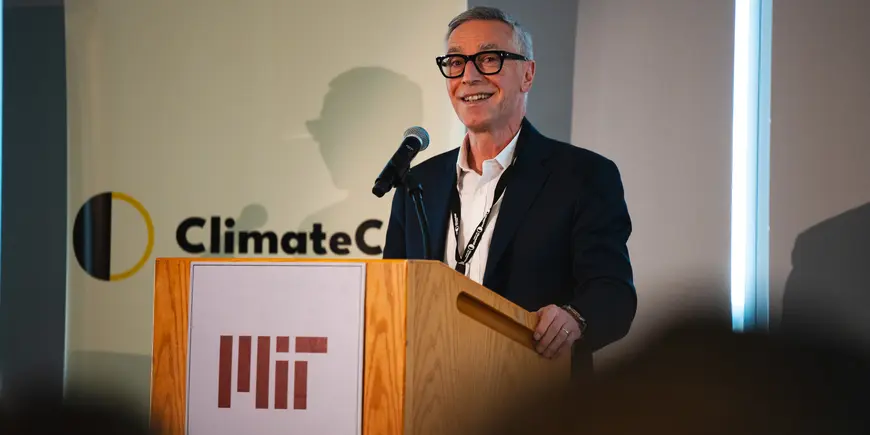
Dean's Welcome MIT Sloan School of Management's John C Head III Dean Richard Locke gives welcoming remarks