Are U.S. Companies Overinvesting in Automation — And Underinvesting in People?
Does the U.S. tax system incentivize companies to overinvest in automation—at the expense of jobs?

If U.S. workers could select the characteristics of a labor organization to represent them, what would they choose? That’s the question explored in an intriguing new journal article by Alexander Hertel-Fernandez of Columbia University’s School of International and Public Affairs, William Kimball of ...
In an economy with many low-wage jobs, employer-provided training can be an important route to upward economic mobility for workers. But which workers receive training? How do workers obtain new skills?
The MIT Task Force on the Work of the Future, an MIT-wide task force recently released its report—and the report includes an extensive focus on improving economic prospects for U.S. workers, particularly those who lack a college education.
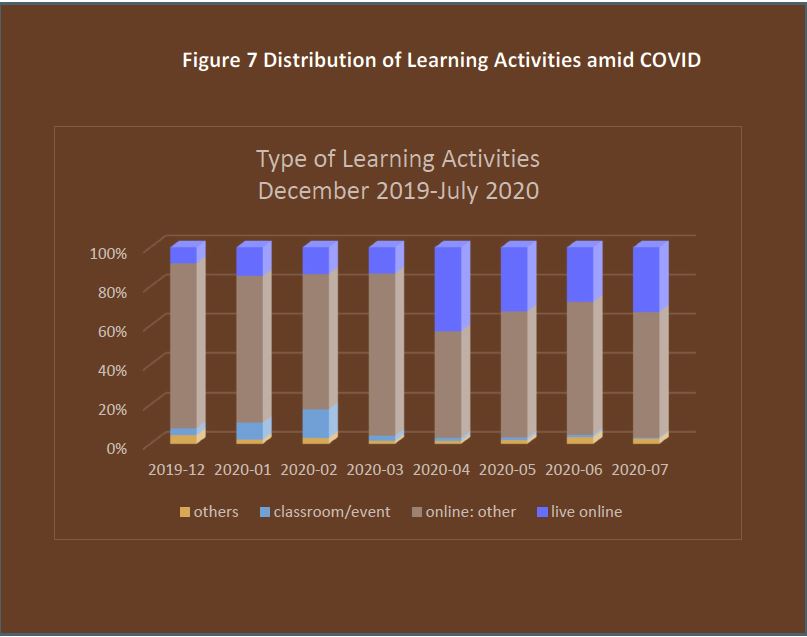
The pandemic has affected the type of learning the IBM employees in the study pursued, as this graph shows, but the researchers found that "overall learning consumption remains high."
At a recent virtual panel discussion organized at MIT Sloan, two industry executives and an MIT Sloan professor focused on the important and timely topic of people analytics, including how people analytics techniques can be used to ameliorate bias within organizations.
Two big shocks, rapid technological change and COVID-19, have recently rocked retail. But the effects on workers have not been uniform.
MIT Sloan MBA student Riddhima Sharma shares insights learned from a panel at MIT Sloan on "Managing with Fairness: The Role of People Analytics."
Income inequality has been increasing in the United States in recent decades, to a level higher than in a number of other comparable economies. But what’s driving that rise?
The future of work will include remote work, but that isn’t all there is to the hybrid model.