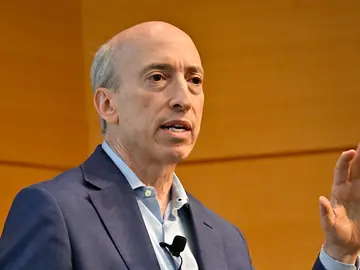
Gary Gensler is Professor of the Practice of Global Economics and Management as well as of Finance at the MIT Sloan School of Management. He conducts research and teaches on artificial intelligence, finance, financial technology, and public policy.
Gensler most recently served as the 33rd Chair of the Securities and Exchange Commission during the Biden Administration. He led the agency through a robust reform agenda to enhance efficiency, resiliency, and integrity in the $120 trillion U.S. capital markets.
Previously, Gensler served as Chairman of the Commodity Futures Trading Commission in the Obama Administration, leading reform of the $400 trillion swaps market. He also served as Under Secretary of the Treasury for Domestic Finance, and Assistant Secretary of the Treasury during the Clinton Administration as well as Senior Advisor to Senator Paul Sarbanes in writing the Sarbanes-Oxley Act (2002). He also was Chairman of the Maryland Financial Consumer Protection Commission (2017-2019).
Gensler co-hosts (with Simon Johnson) the 'Power and Consequences' podcast. He co-edited ‘The Economic Consequences of the Second Trump Administration’ (CEPR Press, 2025) and authored a book on investing for everyday Americans, The Great Mutual Fund Trap, (Broadway Books, 2002).
Prior to his public service, Gensler worked at Goldman Sachs, where he became partner in the Mergers & Acquisition department, headed the firm’s Media Group, led fixed income & currency trading in Asia, and lastly co-headed Finance, being responsible for the firm's worldwide Controllers and Treasury functions.
He is a recipient of the 2014 Tamar Frankel Fiduciary Prize and the US Treasury’s highest honor, the Alexander Hamilton Award. Based on student nominations, he won the MIT Sloan 2019 Outstanding Teacher Award.
Gensler earned his undergraduate degree in economics and his MBA from The Wharton School, University of Pennsylvania.
He has three daughters, and is from Baltimore, Maryland.