
How AI is reshaping workflows and redefining jobs
New research shows that AI delivers the most value when organizations redesign workflows, not just when they automate individual tasks.
Faculty
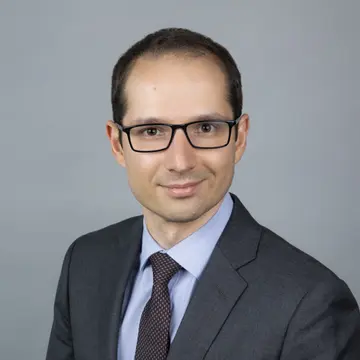
Mert Demirer is the Ford Foundation International Career Development Assistant Professor and an Assistant Professor of Applied Economics at the MIT Sloan School of Management.
Demirer’s main area of research is industrial organization with a particular focus on developing new methods to analyze firm behavior, productivity, and market power. He also conducts research on machine learning for causal inference. This work investigates how to incorporate machine learning tools into econometrics to identify causal effects in economic research.
Prior to joining MIT Sloan, Demirer was a Postdoctoral Researcher at Microsoft Research. He holds a Master’s degree in economics from Koc University and a PhD in economics from MIT.
Featured Publication
"Double/Debiased Machine Learning for Treatment and Structural Parameters."Chernozhukov, Victor, Denis Chetveriko, Mert Demirer, Esther Duflo, Christian Hansen, Whitney Newey, and James Robins. The Econometrics Journal Vol. 21, No. 1 (2018): C1-C68. arXiv Preprint.
Demirer, Mert and Ömer Karaduman. Journal of Political Economy. Forthcoming. Download Preprint.
Cui, Kevin Zheyuan, Mert Demirer, Sonia Jaffe, Leon Musolff, Sida Peng, and Tobias Salz. Management Science. Forthcoming. Download Preprint.
Dubé, Jean-Pierre, John G. Lynch, Dirk Bergemann, Mert Demirer, Avi Goldfarb, Garrett Johnson, Anja Lambrecht, Tesary Lin, Anna Tuchman, and Catherine Tucker. Marketing Science Vol. 44, No. 5 (2025): 975-984.
Chernozhukov, Victor, Mert Demirer, Esther Duflo, Iván Fernández-Val. Econometrica Vol. 93, No. 4 (2025): 1121-1164.
Mert Demirer, Vasilis Syrgkanis, Greg Lewis, and Victor Chernozhukov. In Proceedings of the Thirty-third Conference on Neural Information Processing Systems, Vancouver, BC: December 2019. Supplemental. Download Paper.
New research shows that AI delivers the most value when organizations redesign workflows, not just when they automate individual tasks.
Once again, AI was everywhere. But research about federal spending leads the list.
Research, by assistant professor Mert Demirer, associate professor John Horton, Peyman Shahidi (PhD candidate), and co-authors models production as a sequence of interdependent steps and shows that it is this interdependence that determines the true extent of the gains enabled by AI. "We are seeking to understand the effect of AI at the overall system level, not as a one-off productivity tool applied on a task-by-task basis," said Shahidi.
"I will expect some impact on the legal profession's labor market, but not major," said assistant professor Mert Demirer. "AI is going to be very useful in terms of information discovery and summary," he said, but for complex legal tasks, "the law's low risk tolerance, plus the current capabilities of AI, are going to make that case less automatable at this point."
Experts say the transition to an A.I.-powered workplace is likely to be more gradual, in many cases occurring as new companies, built to exploit A.I., take market share from more established companies that are slower to embrace it. "Widespread adoption is going to happen at the new firms," said assistant professor Mert Demirer. "It's always the case that the smaller the production process, the more the process is easier to change."
A paper co-authored by assistant professor Mert Demirer found that software developers who used an A.I. coding assistant improved a key measure of productivity by more than 25 percent. Demirer said that a software developer's job could change over the longer term, so that the human coder would become a kind of project manager overseeing multiple A.I. assistants.