What you’ll learn:
- AI can participate in negotiations in four positions: in front, beside, behind, or between the parties.
- Each position gives AI different levels of authority and creates different risks for accountability, fairness, and human agency.
- AI can greatly expand access to negotiation practice and feedback, but its most promising uses complement rather than replace human judgment.
Negotiation was once considered the unique domain of humans, but that’s no longer the case. Today, you may encounter AI at your side or across the table, or serving as a mediator in every step of the negotiation process.
For leaders, the question is no longer simply whether to use AI in negotiation. It’s what role AI should play, how much authority it should be granted, and where human oversight must remain in place, according to MIT Sloan School of Management professor Jared Curhan.
“AI is not merely another instrument added to the negotiator’s tool kit. It is a general-purpose technology capable of occupying multiple positions within negotiation systems,” he writes with Vanderbilt professor Jonathan Gratch in the Negotiation Journal. The two co-edited a special issue of the journal that brings together emerging research on how AI is changing negotiation practice, teaching, and research.
Curhan, who is also vice chair for research at the Program on Negotiation (an inter-university consortium of Harvard, MIT, and Tufts), has spent his career studying how negotiators create and claim value, and especially how they foster subjective value — negotiators’ feelings about the outcome, themselves, the process, and their relationship with the other side.
His latest research incorporates AI into the picture, resulting in a framework to understand how this technology is changing not only some of the foundational processes of negotiation but also how the discipline is taught and understood.
Four seats at the table
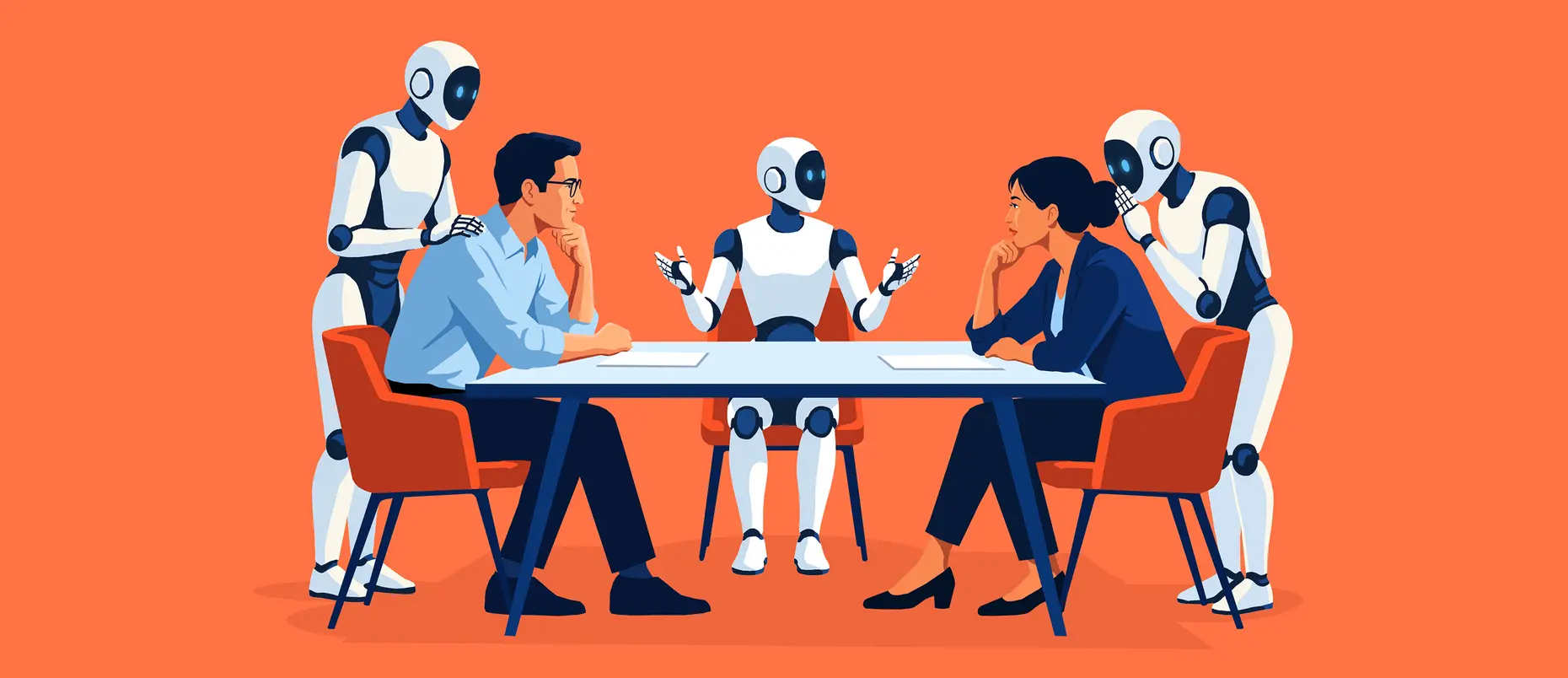
In their paper, “Artificial Intelligence and Negotiation: A Framework for an Emerging Field,” Curhan and Gratch suggest a spatial analogy as the simplest way to understand the four different positions AI might occupy during a negotiation. If the table sits between two negotiating parties, AI can work in the following ways:
- In front, as an agent: AI bargains on behalf of a person or organization, making offers and responding directly to the other side. While earlier automated negotiators relied on rigid decision trees, contemporary systems increasingly combine strategic reasoning with natural language generation, allowing them to justify offers, signal intentions, and manage perceptions of fairness.
- Beside, as a coach: The person remains the negotiator while AI helps with preparation, real-time guidance, and post-negotiation feedback. As Curhan and Gratch note, the transformative promise of AI coaching lies in democratization: Individuals who previously had no access to formal negotiation training now have opportunities to learn and practice with an AI coach.
- Behind, as back-table support: AI synthesizes the sometimes conflicting interests of the team or constituency the negotiator represents; for example, it might summarize where they stand collectively on all of the issues under consideration, or help frame outcomes to maximize the likelihood of reaching a resolution. This role can be particularly important in complex negotiations, such as humanitarian ceasefires, corporate mergers, labor negotiations, or multiparty environmental agreements, in which building internal alignment among constituents may be as challenging as external bargaining.
- Between, as a mediator or facilitator: AI functions as a third party neutral, managing aspects of the process, identifying common ground, and generating possible agreements. While human mediators are limited by time and availability, AI systems can facilitate large numbers of interactions simultaneously. They can analyze conversational patterns in real time, detect escalation, and propose creative options or reframing strategies. They may also introduce procedural safeguards that standardize aspects of fairness.
The roles blur in practice. A single system deployed in the field might combine background analysis with real-time coaching. The seat AI occupies matters because it determines what humans delegate, who remains accountable, and what kind of oversight the system requires. It’s also important to note that each seat presents a different danger: An autonomous agent can blur accountability; a coach can foster dependence; a back-table system can mute minority voices; and an opaque mediator can undermine participants’ trust in the process
A new way to build your negotiation skills
Beyond its use at the negotiating table, “AI is completely transforming the way people learn negotiation,” Curhan said at a recent MIT conference.
Negotiation courses have historically paired students up for live simulations, with a teacher reviewing the process and the outcomes. Although that approach is effective, it is slow and resource-intensive. AI agents could go a long way toward democratizing this work by lowering the resource barrier and providing real-time, individually calibrated feedback, Curhan said.
Negotiation Essentials Sprint: AI-Accelerated Learning
On-Demand Online
Register Now

For example, Curhan and colleagues developed the hourlong Negotiation Skills Assessment in which people answer questions and chat with AI agents, resulting in an analysis of their abilities on three key dimensions: value creation, value claiming, and subjective value. Using that tool, organizations can identify their strongest negotiators, match them to the right deals, and measure to determine whether training is actually improving their performance over time.
Curhan’s new course, Mastering Negotiation With AI, is built around a pair of intensive negotiation “sprints,” with students negotiating against AI counterparts programmed to deploy specific tactics; the students will receive immediate, individualized feedback on their work.
Ready to test your skills against an AI counterpart? Try this negotiation game.
Learners using AI can also reset simulations and repeat the same negotiation scenario to test whether a different approach might produce a better result. “This instant feedback and the coaching we provide is a real game changer for how negotiation is taught," Curhan said. A "time machine" feature even lets students rewind a negotiation to a specific moment and revise what they said to see the ways in which different tactics chart a new course in the negotiation.
Where human judgment still matters
Curhan is careful to describe potential problems alongside AI’s promise. To name two: AI advisers are not neutral in their recommendations — perceived gender can influence its counsel, for example — and the sycophancy baked into AI can leave negotiators overconfident in their positions, ultimately driving a wedge between parties and making agreements harder to reach.
These concerns reflect a key theme of Curhan and Gratch’s framework — and of AI research more generally: The most promising applications are those that expand human capacity while preserving the human judgment that gives negotiated agreements their meaning.
That said, leaders should no longer be thinking about whether AI will enter their negotiations. “That ship has sailed,” Curhan said. “The question now is which seat AI should occupy, and which judgments humans should never give up.”
Negotiation Journal Special Issue: AI and Negotiation
Artificial Intelligence and Negotiation: A Framework for an Emerging Field
Jared Curhan is the Gordon Kaufman Professor of Management and a professor of work and organization studies at the MIT Sloan School of Management, specializing in the psychology of negotiation and conflict resolution. He is also the faculty director of the MIT Behavioral Research Lab. In the MIT Sloan Executive Education program, he teaches Negotiation for Executives, Negotiation Essentials Sprint: AI-Accelerated Learning, and Negotiation Strategy Sprint: AI-Accelerated Learning.
Jonathan Gratch is a research professor at Vanderbilt University’s College of Connected Computing, where he directs the Affective Computing Group. His research develops humanlike software agents for virtual training, therapy, negotiation, and education environments and uses computational methods to give concrete, testable form to psychological theories of human behavior.