
Remembering Robert McKersie, who reshaped how we understand negotiation
McKersie’s 1965 framework for labor bargaining became one of negotiation theory’s most enduring ideas — and helped guide a life of activism, mentorship, and academic leadership.
Robert B. McKersie, a professor emeritus at the MIT Sloan School of Management whose pioneering research on collective bargaining and negotiations is widely credited with shaping the field of industrial relations, died July 11 at the age of 96.
McKersie’s landmark 1965 book, “A Behavioral Theory of Labor Negotiations: An Analysis of a Social Interaction System,” co-authored with his friend Richard Walton, influenced how negotiations are taught, practiced, and studied across the world.
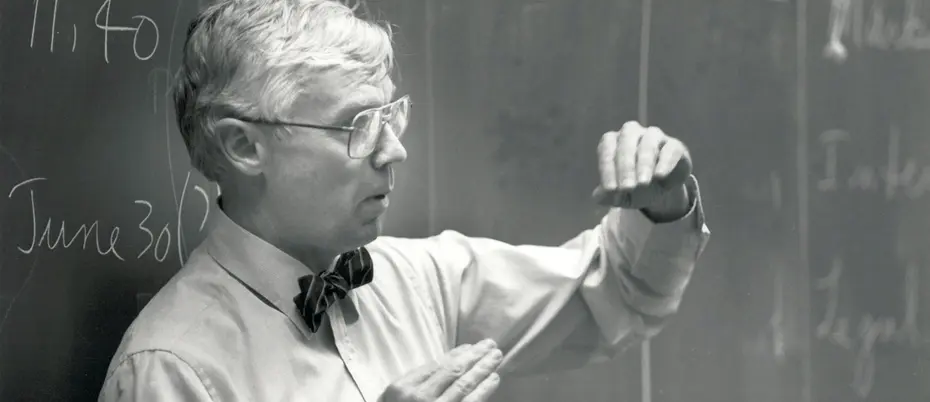
Robert B. McKersie, December 1999
His active participation in the early civil rights movement in Chicago, where he studied and challenged discriminatory employment practices, reflected McKersie’s belief that academic research should contribute to meaningful institutional and social change.
Variously hailed as a distinguished scholar, educator, author, and mentor, McKersie leaves a legacy of ideas and integrity. His friend and colleague MIT Sloan professor emeritus Thomas Kochan once described McKersie as “one of the most important industrial relations scholars and leaders of our time — if not the most important.”
A classic negotiation framework, still applicable after more than 50 years
Begun while McKersie and Walton were doctoral students at Harvard Business School and finished while McKersie was at the University of Chicago and Walton at Purdue, “A Behavioral Theory of Labor Negotiations” introduced the concepts of distributive and integrative bargaining, ideas that remain foundational in negotiation research and teaching throughout the world.
From its detailed description of negotiation tactics to its insights into the importance of mutual affinity between negotiating parties, the framework speaks to nearly any negotiation, not just the labor disputes it was built for.
“The genius of the book is that, though derived from a very careful study of labor relations, it is applicable to every interaction between two or more people that have different points of view,” Mary Rowe, adjunct professor of negotiation at MIT Sloan, said in a 2019 interview about the book’s impact and scope. “That’s just about everybody, all the time.”
“A Behavioral Theory” distills the process of negotiation into four central subprocesses, as McKersie and Walton called them. The first two subprocesses are the closely related notions of distributive and integrative bargaining.
Distributive bargaining refers to situations in which a gain by one side is necessarily a loss for the other. The flip side, integrative bargaining, is where parties come up with innovative ideas to bridge the gap between them. In the case of integrative bargaining, both sides can claim victory by reframing or enlarging the issue under contention. While there had been an intuitive understanding of these distinct aspects of negotiation before “A Behavioral Theory” was published, how they worked and interacted was “crystallized and made famous by Walton and McKersie,” according to a reflection written by Harvard Business School negotiation scholar James Sebenius on the occasion of the book’s 50th anniversary.
“The other two subprocesses, though, were not as well known and were probably where we really plowed new ground,” McKersie said in an interview for the 2019 article. The third subprocess, initially labeled attitudinal restructuring and now referred to as shaping attitudes, maps out the importance of how parties feel during and after a bargaining process. Though subjective, it is an unavoidably material aspect of negotiations, the authors asserted.
The fourth, intra-organizational bargaining, now called internal negotiations, “wasn’t understood at all” before the publication of “A Behavioral Theory,” McKersie said. It accounts for the internal dynamics within each party, which sometimes have a more significant impact on the outcome than what happens at the table itself.
In a 2024 interview conducted by Martha Mangelsdorf for the MIT Institute for Work and Employment Research, McKersie traced the idea to personal experience. “I think the internal negotiation part of our framework was really shaped by my involvement in the civil rights movement,” he said, recalling that the earliest drafts of the book had no internal-negotiations component at all. His own experience navigating the tensions between factions within Chicago’s civil rights movement revealed a second, hidden negotiation running alongside the one at the main table.
McKersie tested the concept in the real world when studying negotiations between the United Auto Workers and International Harvester, which were underway in Chicago at around the same time. Barred from sitting in on the union’s internal strategy sessions, McKersie persuaded UAW representative Seymour Kahan to debrief him after each one, giving him firsthand material for what became the internal negotiations subprocess.
The work also carries implications beyond the realm of negotiation as it is generally defined.
In 1988, political scientist Robert Putnam — who would later be known for his book “Bowling Alone” — cited Walton and McKersie’s framework as the basis for a new way of thinking about international diplomacy. Putnam argued that a diplomat negotiating a treaty is really playing two games at once: one at the table with a foreign counterpart, and another back home, aimed at winning approval from the domestic constituents who must ultimately ratify the deal. He called it a “two-level game.”
And in 2007, the Intelligence Science Board, a U.S. government panel, enlisted McKersie and Walton to help design interrogation protocols for engaging military detainees — techniques that would be effective without compromising human values.
Closer to home, Rowe found the same framework indispensable in a different arena: Reflecting in 2019 on her long career as MIT’s university ombuds, a role centered on conflict management, Rowe said she’d made extensive use of the book’s insights. “I have dealt with thousands and thousands of people who feel they are in a cage, stuck, frozen in place with no options,” she said. “But the tools derived from this book have actually been a great form of solace and comfort to many people facing serious conflict or problems.”
Commemorating A Behavioral Theory of Labor Negotiations
A lifelong commitment to civil rights
In 2015, McKersie and Walton were honored by the Labor and Employment Relations Association at a symposium marking the 50th anniversary of the publication of “A Behavioral Theory of Labor Negotiations,” where the book was described as “a landmark contribution to industrial relations and social science theory, teaching, and practice.”
In remarks later published in Negotiation Journal, the Rev. Jesse Jackson recalled how McKersie was volunteering with Jackson’s community organizing efforts in Chicago at the same time he was working with Walton to develop their behavioral theory of labor negotiations. “He was putting into practice the theory that he was developing at the time,” Jackson said.
Jackson characterized the tension between integrative and distributive bargaining in the scholars’ work as “expanding the pie and dividing the pie,” noting, “We were certainly looking to expand the pie with Chicago area employers, and at the same time there were some tough issues in which we had to engage in hard bargaining. …
“As they document in the last chapter, which was focused in part on civil rights, there were many internal tensions that we had to address,” Jackson said, “from people advocating more militant action and those advocating more collaborative strategies. We had to resolve our internal negotiations before we could be effective externally.”
It was a full-circle moment for McKersie, who, as an assistant professor at the University of Chicago Graduate School of Business, worked with Jackson, then a seminary student, on his Operation Breadbasket economic equity initiative. In a letter to The Boston Globe upon Jackson’s death in February 2026, McKersie said, “It was clear during those early years of the 1960s that he was a brilliant and visionary leader.”
During that period, McKersie studied and then challenged discriminatory employment practices, including those at Motorola. Those early actions planted the seeds for what his family characterized as a “lifelong belief that academic research should contribute to meaningful institutional and social change,” a commitment that McKersie himself documented in his 2013 book, “A Decisive Decade: An Insider’s View of the Chicago Civil Rights Movement During the 1960s.”
Rigorous scholarship and public purpose
After rising through the faculty ranks at the University of Chicago, from assistant to full professor, McKersie joined Cornell University, serving as dean of its Industrial and Labor Relations School from 1971 to 1979. There, he hired and mentored a new generation of faculty members, who introduced modern social science methods to the study of industrial and labor relations.
He joined MIT Sloan in 1980 and served as co-director the Industrial Relations Section, which in 1998 became the MIT Institute for Work and Employment Research.
McKersie served as deputy dean of MIT Sloan from 1991 to 1994 and helped lead a multiyear faculty and student research project on the transformation of American industrial relations, later published as a book co-authored with Kochan and Cornell’s Harry Katz. Together with Max Bazerman, McKersie taught the first-ever negotiation course at MIT Sloan in the early 1980s.
“Bob helped shape IWER around a simple but profound idea: Our best research should never stop at understanding the world of work; it should help improve it,” said Emilio J. Castilla, an MIT Sloan professor of work and organization studies and co-director of IWER.
“Throughout his remarkable career, he demonstrated that rigorous scholarship and public purpose are strongest when they reinforce one another in the service of fairness, opportunity for all, and human dignity,” Castilla said. “That vision continues to define IWER today and remains one of Bob’s most enduring legacies.”
McKersie was also a founding contributor of the Program on Negotiation, a consortium formed by MIT, Tufts University, and Harvard University; served as president of the Industrial Relations Research Association (now called the Labor and Employment Relations Association); and was elected to the National Academy of Arbitrators and the National Academy of Human Resources.
“A transforming effect on every institution”
Into his 90s, McKersie continued to attend faculty meetings and research seminars at MIT, read colleagues’ manuscripts, and discuss emerging ideas with longtime friends and young scholars alike. He traveled this past spring to Cornell to celebrate the career of Harry Katz, and he met at MIT Sloan with Richard Locke, the John C Head III Dean, to discuss the school’s future. “I know I can speak for many when I say that I am grateful for the chance to know and learn from Bob,” Locke wrote this week in a message to the MIT Sloan community.
In 2003, Kochan and David Lipsky, a colleague at Cornell’s ILR School, wrote an essay honoring McKersie’s career. “In McKersie we find a unique blend of intellectual brilliance, visionary leadership, and moral authority,” they wrote. “He has been a role model for countless colleagues, scholars and students … and he has had a transforming effect on every institution with which he has been affiliated.”
Additional reporting by Dylan Walsh
Further reading by and about Bob McKersie
A Behavioral Theory of Labor Negotiations
A classic negotiation framework, still applicable after 50 years
A Decisive Decade: An Insider’s View of the Chicago Civil Rights Movement During the 1960s
A Field in Flux: Sixty Years of Industrial Relations
Negotiations and Change: From the Workplace to Society
Pathways to Change: Case Studies of Strategic Negotiations
Pay, Productivity and Collective Bargaining
Robert McKersie: Integrative Scholar
Strategic Negotiations: A Theory of Change in Labor-Management Relations
The Transformation of American Industrial Relations