What you’ll learn:
- Leading agentic AI transformations requires deep understanding of the technology. Having the right mental model of how AI works under the hood helps leaders move beyond automation to reimagining their business.
- It takes little time to develop an agent; validating its output takes much more. To do it, you need domain experts who are rewarded for their time and expertise.
- Humans tend to conduct work sequentially, one task at a time. Agentic AI requires a shift to working in parallel — managing agents that can perform many tasks at the same time.
This article was adapted from the November 2026 edition of the MIT Sloan School of Management’s monthly AI at Work newsletter. Sign up for AI at Work here.
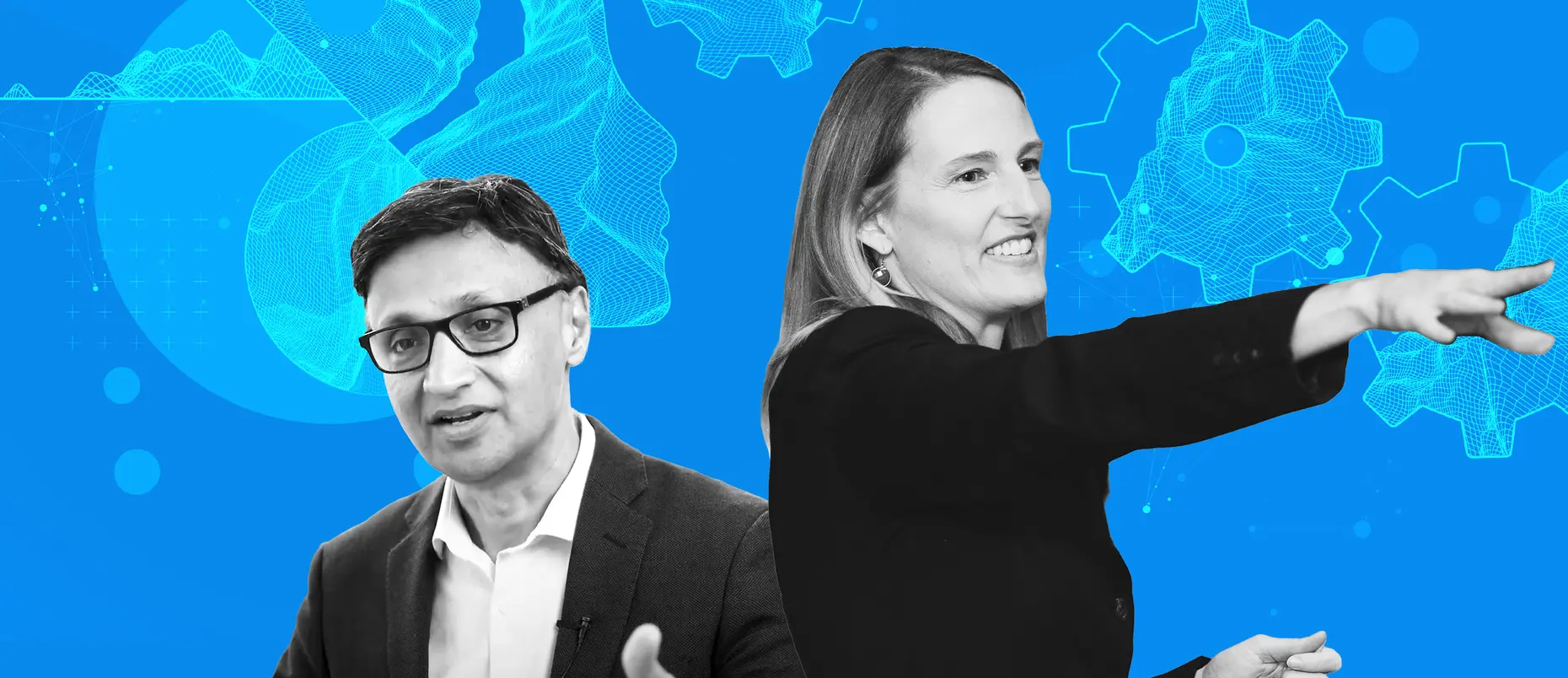
When I talk with professors here at MIT Sloan, I’m always struck by how their ideas stand apart from and above the conventional wisdom that is recycled through professional networks, a glut of business podcasts, and LinkedIn feeds. What’s more, these professors are setting a high bar every day in their teaching, in their work with organizations and leaders, and in their research. Right now, Katherine C. Kellogg and Rama Ramakrishnan are doing this in their work on implementing agentic AI at scale in organizations.
Kellogg, a professor of business administration, is teaching a new MIT Sloan course about leading agentic transformation. It’s based on new case studies she has developed with leaders at major firms in technology, banking, and other industries. And she has a five-phase framework for agentic implementation that focuses on both the technical and human playbooks needed for that work.
Ramakrishnan, a professor of the practice known for his practical talks and decks about using AI, has a new talk called “The 7 AI Mindsets of Highly Effective Executives” (a reference to Stephen Covey’s classic 1989 book “The 7 Habits of Highly Effective People”).
The pair presented last month at Invent the Future: Leading in an AI-enabled World, an MIT Sloan alumni event held on campus. Here’s what stood out in that telling.
You need to understand AI agents at an “atomic level”
If you’re reading this, you probably understand the constantly transformative role technology plays in your industry and your business. That doesn’t always require a deep understanding of how the technology works.
Not so with AI.
“You might ask, ‘Why would a busy executive spend their time understanding … technical stuff?’ Ramakrishnan said. “‘Isn’t it beneath them?’ Well, the reality is that these people have realized that having the right mental model of how AI works under the hood completely changes their ability to go beyond automation to actually reimagining their business.
“They fundamentally understand that a good mental model allows them to achieve this fine balance between being very pragmatic and being very ambitious,” he said. “Because a lot of the things they see in AI projects are not sufficiently ambitious.”
You should invest in your domain experts
It takes very little time to develop an agent. It takes much more to validate its output. And to do that, you still need domain experts.
There’s an imbalance here. Even if you employ the method of having agents validate agents, the most critical outputs still need an expert to check the agents’ work both during development and as the outputs get put into use. When there are more agents in the chain and those agents are working simultaneously, it means more complexity and more validation. That’s a lot of work.
“You need to be rewarding your people for engaging in that kind of effort,” Kellogg said. “And you also need to be staffing projects with fully resourced teams. This can’t be a side-of-the-desk effort for your most important projects.”

Agentic AI: Business Implications and Applications
In person at MIT Sloan
Register now

Kellogg has observed that overworked domain experts will often drop validation first when their to-do lists become too long. That only makes the validation bottleneck tighter.
How to combat this? You can consider validation work in performance reviews, promotions, and rewards. You can create teams dedicated to this high-priority work. And you can move some domain experts into hybrid roles that entail both building and validating agents. Whatever methods you employ, they will require more investment in your people.
You will be managing agents, perhaps more than you manage people
We tend to conduct work sequentially, one task at a time, even if it feels like we’re doing a million things at once. Kellogg noted that agentic AI will require us to work in parallel, using agents that can perform many tasks at the same time. That will cause a substantial shift in how we manage work.
“I don’t want to get too futuristic on you, but you will become managers of agents, not of people,” she said.
“People don’t know how to do that yet. So, what can you do as a leader? You can encourage people to have a growth mindset” so they’re willing to dive in and troubleshoot agent errors, Kellogg said. “The other thing you can do is realize that people need to be running a lot of agents.” That means you need to give them new training, a new job description, and an awareness of what it means to manage agents at scale, she said.
Katherine C. Kellogg is the David J. McGrath Jr. Professor of Management and Innovation at the MIT Sloan School of Management. Her research focuses on helping knowledge workers and organizations develop and implement predictive, generative, and agentic AI systems in everyday work to improve decision-making, collaboration, and learning.
Rama Ramakrishnan is professor of the practice in AI and machine learning at MIT Sloan. His interests center on the application of AI to drive business growth and productivity gains, and in the creation of intelligent products and services.