
What senior leaders want to know about AI
Peter Hirst, the senior associate dean for MIT Sloan Executive Education, has unique insight into how leaders are thinking about artificial intelligence. Themes include:
- Technology shouldn’t overshadow humans. Having a basic understanding of AI is important, but leaders should focus on how it affects organizations, systems, and people.
- AI changes the relationship between IT and the C-suite. Top leaders are driving AI adoption, whereas in the past, the IT department was pushing digital transformation.
- Leaders are facing unpredictable challenges. AI is part of a “bewildering onslaught of change” that is driving executives to seek learning opportunities.
This article was adapted from the May 2026 edition of the MIT Sloan School of Management’s monthly AI at Work newsletter. Sign up for AI at Work here.
MIT Sloan Executive Education launched its first AI-focused course — Artificial Intelligence: Implications for Business Strategy — in 2017, and it’s been consistently popular since then.
Nine years ago, however, executives were focused on the role of AI as part of larger digital transformation. Today we’re seeing an explosion of demand for learning about AI specifically, from the basics to specific topics, such as robotics, adopting AI at scale, and understanding the implications for the workforce.
More than 20,000 leaders and managers at every level and from a wide variety of industries attend MIT Sloan Executive Education courses each year to deepen their knowledge about important topics and connect with MIT experts and industry leaders. That gives the senior associate dean for Executive Education at the MIT Sloan School of Management, unique insight into how leaders are thinking about AI. Hirst, who has led Executive Education for 19 years, sees who is seeking lifelong learning, their concerns, and what skills they want to learn.
And what leaders are interested in is changing, evolving from a basic understanding of AI to how to adopt and scale the technology and manage its workforce implications.
“[Demand for AI education] now shows up at our door as a request to ‘help us understand, help us think about AI, help us implement it, and help us manage the implications and the consequences,’” Hirst said. “And it’s every part of that journey as well, because different companies are in different stages.”
I spoke with Hirst recently about how leaders are thinking about AI. Here are some insights he shared.
Leading in the age of AI isn’t (just) about tech — it’s about managing humans
A basic understanding of technology is important, and many Executive Education courses encourage participants to experiment with AI, including building AI agents. But technology changes, and leaders don’t need to understand AI technology at a deep level — in fact, it can be a distraction. Executive courses focus on “organizations, systems, and people, and the role for all of those in the future of each of the businesses that we’re working with,” Hirst said. Leaders are learning ways of thinking about and understanding what’s going on with technology, which helps them keep up with the rapid pace of change.
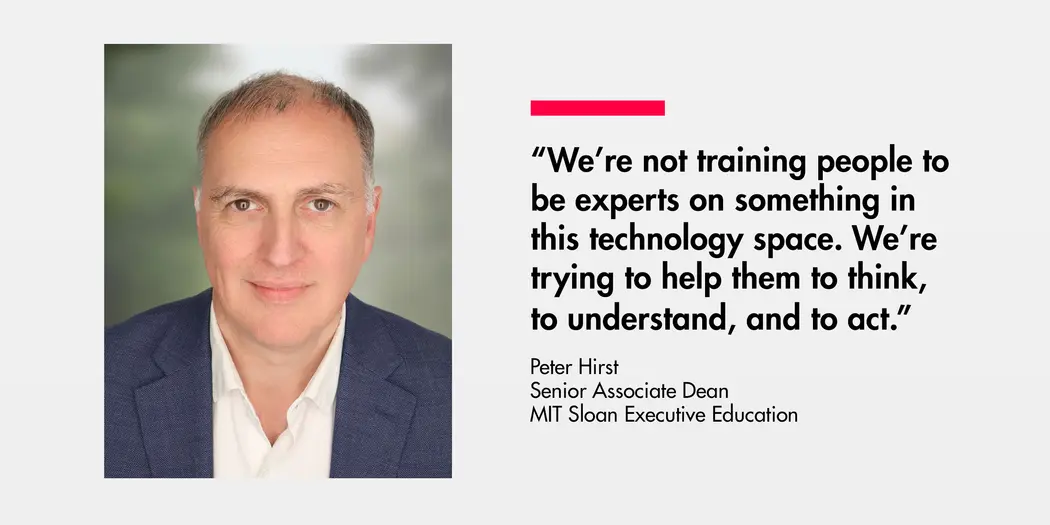
Executives might be surprised to come to MIT and “spend all this time talking about who we are as leaders and what are the human aspects of what we had thought of as just being all about the technology,” Hirst said. “We’re not training people to be experts on something in this technology space. We’re trying to help them to think, to understand, and to act.”
AI has changed the relationship between leaders and IT departments
Leaders might not need to know all about the technology, but they must manage people who have a real understanding of AI and how to implement it successfully and securely. “We’re trying to make [executives] better-informed leaders and consumers of the AI advice and services that they’re getting from their organizations and from their teams,” Hirst said.
Senior business leadership now has the driving role in AI adoption, he said, whereas in the past, the IT department was often trying to push digital transformation. While technology and IT people still take classes, non-IT executives are seeking to learn how to guide their IT departments into AI adoption.
“The IT organizations are often — quite appropriately, I would say — resistant to some of these opportunities and these changes because there are a lot of unknowns,” Hirst said. “There’s a fast pace of change; there are a lot of perceived and actual risks. Are we exposing sensitive data? Are we leaking our ideas? Are we misappropriating intellectual property without realizing it in ways that [are] going to come back to haunt us as well?”
The weight of such concerns can put IT departments in challenging situations. As leaders encourage AI use, they should be aware of this tension.
It’s a tough time to be a leader
Leaders are grappling with a “bewildering onslaught of change” that can be overwhelming, Hirst said. They’re asking two big questions: How does AI change how I should think about business? And what does it take to actually drive AI use and adoption instead of reacting to it?
At the heart of these questions: Organizations and leaders are seeking to be fully informed as they make deliberate choices about how they want to move forward with AI, and about the role of people and machines in that future.
C-suite leaders are hungry to learn more about AI
The most senior-level executives used to be relatively rare in Executive Education courses, Hirst said. But these days, people with C-level jobs in large companies are taking weeklong in-person courses, and the MIT team is also being asked to lead custom courses about AI and its implications for boards and C-suites.
Hirst said that the answer might be partly psychological — it’s not threatening for people in senior roles to admit that they don’t know much about AI, because it’s such a new and evolving technology.
“A lot of our faculty are saying boards and leaders really need to understand and know the use cases of AI, and technology more broadly enabled by AI,” Hirst said. “So the fact that people are showing up in pretty significant numbers in our programs from those levels of large organizations suggests that they understand that … and they are trying to do something about it.”
Executive Education courses to explore:
AI Executive Academy, a two-week program offered jointly by MIT Sloan and the MIT Schwarzman College of Computing, looks at the business and technical aspects of AI, from machine learning and natural language processing to AI workflows, business strategy, and ethics.
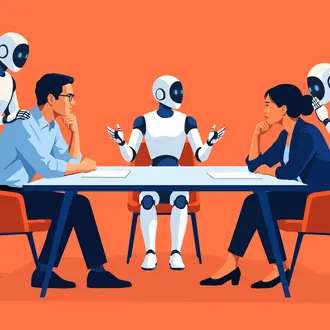
The new course Agentic AI: Business Implications and Applications will help leaders approach the idea of having AI “teammates” embedded in organizations.
Strategy, Survival, and Success in the Age of Industrial AI offers leaders guidance on embracing AI along with other Industry 4.0 technologies, such as digital twins and augmented reality.
Peter Hirst is senior associate dean, Executive Education, at the MIT Sloan School of Management. He leads a team of professionals who partner with clients and faculty members to design, develop, and deliver innovative and impactful executive education programs for individuals and companies. He has over 30 years of experience in international strategy, technology consulting and organizational leadership and development.