The Rise of the “Disposable” American Worker
The transformation of employment has left roughly one-third of the U.S. workforce without job security, according to a new book by MIT Sloan School of Management professor Paul Osterman.
Faculty
Paul Osterman is a Professor Emeritus of Human Resources and Management at the MIT Sloan School of Management as well as a member of the Department of Urban Planning at MIT. From July 2003 to June 2007 he also served as Deputy Dean at the MIT Sloan School.
His research concerns changes in work organization within companies, career patterns and processes within firms, economic development, urban poverty, and public policy surrounding skills training and employment programs.
Osterman has been a senior administrator of job training programs for the Commonwealth of Massachusetts and has consulted widely for government agencies, foundations, community groups, firms, and public interest organizations.
His most recent book is Who Will Care For Us: Long Term Care and the Long Term Workforce (Russell Sage,2017). Other recent books include Good Jobs America: Making Work Better for Everyone (Russell Sage, 2011); The Truth About Middle Managers: Who They Are, How They Work, How They Matter (Harvard Business School Press, 2009); Gathering Power: The Future of Progressive Politics in America (Beacon Press, 2003),; Securing Prosperity: The American Labor Market: How It Has Changed and What to Do About It (Princeton University Press, 1999), and Working In America: A Blueprint for the New Labor Market (MIT Press, 2001).
Osterman is also the author of Employment Futures: Reorganization, Dislocation, and Public Policy; Getting Started: The Youth Labor Market; The Mutual Gains Enterprise: Forging a Winning Partnership Among Labor, Management, and Government; and Change At Work. He is the editor of two books, Internal Labor Markets and Broken Ladders: Managerial Careers in the New Economy. In addition, he has written numerous academic journal articles and policy issue papers on topics such as labor market policy, the organization of work within firms, careers, job training programs, economic development, and anti-poverty programs.

Osterman, Paul. Cambridge, MA: Harvard University Press, 2026.
Osterman, Paul. Review of Our Least Important Asset: Why the Relentless Focus on Finance and Accounting Is Bad for Business and Employees, by Peter Cappelli. ILR Review, August 2024.
Osterman, Paul. ILR Review Vol. 77, No. 3 (2024): 366-395.
Osterman, Paul. ILR Review Vol. 76, No. 2 (2023): 320-356.
Osterman, Paul, Nichola Lowe, Bridget Anderson, Joe William Trotter, Natasha Iskander, and Rina Agarwala. ILR Review Vol. 75, No. 5 (2022): 1348-1368. Download Paper.
Osterman, Paul. ILR Review Vol. 75, No. 3 (2022): 578-607. Download Paper.
The transformation of employment has left roughly one-third of the U.S. workforce without job security, according to a new book by MIT Sloan School of Management professor Paul Osterman.
MIT Sloan’s Paul Osterman argues that the rise in gig workers, freelancers, contractors, adjuncts, and other contingent workers carries long-term implications for the future of work.
Professor Emeritus Paul Osterman wrote: "Employers have strong financial incentives to classify workers as independent contractors rather than employees even where the practical reality of the work relationship closely resembles traditional employment. The disputes that have followed reveal not just a legal ambiguity but a policy system struggling to keep pace with how work has actually changed. A straightforward [solution] would be federal adoption of the ABC rule, already in use by over thirty states to define employee status for state employment rules and for programs related to minimum wages, unemployment insurance, and workers' compensation."
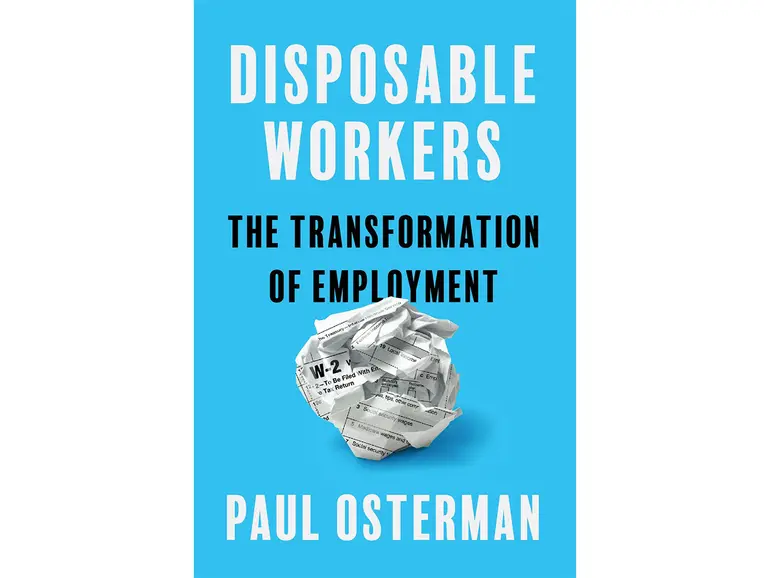
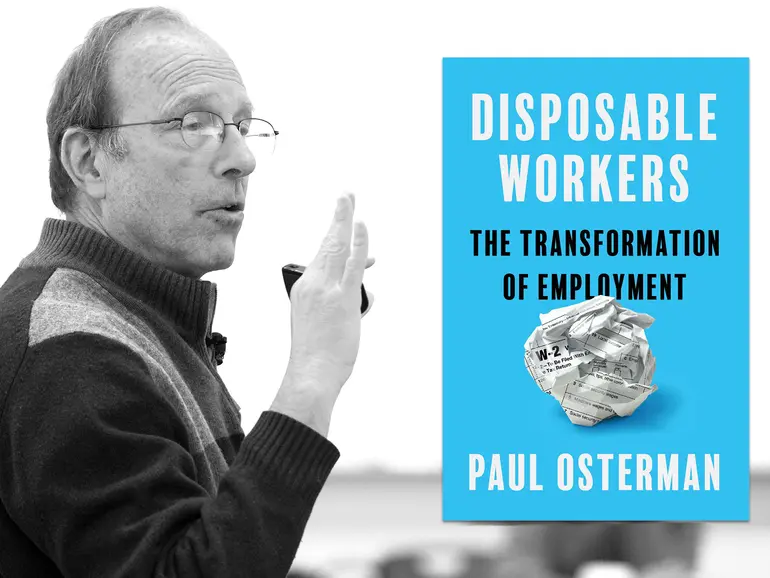
In his new book "Disposable Workers: The Transformation of Employment," Professor Emeritus Paul Osterman highlighted how employers are already becoming less committed to workers, with 35% of current employees falling into a category he describes as "disposable." "Examples of [marginal workers] are adjunct faculty or staff attorneys who do the grunt work in law firms, but will never be considered for partner. These are high-turnover jobs with no future in the organization. These people get the work done for organizations, but the organizations make no commitment to them. They're disposable," he said.
Professor Emeritus Paul Osterman wrote: "People who have [disposable jobs] work at an employer's site, but their employer makes no commitment to them regarding career prospects or job security. My research shows that employers treat more than 1 in 3 U.S. workers as disposable. That comes to just under 57 million full- or part-time workers out of the nation's workforce of 162 million."
"Do we need more people? Do we need fewer people? We have no idea. Nobody has a clue," wrote Professor Emeritus Paul Osterman in the forthcoming book "Disposable Workers." He added that companies treated workers as expendable and got rid of them when it was convenient. Osterman expects this trend of precarious work to continue during this period of change. "Artificial intelligence introduces a lot of uncertainty among employers who do not know what they need and what they do not need," he said.