By Alexandra Diaz Arias, SFMBA ‘26
The first analytical model I ever built wasn't designed in a boardroom. Working as a field engineer, I could see a gap between what advanced technology could do and what it was actually delivering on the ground—so I built a tool to close it, translating technical capability into measurable outcomes across system yield, energy efficiency, and labor productivity.
Alexandra Diaz Arias, SFMBA '26
That gap became the defining thread of the decade that followed. In leading cross-functional teams across geographies and increasingly complex environments, I developed a repeatable approach: aligning engineers with operators, operators with executives, and executives with regulators, all while keeping a clear line of sight to business impact. Over time, I came to understand that the bottleneck in energy transformation is rarely the technology itself. It’s the system surrounding it.
In complex systems, impact is not defined by the strength of individual components, but by the ability to integrate them into coordinated action.
Ten years after building that first tool, I came to MIT Sloan with a sharper question: how do you scale this approach across an entire ecosystem, at a moment when global energy challenges are becoming more urgent and interconnected than ever?
It was here, through the lens of system dynamics developed at MIT Sloan, that I articulated a framework that had long guided my instincts. Complex transformation operates through three interconnected reinforcing loops:
- The innovation loop, where innovation intensity drives solution performance and measurable impact.
- The business loop, where demonstrated impact builds economic viability, stakeholder commitment, and deployment at scale.
- The learning loop, where deployment at scale generates operational learning that improves solution performance, coupling execution back into innovation and compounding impact over time.
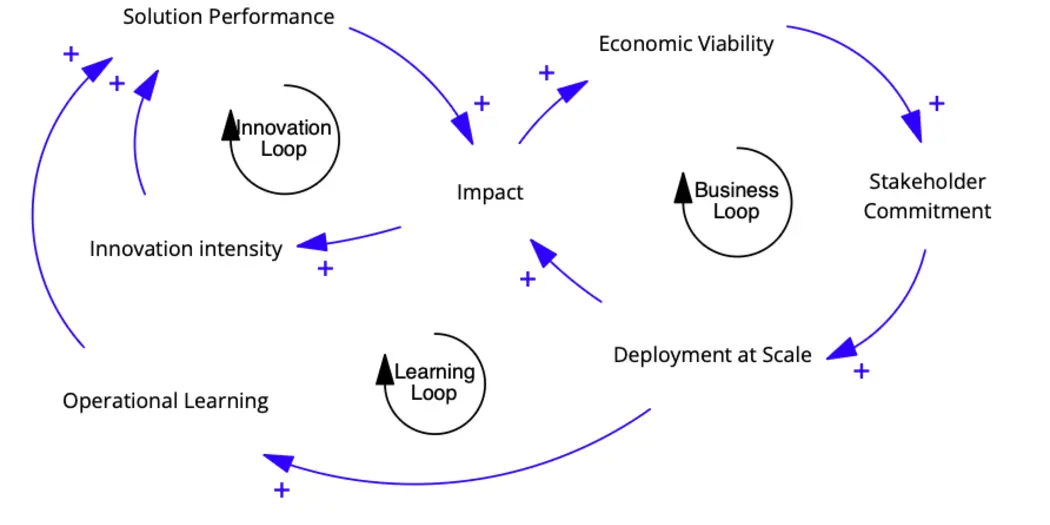
Reinforcing innovation, learning, and business feedback loops interact to amplify impact, linking solution performance, operational learning, and economic viability to sustained stakeholder commitment and scaled deployment.
When these loops operate in isolation, transformation stalls. When they reinforce each other, they create a compounding system that accelerates the translation of innovation into real-world impact. MIT gave me the language and the community to put this framework to work at a new level of scale.
The MIT Sloan Fellows MBA, in particular, creates the conditions for this kind of integration, bringing together experienced leaders and connecting them across MIT’s broader ecosystem in ways that accelerate both learning and execution.
The opportunity to apply this thinking came through my role as one of four Co-Managing Directors of the MIT Energy Conference, one of the largest student-led energy platforms in the world. The event convened leaders across industry, academia, and policy around a central question: How do we secure reliable, affordable, and resilient energy so that humanity may continue to flourish?
Drawing on the ecosystem-driven innovation framework developed by Fiona Murray and Phil Budden at MIT Sloan, we structured the conference to deliberately activate the MIT innovation ecosystem alongside a global energy community—connecting MIT departments, corporate partners, innovators, policy makers, risk capital, world-renowned faculty, and students around shared challenges, designed to surface trade-offs and accelerate pathways from insight to implementation.
Seventy-two hours before the event, that system was tested. A severe winter storm forced the closure of MIT's campus and disrupted global travel. Our team transitioned the entire conference to a fully virtual format, preserving content and engagement. The conference convened over 150 organizations, 40 universities, and more than 100 volunteers, demonstrating that the strength of an innovation ecosystem is defined by its ability to adapt under pressure.
For me, the conference was a personal convergence—more than a decade of field experience deploying advanced technologies, scaled through an ecosystem. MIT was where those two things met.
The energy industry is entering a period of profound structural change. The rapid expansion of AI and data center infrastructure is reshaping electricity demand in ways existing grids were not designed to handle. Accelerating demand across emerging economies is intensifying competition for natural resources, critical materials, talent and capital. These are not problems that better technology alone will solve.
They require leaders who can operate across the full transformation system, understanding the technical architecture of AI and energy, translating it into business and regulatory realities, and executing in complex environments where misalignment is the norm. That is the work I am returning to: leading transformation inside large energy organizations, applying the blueprint of ecosystem-driven innovation to make energy systems more intelligent, resilient, and capable of meeting the demands ahead.
Alexandra Diaz Arias is a member of the MIT Sloan Fellows Class MBA of 2026 and served as Co-Managing Director of the 2026 MIT Energy Conference. Her current work focuses on the deployment of artificial intelligence in complex energy systems across the world.