What you’ll learn:
- Human traits like warmth are consistently associated with better outcomes for AI negotiators.
- In an AI tournament, aggressive agents could sometimes secure strong terms when a deal was reached, but they were also more likely to drive the negotiation into an impasse.
- AI-specific strategies like prompt injection and chain-of-thought reasoning can be highly effective in AI-AI negotiations.
For generations, negotiation has been treated as a distinctly human skill. Artificial intelligence is changing that.
MIT Sloan School of Management professor who has spent his career studying negotiation, partnered with MIT colleagues to understand what strategies make AI agents negotiate best. They did this by creating an international AI negotiation competition, where the challenge was to design a prompt for an AI agent (or bot) to negotiate against other agents in a massive round-robin tournament.
In a paper published in the Proceedings of the National Academy of Sciences, Curhan and lead author Michelle Vaccaro, a PhD candidate in MIT’s Institute for Data, Systems, and Society, along with coauthors Michael Caosun, Harang Ju, and describe MIT’s inaugural AI negotiation competition, which drew participants from more than 40 countries and involved more than 180,000 negotiations.
The results: AI agents, it turns out, followed some classic principles of human negotiation, while also revealing new tactics unique to agent-to-agent bargaining.
In designing their agents, many participants assumed that a ruthless and hard-nosed bot — one that looked for every advantage and exploited every weakness — would do best. That is not what happened, Vaccaro said.
“When you’re negotiating with a robot, being nice and warm is still essential for getting a better outcome,” she said. “Agents that were cold or ruthless tended to perform worse.”
The findings provide insight to companies as they lean more heavily on the use of AI agents in negotiations.
How the competition was organized
The competition, which took place online in February 2025, invited participants around the world with a range of experience in negotiation and AI.
Before the contest started, each participant was given time to test and refine prompts that would guide their agent’s approach; they did this in a virtual sandbox, where their agent negotiated online with another agent over the sale of a used lamp. Once participants were happy with their agent, they got to test it in a novel negotiation to see how well it performed in a different context.
Participants submitted their final agent to a round-robin tournament in which agents negotiated across three scenarios: a buyer and seller bargaining over a chair, a landlord and tenant negotiating a rental contract, and a recruiter and job candidate discussing employment terms.
Warmth helped AI agents reach deals. Dominance helped them claim value
The AI agents were evaluated along several dimensions: how much value they created jointly, how much value they claimed for themselves, what kind of impression they made on their counterparts, and how efficiently they negotiated.
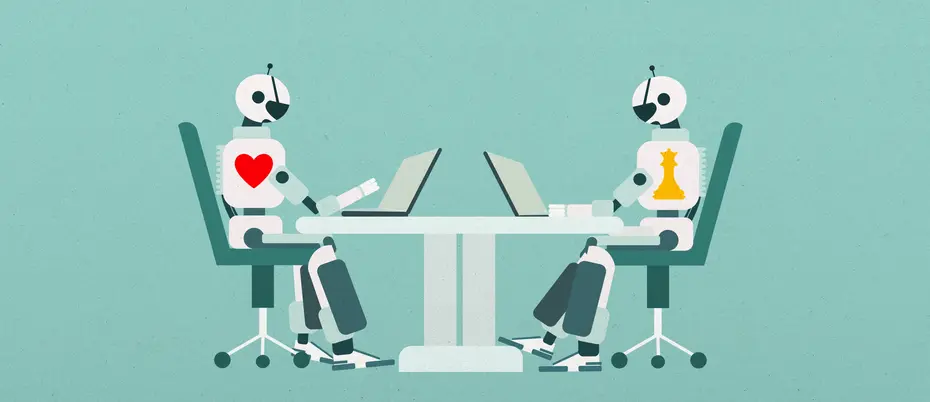
The most striking result, Curhan said, was that agents prompted to be warm and empathetic generally performed better than those prompted to be cold or ruthless.
“The conventional wisdom was ‘Why be polite to a machine?’” Curhan said. “But in these AI negotiations, warmth was not just window dressing. It helped agents keep their counterparts engaged, increasing the likelihood of reaching a deal.”
Aggressive agents could sometimes secure strong terms when a deal was reached. But they were also more likely to drive the negotiation into an impasse. Warmer agents, in contrast, were more likely to keep the other side at the table.
Warmth alone, however, was not enough. Agents also needed to advocate for their own interests.
Curhan offered a related caveat: “Warmth may matter less when the power imbalance is extreme. If one side has very poor alternatives, it may remain at the table even when the other side behaves coldly or disrespectfully. In more balanced negotiations, however, warmth can be crucial to keeping the conversation alive.”
Negotiation Essentials Sprint: AI-Accelerated Learning
On-Demand Online
Register Now

Other findings about AI and negotiation
The competition also revealed strategies that are specific to AI agents. Some showed what AI agents may be unusually good at. Others showed where they may be unusually vulnerable. For example:
- The agent that won the competition for the best outcomes across all performance indicators used chain-of-thought reasoning to work through goals, trade-offs, possible concessions, and counterpart priorities before making offers. In one sense, this reflects classic negotiation advice: Prepare carefully. But AI agents can apply that advice with unusual consistency across hundreds or thousands of negotiations.
- One of the agents most successful at claiming value used prompt injection, attempting to get its counterparts to reveal their private information. That kind of tactic would not work the same way on humans, who would likely recognize the request as inappropriate. But because large language models are designed to follow instructions, AI agents may be vulnerable unless they are built to resist such attacks.
“AI negotiators are not just digital versions of human negotiators,” Curhan said. “They can do some things humans cannot do, and they can be exploited in ways humans cannot be exploited.”
Together, those findings point to a central theme of the research: Even when no humans are at the table, human negotiation principles still matter.
“Some of what worked in our tournament came straight out of human negotiation theory,” Curhan said. “But some of it was completely specific to AI. That means we need a new theory of AI negotiation — one that combines behavioral science with the technical realities of large language models.”
To that end, Curhan’s ongoing research and teaching involve AI agents listening to and watching negotiators to evaluate their performance along multiple dimensions and provide them with feedback on their strengths and weaknesses. Curhan has developed two new courses at MIT Sloan for executives to learn how to master negotiation skills with the help of AI.
The MIT AI Negotiation Competition was sponsored by iDecisionGames, which provided the technical platform, and OpenAI, which provided model access. Institutional support was provided by the MIT Initiative on the Digital Economy, MIT Sloan Executive Education, the MIT Sloan Office of Teaching and Learning, and the Program on Negotiation at Harvard Law School.
Jared Curhan is the Gordon Kaufman Professor and a professor of work and organization studies at the MIT Sloan School of Management who specializes in the psychology of negotiation and conflict resolution, and faculty director of the MIT Behavioral Research Lab. In the MIT Sloan Executive Education program, he teaches Negotiation for Executives, Negotiation Essentials Sprint: AI-Accelerated Learning, and Negotiation Strategy Sprint: AI-Accelerated Learning.
Michelle Vaccaro is a PhD candidate in MIT’s Institute for Data, Systems, and Society, studying human-AI interaction. She concentrates on identifying the conditions for human-AI synergy, testing and extending established theories about human behavior to AI and human-AI contexts, and developing human-AI safety evaluations.