What you’ll learn:
- Alumni panelists emphasized that AI fluency is becoming a baseline job requirement, while critical thinking, adaptability, and the ability to use AI strategically remain key differentiators.
- Gary Gensler urged attendees to identify where AI creates competitive advantage, stay grounded in business fundamentals, and continually develop their own skills.
- Eric So warned that while AI offers powerful efficiencies, overreliance can erode learning, problem-solving, and independent thinking.
Featured Experts


Artificial intelligence (AI) was the most widely discussed, and hotly debated, topic at MIT Sloan Reunion 2026. Alumni were particularly interested in how to handle these rapid changes and stay ahead of the curve.
Across an alumni panel and two faculty talks, presenters distilled their experience and work into concrete, scalable advice for attendees. Their insights ranged from the practical to the esoteric, from its most immediate applications to an exploration of its upper limits.
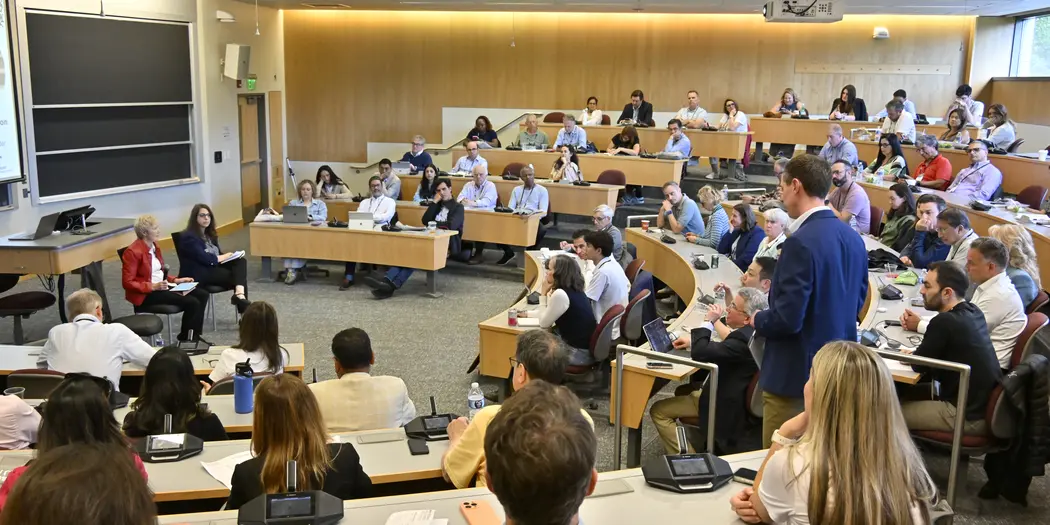
Moderator Chris Mannion, MBA ’16, fields audience questions to panelists Luda Kopeikina, SF ’90, Robin Ganek, MBA ’15, and Wendi X. Zhang, SB ’09 (offscreen).
Credit: L. Barry Hetherington
Market ready in the age of AI
The labor market is evolving rapidly, thanks to AI—and that influence is trickling down to every aspect of the hiring process. Moderator Chris Mannion, MBA ’16, founder of Meander Talent Academy, and alumni panelists advised the audience about how to understand AI as a driving disruptive force in workplaces, and how to use it to one's advantage.
Luda Kopeikina, SF ’90, CEO of Women Applying AI and managing partner at Noventra Ventures, noted that as AI transforms the workplace, hiring managers’ requirements for potential hires have increased. She referenced the Cloudflare CEO Matthew Prince’s recent Wall Street Journal opinion piece, wherein he justified cutting 20 percent of his staff with the idea that AI empowered his sellers and builders, but drastically reduced the need for measurers (including operations, compliance, finance, legal, and middle management).
In her experience, Kopeikina said, “Enterprises are now hiring people who are versed in AI across the board ... it has become a screening criterion. Also, for the positions where AI is needed, they look for builders ... [someone] who can develop an agent to perform tasks versus use a chatbot.”
By contrast, noted Wendi X. Zhang, SB ’09, leadership advisor, there’s uncertainty and experimentation at the corporate level: “Everyone’s trying to figure it out. No one has the perfect answer for how to deploy AI—in any company.” She added that many organizations have learned through trial and error: “Plenty of people have also tried to deploy AI, and they learn, ‘Oh, this really didn’t work,’ or ‘Hey, we let go of people too early, and we realized we had to hire them back.’”
Zhang’s broader point was that most organizations are still experimenting, learning, and adapting as the technology—and the ways to use it effectively—continue to evolve.
According to Robin Ganek, MBA ’15, vice president of people at Lexington Medical, Inc., “[AI] democratizes access to certain types of information. But to use any of it well, you have to have context. You can’t do it completely in isolation of the outcome that you’re trying to achieve.” AI has changed criteria for evaluating candidates, but some criteria never change. She added, “I’m always looking for great raw material. I continue to believe that everyone can be taught to do something new, but also, I’m looking for people who can think critically about the information they are receiving and validate how they are using it.”
Ganek asks job candidates how they used AI to prepare. The worst answer is the one she gets most frequently: using AI to proofread a resume. A more interesting answer is not using AI at all and doing research without it, but the best answer, in her opinion, would be utilizing AI to deepen research and preparation.
“You can upload your resume and the job description into AI and have it prepare you for what we’re likely to ask you about your experiences, or gaps on your resume that we’re likely to probe on. You can put your interviewers into AI and say, ‘What are a couple of good questions that I could ask them, or what should I know about this company from the last five years?’” she added.
All three panelists agreed: Participants should start wrapping AI up in their work and experimenting with its capabilities. As Kopeikina noted, executives remain results-focused and are working on using AI to differentiate their companies from competitors. Those hoping to be hired should keep that in mind.
“Dig deep into your skills. Then ask yourself, or your friendly bot: ‘How can I do much better, or differentiate with AI with these skills? How can I outperform everybody else?’... Then work with AI to figure out what AI capabilities you need to put [you] on that pathway.”
AI is like a bucking bronco. You’ve got to figure out as an individual how to ride it. And I do say to students, you have to lean into professionalism. It’s tech neutral. Prep, make lists, stay curious, learn every day.
AI and money
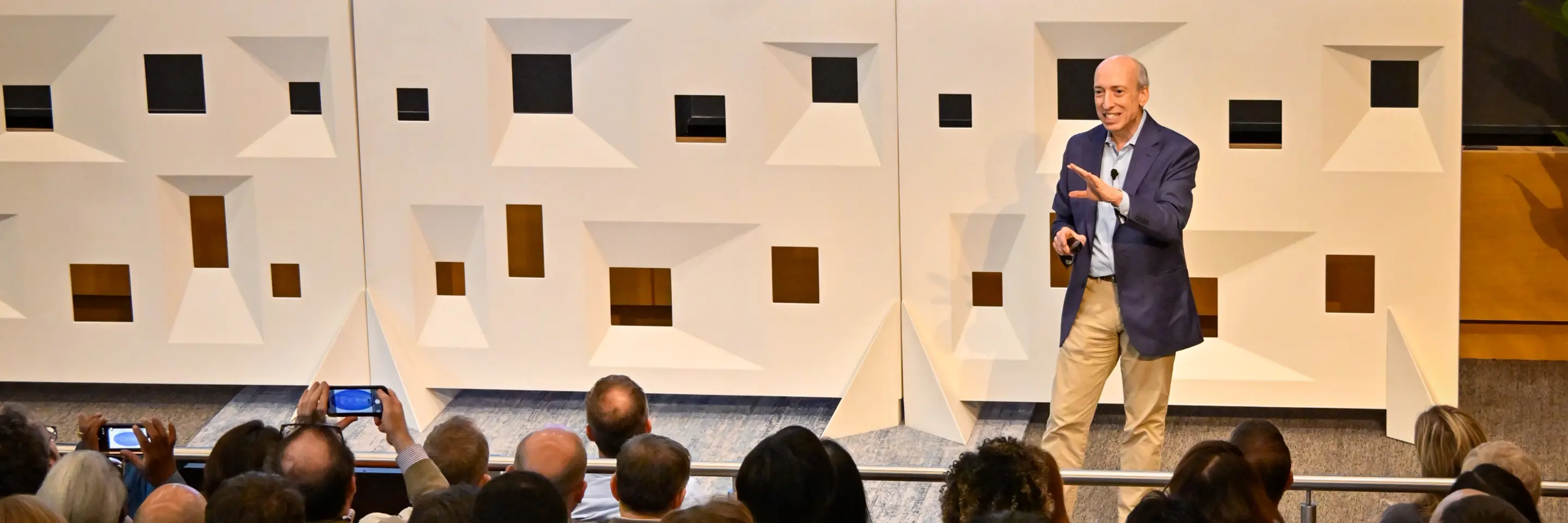
Gary Gensler (Professor of the Practice, Global Economics and Management; Professor of the Practice, Finance) spoke to alumni about the intersection of AI and finance, particularly through the lens of investment. Its effects are widespread and evolving.
“It’s not just how AI is influencing finance—and it is—it’s changing how we do automobile underwriting, insurance underwriting, and how we trade: high frequency trading more than how we individually trade,” said the former Chair of the U.S. Securities and Exchange Commission.
Unlike some pundits, Gensler said he believed it would take time for AI to truly transform business. “It really took Henry Ford about 25 years to figure out: ‘Let’s re-envision the factory floor.’ ... I think there’s a lot of re-envisioning that’s going to need to go on.”
Furthermore, for those thinking about AI implementation, he noted that existing tools may even offer a version of the same efficacy. “I’m not saying you can ignore large language models, but if you run a business and you can get what you need performance-wise out of machine learning, deep learning, and feature extraction, it will be a lot cheaper,” he said.
He wouldn’t definitively offer an opinion about whether we’re in an AI boom or bubble, but he identified some context. Unlike Chinese models, which are open weight which may diffuse AI technology through their economy and standardize more quickly, American model companies are largely offering closed large language models.
“It’s financially not sustainable. You cannot spend $750 billion a year building data centers and only bring in $100 to 150 billion in revenues ... So, they either have to charge a heck of a lot more or OpenAI and Anthropic and Google have to figure out how to get more ad revenues,” he said.
Gensler advised the assembled audience about AI in the same way that he advises his students: Identify value creation opportunities and one’s comparative strengths, instead of looking at hype. Establish a strategy relative to a competitive baseline. Then, figure out what’s table stakes (the minimum requirements for buy-in) and what’s the comparative advantage.
All the while, “continuously train your most powerful processor—your brain,” he said, particularly in these volatile times. “AI is like a bucking bronco. You’ve got to figure out as an individual how to ride it. And I do say to students, you have to lean into professionalism. It’s tech neutral. Prep, make lists, stay curious, learn every day.”
We’re not gradually adapting to AI. I think we’re colliding with it. In physics, when objects collide, they often create something entirely new, something that transforms the fundamental nature of both. That’s what’s happening to how we think, to what we remember, to how we relate with other people.
How AI is reshaping what we learn, remember, and believe
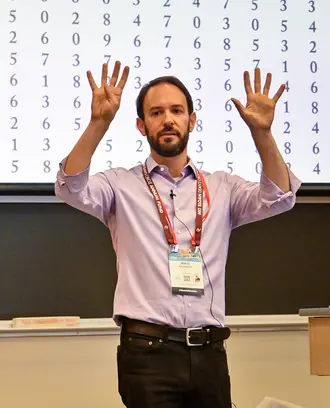
The most cautionary message came from Eric So (Sloan Distinguished Professor of Global Economics and Behavioral Science), who serves as faculty co-director of MIT Sloan Executive Education’s AI Executive Academy. He first noticed that his relationship to his own thinking had changed when he used AI to complete a task in a way that wouldn’t just make the task easier but replaced the act of thinking.
“It didn’t feel like a loss; it felt more like convenience,” he remembered thinking. “Tackling a hard problem used to be the work, it used to be the thing that I did that built something that I felt proud of. The work was not just the output; it was the effort that was required. Now, increasingly, it felt like a choice, and particularly an eccentric one in this age of AI.”
He noted that there were several factors contributing to the rapid rise of AI, ranging from the human brain’s desire to conserve energy to societal pressure and convex payoffs that led to a “winner take all” mentality. Now, he explained, AI has become a professional “arms race,” where it’s disadvantageous to not use it when all your competitors are.
“We’re not gradually adapting to AI. I think we’re colliding with it,” he explained, citing his forthcoming book The Collision: What AI Does to Us. “In physics, when objects collide, they often create something entirely new, something that transforms the fundamental nature of both. That’s what’s happening to how we think, to what we remember, to how we relate with other people.”
This is particularly true for young people. Referencing the Flynn Effect and its inverse, So noted that collective IQ has been steadily decreasing since 1975, but that the decline is sharpest among young people. This trend has been associated with the decline of reading and the rise of technology. Now, with “our smartest tools colliding with our most vulnerable generation,” So explained that we’re now seeing rampant AI misuse among students, and a corresponding outsourcing of skills.
AI has its uses, but So noted that the “danger zone” is when it replaces our own skills and expertise. “Oftentimes the struggle should be viewed not as the problem to be solved, but actually the purpose of doing the exercise,” he said. “It’s really important to value who you are without AI.”
Check out the MIT Sloan Reunion 2026 website to see more highlights and videos.