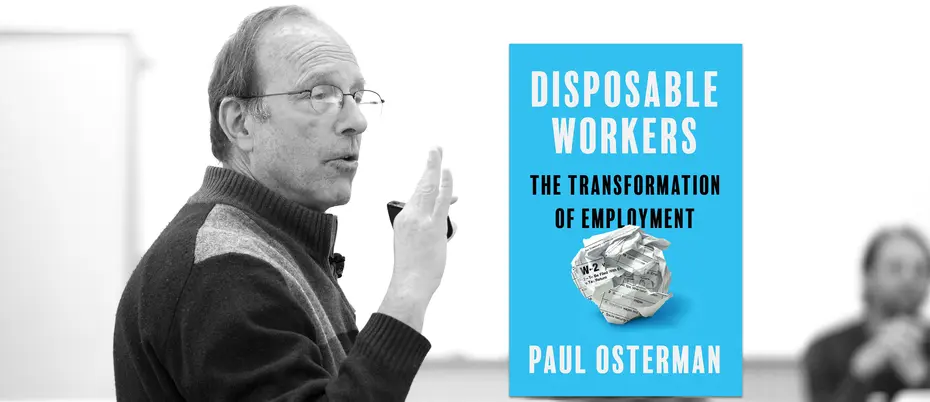
‘Disposable Workers: The Transformation of Employment’
A new book argues that the rise in gig workers, freelancers, contractors, part-timers, adjuncts, and other contingent workers carries long-term implications for the future of work.
A profound shift is reshaping employment culture in the U.S. — a shift that MIT Sloan School of Management emeritus professor Paul Osterman says is happening at the expense of a large swath of the U.S. workforce: Increasingly, employers are bypassing long-term, mutually beneficial relationships with employees in favor of short-term contract work.
Drawing on original survey data from more than 6,000 civilian, nonagricultural working adults, Osterman found that the strategy already constitutes a large fraction of the job market and, he predicts, will become increasingly widespread.
In the following excerpt from his new book, “Disposable Workers: The Transformation of Employment,” Osterman details the benefits that have accrued to standard employees since the end of World War II — and explores why disposable workers are left out of that bargain.
To understand what it means to be a disposable worker, we need to first understand what it means to be a standard employee. There are two components: being eligible for the benefits and protections that the law mandates for employees, and being connected in a meaningful way to an organization’s career system (as opposed to being seen as disposable and interchangeable).
The starting point is legal but far from being just boilerplate. If someone is a standard employee, it means their organization withholds their taxes and provides them with a W-2 at tax time, and that they are protected by an extensive list of legally required benefits and “process” requirements. Some of these we can put a dollar value on, such as the Affordable Care Act’s requirements regarding health insurance, and benefits such as Social Security and unemployment insurance contributions. Others are process-related, such as protections from age, gender, and race discrimination, or state court rulings regarding unfair dismissal.
These and other features of standard employment add up to what legal scholar Cynthia Estlund has termed “a fortress of rights and benefits.”
But these are just the table stakes of what it means to be an employee. Beyond legal and process requirements, being a standard employee means that the entity you work for cares about you and wants to retain you. You are not just a body that is interchangeable with another. A succinct way of stating this is that there is an implicit contract between an employer and its employees, and a set of norms that emerges relating to mutual commitment.
The implicit contract means that that the employer invests in training, that there are career paths, that the worker has access to the organization’s human resource system and rules and procedures, and that there is an element of mutual commitment between the worker and the organization.
All of these features are less precise than the legal requirements for employee status, and they are implemented in differing degrees in different organizations. But they add up to the worker’s being seen as a valued member of the organization rather than someone who can be easily disposed of and replaced.
From the worker perspective, employee status brings the obvious advantages of reasonably stable and secure work and opportunities for skill development.
Of course, being an employee is not paradise: Among other things, organizations are shot full of bias against women and people of color, and the struggles for a fair wage, predictable hours, and fair treatment have never gone away. Though being an employee is far from perfect, on balance it certainly appears — as evidenced by the long political struggle to achieve it — that employee status is a desirable arrangement from the perspective of the workforce and that its imperfections could be addressed without undermining the basic architecture of the system.
The pros and cons of hiring standard employees
Having employees also provides important advantages for organizations. They benefit because their labor supply is more predictable, since they control internal career ladders and can reduce turnover via backloaded pay and benefits. High turnover is disruptive because it impedes skill development and also makes control difficult, since short-term employees do not master key systems and procedures.
This said, while having employees can be a plus for organizations, it also constrains them. A powerful driver to avoid having too many standard-job employees is that the “fortress” is costly, but beyond sheer cost, managers often find the prerogatives that go along with standard employment inflexible and constraining.
Managing employees who are attached to job ladders and career systems means accepting certain rigidities that impede the flexibility and agility managers want to achieve. For example, when workers remain stably attached to an employer, expectations arise regarding wage relationships and the employer’s ability to adjust staffing levels.
Another driver toward disposability is the attitude often held about the workforce. McKinsey, which ironically coined the phrase “war for talent,” nonetheless recently issued a report entitled “The State of Organizations 2023.” The report, based on a survey of clients and other organizations, says that “McKinsey research shows that 5% of employees deliver 95% of an organization’s value.”
It is easy to mock the quality of the research that underlies statements of this kind, but the lesson is not the accuracy of the claim but rather the implicit attitudes of McKinsey and its followers toward the other 95% of workers. They are seen as disposable.
The bottom line is that having employees is costly and limiting. But the work needs to get done, and this leads to the idea of disposable workers. “Disposable workers, not employees,” is shorthand for having their cake (obtaining people to do the work) and eating it too (avoiding the responsibilities entailed by standard employee status).
The central argument of my book is that this strategy is common, already constituting a surprisingly large fraction of the job market, and will become increasingly widespread. An additional nuance is that some people prefer to be disposable workers, and while employers are the main driver of the change, these evolving preferences complicate both the assessment of and the responses to what is happening.

Understanding and Solving Complex Business Problems
Live Online
Register now

What is a disposable worker?
Employers obtain disposable workers through several strategies and work relationships. Some of these are well defined whereas others are hidden and more subtle but important.
Contracting is widespread and one of the most visible manifestations of disposable workers. Contractors are employed by a staffing agency but are assigned to work at another location. Consider the example of building-service workers and travel nurses. Note that cleaning buildings is low-paid work and becomes even lower-paid when the work is contracted out; by contrast, travel nurses are highly paid.
The New York Times recently reported that Google’s 130,000 or so contractors outnumbered its 120,000 or so standard employees. A Washington Post article about National Public Radio was headlined “At NPR, an Army of Temps Faces a Workplace of Anxiety and Insecurity.” The Wall Street Journal reported that Facebook employed just under 100,000 contractors. And in Boston, the Museum of Fine Arts recently stirred up controversy when it sought to lay off its security staff and replace them with contractors.
Freelancers lack any employer and typically work for multiple clients.
The mention of freelancing might cause many to picture the prototypical software coder hopping from one client’s project to another.
But freelancers are far more varied. Some work for individuals — for example, clearing their gutters, caring for an elderly parent, or editing memoirs. But while, as I will show, these account for more than half the people officially classified as freelancers, they are not relevant to the discussion here because they are not working in organizational settings. The focus of this book is on what I term organizational freelancers — freelancers hired by enterprises to perform tasks that could be handled by standard employees.
What is a marginal employee?
Marginal employees is a category I introduce in my book. Think of a marginal job as an attenuated or denatured version of a standard job. These workers are employees in the legal sense, not externalized in the way that contractors and freelancers are. At the same time, they are disconnected from the organization’s career pathways and human resource systems and are treated as disposable. Some marginal workers hold part-time jobs, and many are low-wage service workers.
The defining feature of these jobs is that their holders are not treated as full members of the organization, as their employers avoid career commitments and expect high attrition in their positions. Indeed, turnover is built into these jobs. They are marginal.
A reasonable objection to the foregoing might be that, in the American labor market, every worker is disposable. The legal regime governing employment is termed “employment at will,” which means that there are very few constraints on layoffs. There are, of course, exceptions to this — including federal judges, tenured faculty, and unionized employees for the terms of their contracts — but employment for the vast majority of American workers is always at some degree of risk.
Yet there is no question that some jobs are disposable in a deeper sense than employment at will. The fact that, say, an underperforming employee can easily be fired or that a decline in product demand leads to large-scale layoffs does not mean that the company, when it initially filled the positions, thought of those workers as disposable employees whose contributions could just as easily be matched by any number of other job seekers.
The marginal employees central to my book are disconnected from their organizations from the start, and investments were never made with an eye to their growth and advancement. This is obviously true of contractors and freelancers, who do not receive W-2 tax forms from the organizations they assist and are not treated as full-fledged colleagues. But it is also true of marginal employees, for whom career progress in the organization is unlikely and continued employment is always uncertain.
In my book, I tell a unified story about these categories of workers and explain why “disposability” is a descriptively useful and analytically powerful way of thinking about an important feature and trend in the American job market.
The data behind the arguments
Throughout my book, I utilize an original survey first conducted in 2020 and repeated in 2022, following up with the same people and adding an additional sample. It was nationally representative, large (with over 6,000 people in the 2022 version), and unique in several ways.
First, it very carefully defined the different versions of disposable employment and asked respondents about each. This yielded estimates of the incidence of each version, a substantial improvement over most data sources. Second, it posed detailed questions about the nature of respondents’ work and about their attitudes and expectations. The level of fine-grained detail on the characteristics of jobs and people’s feelings about them is powerful. Overall, the result is a textured, representative, and complete portrait of nonstandard work.
I also drew on nearly 100 interviews with workers, employers, and staffing agencies. Without claiming that these add up to the kind of representative sample provided by the survey, these perspectives enrich my arguments in many ways.
Excerpted from “Disposable Workers: The Transformation of Employment,” by Paul Osterman, published by Harvard University Press. Copyright © 2026 by the President and Fellows of Harvard College. Used by permission. All rights reserved.
Paul Osterman is a professor emeritus of human resources and management at the MIT Sloan School of Management, as well as a member of the Department of Urban Planning at MIT. His research concerns changes in work organization within companies, career patterns and processes within firms, economic development, urban poverty, and public policy surrounding skills training and employment programs. His books include “Good Jobs America: Making Work Better for Everyone,” “Who Will Care for Us?: Long-Term Care and the Long-Term Workforce,” and “The Truth About Middle Managers: Who They Are, How They Work, Why They Matter.”