‘The Collision: What AI Does to Us’
In his new book, MIT Sloan professor Eric So examines the ways artificial intelligence is reshaping human cognition and offers advice on protecting your uniquely human skills while using AI.
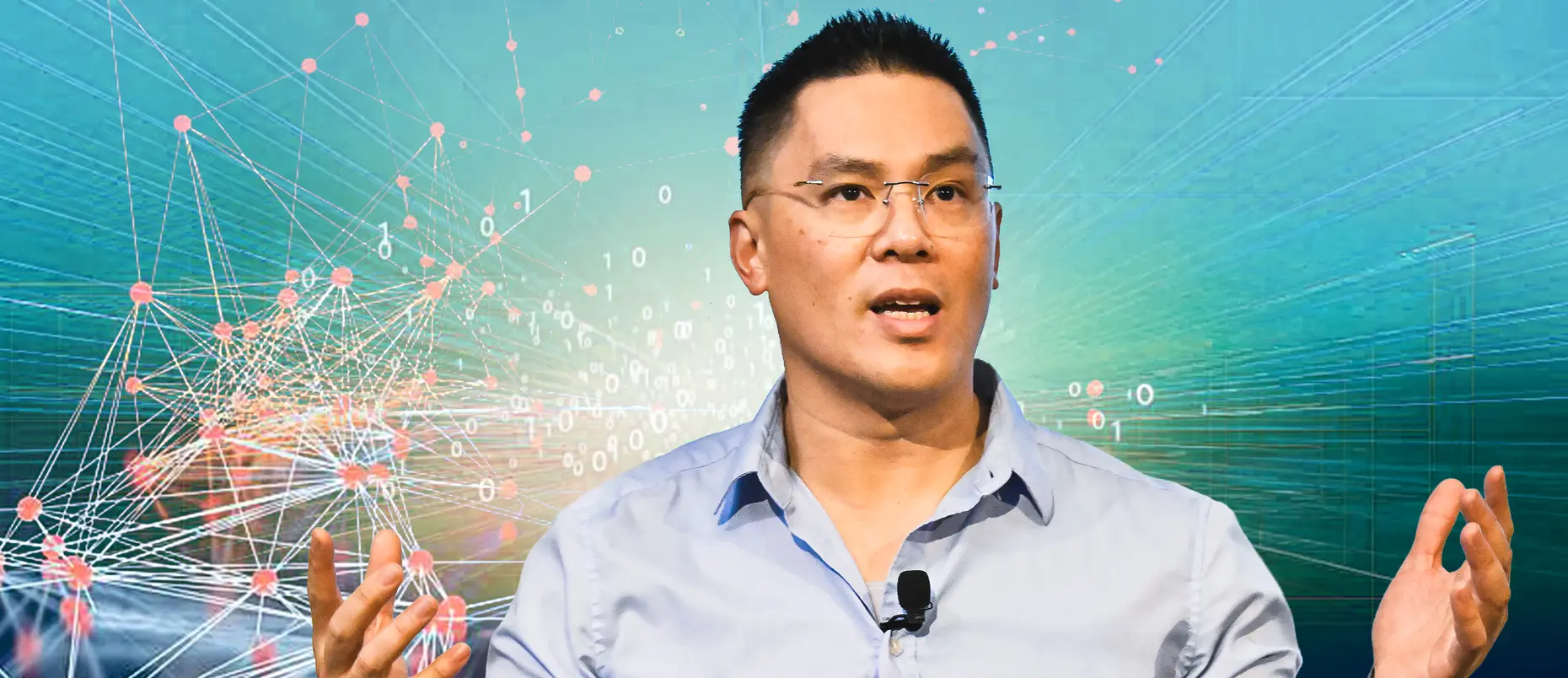
Eric So believes that people who use artificial intelligence fall into one of two groups: those who use the technology to think better, and those who use AI instead of thinking. Without intervention, the latter group could pay a heavy price.
“AI offers us enormous potential in a positive way, if used correctly. But in the absence of some sort of intervention, our instinct is to use it in a way that’s quite bad,” said So, a professor of global economics and behavioral science at the MIT Sloan School of Management.
In his new book, “The Collision: What AI Does to Us,” So argues that artificial intelligence is reshaping human cognition: memory, judgment, learning, attention, and our willingness to struggle through difficult problems. AI makes surrendering that cognition tempting, because surrender often looks like productivity. So calls this tendency “AI gravity.”
It’s a gravitational pull that can lull us into dependence, with grave ramifications.
“AI is changing not just what we can do; it’s really changing who we are as thinkers,” So said. “Our capacity to engage in sustained focus and struggle is being disrupted by AI. It’s not just a matter of our capabilities but our tolerance for friction.”
Of course, AI’s charms are obvious: Rudimentary tasks and higher-order analysis that once took hours or weeks can be completed in moments. Its efficiency is seductive. But when humans instinctively reach for it to solve every problem, it can also weaken, manipulate, and corrode the way we think.
Outsourcing thinking leads to cognitive atrophy, So said. The human brain adapts to the work it performs. When people routinely outsource to AI, “your brain doesn’t really fire very much; it doesn’t get that exercise,” So said. Over time, people may become less capable, and less comfortable, performing tasks independently.
So compares the AI gravity phenomenon to physical atrophy: Muscles weaken with disuse. Likewise, cognitive skills deteriorate when people stop practicing them.
“There’s a lot of evidence that when people get accustomed to working with AI, they lose their ability to function absent it. We lose the ability to tolerate normal day-to-day frictions, because AI is so seamless,” So said.
He offers four guidelines for keeping employees, managers, executives, and students sharp in the AI age.
For employees: Decide which parts of thinking you refuse to outsource
Every worker has signature thinking skills: uniquely human cognitive abilities that make them distinctive and marketable. AI should amplify those skills, not perform them.
For a doctor, this may be an ability to diagnose properly; for a lawyer, maybe it’s about carefully structuring arguments.
“AI can be used in service of you getting to a task where you practice your signature thinking skills, or it can be used to replace your involvement in those signature thinking skills,” So said. “If you choose the latter — where AI is doing it for you — you lose touch with the skill that you want to preserve in yourself.”
For managers: Reward productivity, but also judgment
AI makes it deceptively easy for people to churn out polished work without engaging in deep thinking. This can lead to the subtle de-skilling of a workforce. Managers should ask employees to explain their reasoning, defend their decisions, and engage intellectually — and model this behavior themselves.
“Managers should recognize that the output itself is not where the work ends,” So said. “The message I give to managers is: It matters how you frame AI use and what you model to other people. People listen to what you say, but they will listen a lot closer to the things that you do yourself. It matters how you display good AI use and what things you try to reward.”
He discourages managers from incentivizing workers to use AI by tracking their use of the technology, an increasingly common practice.
“That’s not what I think of as the right mental model for how to use AI in a way that’s productive for employees,” he said. “Assess whether people are not just generating the output but whether they understand it.”
For executives: Treat AI adoption as a talent-development challenge, not a cost-cutting opportunity
“There’s an excitement these days to throw AI at everything, which is creating a new form of cognitive short-termism, where people are obsessed with cutting costs with AI, without thinking about the toll that it takes on their workforce,” So said.
If AI replaces entry-level thinking, and companies stop hiring and developing junior people, they may save money now. They could also destroy the pipeline that produces future senior talent.
“If you suddenly outsource your thinking to AI and stop hiring junior employees, the question is, who’s going to be running your organization?” So said.
“Use AI to free junior employees from routine tasks, then reinvest that time in work that builds their judgment, with opportunities to explain their reasoning and learn from experienced colleagues,” So said.
For educators: Resist the urge to outlaw AI
Ignoring AI isn’t going to make it go away: It’s here to stay, So said. Parents and teachers need to teach kids how to use it as a tool rather than a crutch. That’s why So isn’t a fan of New York Mayor Zohran Mamdani’s move to impose a one-year ban on AI in public schools.
“Outlawing AI essentially pushes AI use into the shadows and creates this fear of being caught, so you use it secretively. I think we need to bring it out into the open but educate teachers about the risks that students might encounter,” So said.
If we ignore AI, the secretly AI-reliant child who becomes an AI-dependent college student could grow into a useless employee, he warned.
AI Executive Academy
In person at MIT Sloan
Register Now

“If you’re not actually learning and engaging with ideas, it really raises this question: Why would anyone want to hire you in the future? If you’re having AI do all your work, you’re just a vessel for the AI,” So said.
A better approach: Educators should teach students of all ages how to deploy AI to their advantage by using it as an amplifier for their own ideas, instead of a cognitive replacement that generates ideas for them.
“Pushing the boundaries of what we’re capable of”
So urges everyone to use AI on routine responsibilities to free up valuable time for more sophisticated thinking — not to replace their thinking completely.
“If you look back in human history, the most transformative technologies are not the ones that allowed us to simply automate things that we’re already doing or to do them a little bit faster. They’re really about the technologies that allow us to reach for something that was previously impossible, pushing the boundaries of what we’re capable of,” he said.
In short, AI isn’t the enemy. It’s an ally when used correctly, with humans still in charge.
“AI can save you time on rote tasks, but it matters what you do with that time,” he said. “If you can reinvest it in a way that continues to challenge and push your thinking, then there’s real benefit.”
Read the Book: “The Collision: What AI Does to Us”
Eric So is the Sloan Distinguished Professor of Global Economics and Behavioral Science at the MIT Sloan School of Management, faculty co-director of the AI Executive Academy, faculty chair of MIT Sloan’s PhD program, and lead faculty for the MIT Sloan Generative AI for Teaching & Learning hub. His current research portfolio spans interconnected topics, including artificial intelligence, behavioral economics, human-computer interactions, and regulatory policy. His book “The Collision: What AI Does to Us” is available now.