
MIT Sloan logo
  • Expert Insights
  • Values
  • Events
  • Alumni
  • Faculty
  • About
  • Executive Education
  • contact
  • facebook
  • instagram
  • linkedin
  • twitter
  • youtube
MIT

Get MIT Sloan's latest expert insights in your inbox. Sign up for the MIT Sloan Thinking Forward newsletter.

contact

Which program is right for you?

MIT Sloan Campus life
MBA

A full-time, two-year MBA program.

Leaders for Global Operations

A two-year, dual-degree program awarding an MBA from MIT Sloan and an SM from MIT School of Engineering.

MBA Early (Deferred admissions option)

Deferred admission program; candidates work two to five years before enrolling in the MBA program.

MIT Sloan Evening MBA

An MBA program designed for working professionals.

Master of Finance

A 12- or 18-month graduate program in finance.

Master of Business Analytics

A 12-month graduate program in business analytics.

PhD

A doctoral program that researches management science, economics, finance, marketing, operations, strategy, and other business disciplines.

Undergraduate

Undergraduate degrees offered in management, business analytics, and finance.

Master of Science in Management Studies

Combine an international MBA with a graduate degree in management science; available to partner and affiliate school students only.

Executive Programs

MIT Executive MBA

A 20-month executive MBA program for mid-career professionals.

MIT Sloan Fellows MBA

A one-year, full-time MBA program for mid-career professionals.

System Design & Management

A master's degree program combining engineering and management for mid-career professionals.

Executive Education

Non-degree programs for senior executives and high-potential managers.

Visiting Fellows

A non-degree, customizable program for mid-career professionals.

Explore Our Programs

Search

Filter content by

Search For

Academic Programs
Content Type
Academic Groups
Offices
Centers + Initiatives

Search For

Generating summary
4701 - 4710 out of 10785
MIT Sloan Sustainability Initiative

Power for the People

By Tracey Palmer

Mojola Ola, EMBA ’22, is redefining energy access across Africa—and transforming the lives of the people in the country he calls home.

Jul 14, 2025

Read More

What is the future of work?

Work and workplaces are changing rapidly. At the MIT Sloan School of Management, we're not just studying the future of work—we're inventing it. Learn what's next from MIT Sloan experts.
Find out how MIT Sloan is leading the future of work
Institute for Work and Employment Research (IWER)
Centers + Intiatives
MIT Institute for Work and Employment Research
IWER is a multidisciplinary and highly collaborative hub for the study of work and employment
Photo illustration of Simon Johnson and Daron Acemoglu
Centers + Intiatives
The Stone Center on Inequality and Shaping the Future of Work
The Stone Center applies economics research to identify innovative ways to move the labor market onto a more equitable trajectory.
A human hand and a robotic hand hold interlocking gears of varying colors against a green background.
Executive Education
Leading the Future of Work
This course prepare you, and your organization, for an evolving workplace as it investigates its impact on social, legal, and economic policy.


MIT hasn’t just prepared me for the future of work—it’s pushed me to study it. As AI systems become more capable, more of our online activity will be carried out by artificial agents. That raises big questions.
Profile Photo of Current PhD Student, Benjamin Manning
Benjamin Manning

PhD Student


I think, at its most generous, AI tools enable us to learn from our collective actions ... What AI tools do is they take all of those solutions, those attempts—whether good or bad—and use them as training data to build models.
Headshot of MIT Sloan Professor Danielle Li
Danielle Li

David Sarnoff Professor of Management of Technology; Professor, Technological Innovation, Entrepreneurship, and Strategic Management


To me, the future of work means democracy. It’s hard to have any positive vision of work without meaningfully engaging workers. This is why I research economic democracy—worker voice is pivotal in designing good jobs.
Alexander Busch 2
Alex Busch

PhD Student


The rise of generative AI is a real opportunity, but making the most of it will demand a new approach to decision-making, as well as a new focus on worker training, fair transitions, and effective policy.
Professor Thomas A. Kochan headshot
Thomas Kochan

George Maverick Bunker Professor of Management, Emeritus; Professor of Human Resources and Management, Emeritus


Combinations of humans and AI work best when each party can do the thing they do better than the other.
Thomas Malone
Thomas W. Malone

Patrick J. McGovern (1959) Professor of Management; Director, MIT Center for Collective Intelligence; Professor, Information Technology
 

/
Illustration of robot hands doing a variety of things
Centers + Intiatives
MIT Work of the Future at the IPC
Growing out of MIT's Work of the Future Task Force (2018-2020), the Work of the Future Initiative at the Industrial Performance Center conducts multidisciplinary research on the ways technology is changing work.
A human hand and a robot hand touch a lightbulb with flares
Download
Workforce development in the age of AI
MIT experts share strategies to transform skills, roles, and human potential across your organization.
Gears surrounded by code and other digital imagery
Centers + Intiatives
MIT Initiative for New Manufacturing
INM is an MIT-wide effort that drives research, education, and collaborations to transform the future of manufacturing in the United States and beyond.

The Future of Work

Across the MIT Sloan School of Management, students and faculty are inventing the future of work. Explore research from MIT Sloan experts on the impact of AI and technology on labor and the economy, discover recommendations on empowering yourself and your workforce to master new technologies and navigate evolving risks, and learn how MIT Sloan prepares global business leaders to excel in an ever-changing landscape.
A robot hand with various professionals presented from industries ranging from healthcare, science, and manufacturing
Choose the human path for AI
To realize the greatest gains from artificial intelligence, we must make the future of work more human, not less.
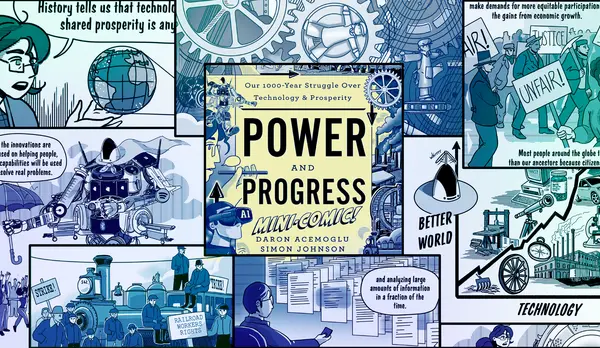
Excerpt of "Power and Progress Mini-Comic!"
Who benefits from AI? New comic explores technology’s impact on labor
A free comic book adapts MIT Nobel Prize-winning economists’ work on how AI and technological change affect workers and shared prosperity.
An illustration of workers talking into a megaphone on top of a line chart going up to the right
For manufacturers, listening to workers pays off in productivity
Companies that act on input from front-line employees pay their workers more and experience a productivity bump that offsets those costs.
Silhouettes of various employees in a larger than life quantum computer
Building a quantum workforce
The Quantum Index Report from MIT documents a growing demand for quantum skills and emerging efforts to train a quantum workforce.
PhD student Ben Manning sits at a desk in the MIT Sloan PhD offices. He looks down at a tablet, talking to someone out of frame.
PhD Student Benjamin Manning Explores How AI Will Shape the Future of Work
“MIT hasn’t just prepared me for the future of work—it’s pushed me to study it."
Artificial intelligence and machine learning concept. Abstract technology background.
Media: CIO
Humanizing AI: Empowering people, not replacing them
AI works best not when it replaces humans, but when it augments them. As professor Thomas W. Malone, director of the MIT Center for Collective Intelligence, puts it: "Combinations of humans and AI work best when each party can do the thing they do better than the other."

Faculty Publications

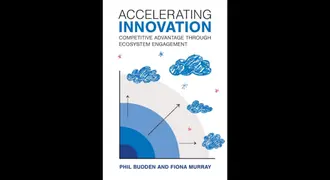
The cover for the book Accelerating Innovation, which reads "Accelerating Innovation: Competitive Advantage Through Ecosystem Engagement by Phil Budden and Fiona Murray"
Accelerating Innovation: Competitive Advantage Through Ecosystem Engagement
Senior lecturer Phil Budden and associate dean for innovation Fiona Murray provide a practical guide to engaging with the five key stakeholders in an innovation ecosystem.
The cover for the book The Meritocracy Paradox, which reads "The Meritocracy Paradox Where Talent Management Strategies Go Wrong and How to Fix Them by Emilio J. Castilla"
The Meritocracy Paradox: Where Talent Management Strategies Go Wrong and How to…
MIT Sloan professor Emilio J. Castilla offers practical solutions to help organizations build fairer, more effective people management practices.
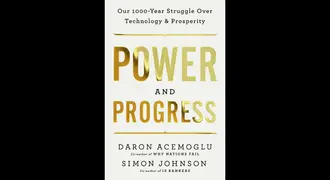
The cover for the book Power and Progress, which reads "Power and Progress: Our 1000-Year Struggle Over Technology and Prosperity by Daron Acemoglu and Simon Johnson"
Power and Progress: Our 1000-Year Struggle Over Technology and Prosperity
In their book, “Power and Progress,” Nobel laureates Daron Acemoglu, Institute professor, and Simon Johnson, MIT Sloan professor, ask whether the benefits of AI will be shared widely or feed inequality.

Working Definitions: Future of Work

MIT Sloan's Working Definitions explore the words and phrases behind emerging management ideas.
pro-worker AI
collective work habits
meritocracy paradox
dynamic work design
extended reality
engagement variability
A human hand and a robotic hand hold interlocking gears of varying colors against a green background.
Alumni Leaders
MIT Alumni are shaping the future of work.
Read More
Various groups of employees with one main leader directing
Ideas Made to Matter: Future of Work
Ideas and insights about the future of work from MIT Sloan.
Read More
Off
MIT Kuo Sharper Center for Prosperity and Entrepreneurship

Carbon Pricing in Growth Markets

This white paper, intended for entrepreneurs, innovators, and policymakers in growth markets, argues that addressing the MRV gap is a strategic priority. It discusses how a digital Carbon-MRV platform could enable exporters to accurately measure emissions, verify reductions (for example, using AI an...

Jul 14, 2025

Read More
MIT Executive MBA

The Uncommon Sounds' Plan to Empower Sierra Leone's Music Economy

By Alyssa Loebig

MIT Sloan EMBA students partnered with Telem Uncommon Sounds as part of their Global Labs course to build a business plan that would help rebuild Sierra Leone's music scene.

Jul 10, 2025
Read More
Institute for Work and Employment Research Human Resources

Announcing Emilio Castilla’s New Book “The Meritocracy Paradox”

MIT Sloan Professor Emilio J. Castilla’s new book, "The Meritocracy Paradox: Where Talent Management Strategies Go Wrong and How to Fix Them," published by Columbia University Press, is now available.

Jul 29, 2025
Read More
MIT Kuo Sharper Center for Prosperity and Entrepreneurship Digital Economy

Challenging Assumptions by Micheil Banoub

This raises another question: how can SMEs afford annualized rates exceeding 70%? The answer lies in short loan tenures and high profit margins. Many supply contracts have short tenures of 1-2 months, meaning the interest accumulated is minimal relative to the loan term. Moreover, as I learned durin...

Mar 4, 2025
Read More
MIT Sloan Sustainability Initiative

Streams of Study

By Jennifer Graham

Navigating the countless opportunities at MIT can feel overwhelming, especially when it comes to charting your career path in sustainability. Streams of Study is a growing resource designed to make your journey easier, intentional, and actionable.

Feb 26, 2025
Read More
Institute for Work and Employment Research

A Lively Discussion of “Retiring” with MIT Sloan’s Lotte Bailyn

At a presentation at the MIT Institute for Work and Employment Research seminar, MIT Sloan School of Management Professor Emerita Lotte Bailyn and three additional experts discussed a new book Bailyn coauthored, "Retiring: Creating a Life That Works for You."

Feb 26, 2025
Read More
Alumni Leadership

Alumnae Look to Deepen Connections at the 2025 MIT Women’s Conference

By Andrew Husband

Hundreds of alumnae will convene in Boston on March 28 for the 2025 MIT Women’s Conference.

Feb 26, 2025
Read More
MIT Kuo Sharper Center for Prosperity and Entrepreneurship Finance

Redesigning the Startup Funding Chain in Global Growth Markets

For too long, startup funding in emerging markets has been fragmented and insufficient, leaving entrepreneurs without the right financial instruments to grow. In her latest blog, Salma Baghdadi challenges this status quo and issues a call to action for ecosystem builders, investors, and policymakers...

Feb 7, 2025
Read More

Pagination

  • Previous page Previous
  • Page 1
  • …
  • Page 470
  • Current page 471
  • Page 472
  • …
  • Page 1079
  • Next page Next page

The Mission

The mission of the MIT Sloan School of Management is to develop principled, innovative leaders who improve the world and to generate ideas that advance management practice.

Find Us

MIT Sloan School of Management 100 Main Street Cambridge, MA 02142 617-253-1000

Links

  • Press
  • Careers
  • Accessibility
  • Licensing
  • Privacy
MIT Sloan on facebook MIT Sloan on X MIT Sloan on YouTube MIT Sloan on Instagram MIT Sloan on LinkedIn
©2026 MIT Sloan School of Management