
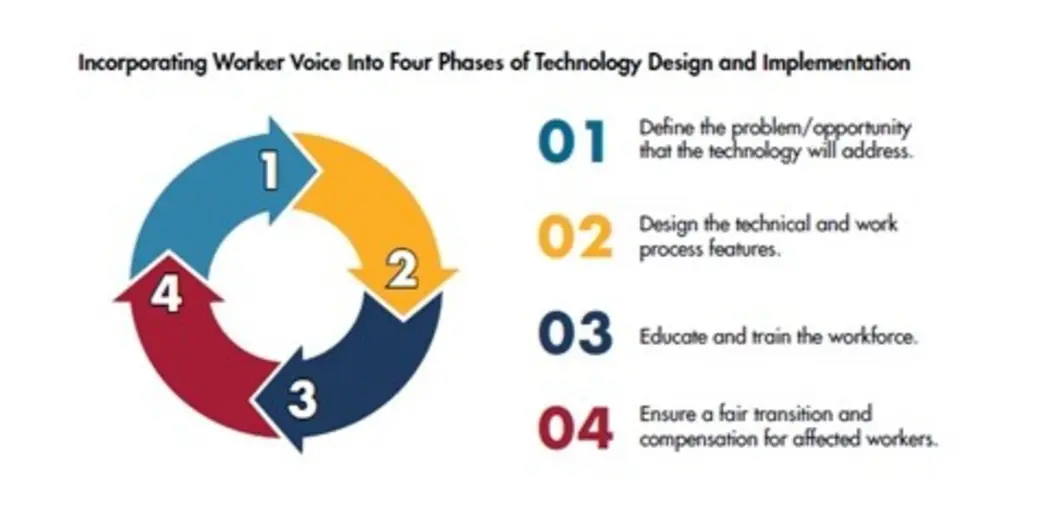
Credit: Thomas A. Kochan, Ben Armstrong, Julie Shah, Emilio J. Castilla, Ben Likis, and Martha E. Mangelsdorf. MIT Open Publishing Services (2024).
Integrating worker voice into artificial intelligence governance is increasingly recognized as essential to responsible AI adoption.
The 2025 negotiations between Kaiser Permanente (KP) and the Alliance of Health Care Unions produced a landmark agreement on artificial intelligence and other related emerging technologies. This agreement represents the first comprehensive effort by a major healthcare employer and its union partners to integrate worker voice into all phases of AI decision-making—from problem identification through design, implementation, training, and transition assistance.
A research team led by Thomas A. Kochan (MIT Sloan George Maverick Bunker Professor Emeritus), Erin L. Kelly (Sloan Distinguished Professor and Co-Director of MIT IWER, the Institute for Work and Employment Research), and Arrow Minster (Assistant Professor, Lam Family College of Business, San Francisco State University; MIT Sloan PhD '24) observed over 150 hours of interest-based bargaining negotiations.
This report documents what was achieved, how it was accomplished, and what will be required to realize the agreement’s full potential in practice.
Key Findings:
Worker voice integration: First comprehensive effort to involve workers in all phases of AI decision-making—from problem identification through design, implementation, training, and transition assistance—in a major healthcare organization.
Two-pronged strategy: National Task Force discusses enterprise-wide initiatives while enhanced Unit-Based Teams surface frontline innovation and bottom-up problem identification.
Interest-based bargaining effectiveness: Collaborative problem-solving proved more effective than traditional position-based negotiations for reaching consensus on complex, nontraditional subjects.
Three foundational commitments: Agreement preamble establishes relational care (preserving human elements of healthcare), meaningful employee voice throughout technology lifecycle, and ethical use standards (transparency and bias mitigation).
Labor solidarity as catalyst: United front across multiple occupational groups and unions achieved breakthrough results that individual unions could not accomplish separately.
Implications beyond unionized settings: Organizations can benefit when frontline expertise informs technology decisions, raising urgent questions about ensuring worker voice in organizations without formal collective bargaining structures.
Support for this research was provided by the Worker Empowerment Research Fund, the MIT Sloan Health Systems Initiative, Omidyar Network, and the MIT Institute for Work and Employment Research (IWER). The views expressed are solely those of the authors.