What you’ll learn:
- AI can help organizations create more collaborative, repeatable innovation processes, but humans should stay in charge.
- Organizations should map and fix their existing workflows before applying AI; otherwise, AI will only speed up any errors within them.
- Teams should build review steps into innovation workflows to catch errors and hallucinations, with validation and decisions made by humans, AI tools, or both.
Organizations are under tremendous pressure to innovate amid changing customer demands and markets that are continuously in flux. Artificial intelligence can help — serving as a catalyst for changing work patterns and materially enhancing innovation and creativity processes.
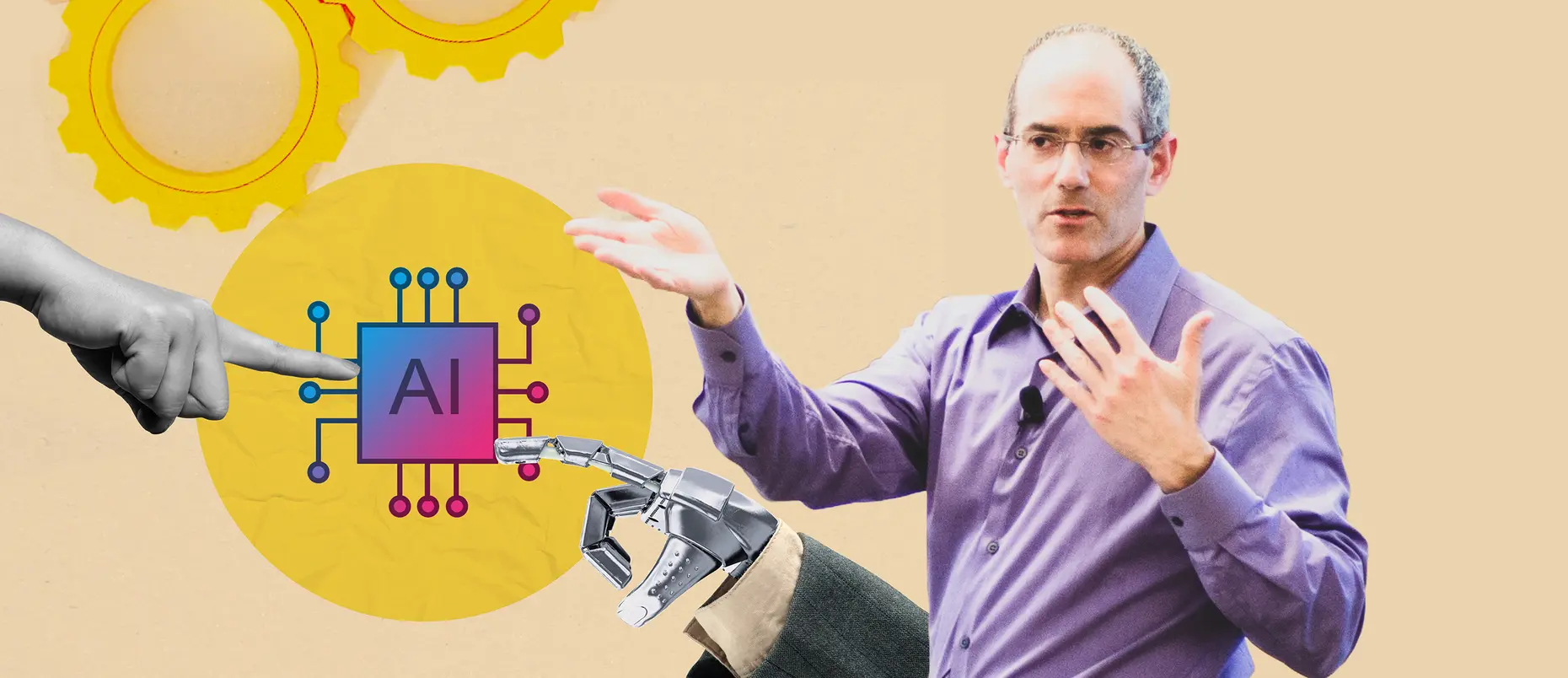
For that to happen, organizations must take a systematic approach and keep humans at the center of decision-making, said Steven Eppinger, a professor of management science and innovation at the MIT Sloan School of Management.
In a recent talk previewing his upcoming MIT Sloan Executive Education course, Systematic Innovation of Products, Processes, and Services, Eppinger described how organizations can use AI to unlock greater possibilities and create more collaborative, repeatable innovation processes.
Decomposing the innovation process
The key to empowering systematic innovation is to design processes that can be decomposed into a series of smaller, discrete steps, Eppinger said. This approach is essential, whether the innovation team comprises humans, AI, or both.
Eppinger compared it to managing a group of eager workers: You’d give them small tasks with specific instructions, because otherwise “they’ll make up a way to do it on their own, and it may not be done the way you’d like.”
The same approach works with AI, he said, for two reasons. Research shows that AI tools work better on smaller tasks than on larger ones. And while AI tools can write their own instructions, that doesn’t mean they’ll write the right ones. So for tasks the team already knows how to do, it makes sense for them to write the instructions for AI to follow.
“You need to give AI tools tasks to do and be very specific about it,” Eppinger said. “That allows us, the human supervisors, to be in charge. We have to retain decision responsibility.”
Beyond that, Eppinger outlined four steps organizations should take to effectively harness AI to enhance systematic innovation.
1. Get a handle on existing processes
Before unleashing AI on any type of process, organizations need to understand their own workflows and address what isn’t working. If a process is already generating errors, AI will only accelerate that, Eppinger said: “You’d have a kind of faster mess, and that’s obviously not useful.”
Rather than “turning the whole thing over to AI,” organizations should map out basic workflows for specific innovation tasks, even if they’re not perfect, and then use AI to enhance those processes, Eppinger advised.
Teams can start simply, by experimenting in an AI chat interface. “You don’t need to create agents to do it,” Eppinger said. Once the AI handles a task well, ask it to export the instructions — as a set of markdown instructions, for example. When those instructions consistently produce good results, “then you can freeze it into an automation.”
As teams automate, test, and improve their workflows in this manner, he said, they’ll come up with better approaches.
2. Prioritize the human in human-machine collaboration
Most organizations recognize the need to include humans as enterprise AI use intensifies. Yet Eppinger makes an important distinction: AI should be integrated into innovation processes as a supporting character, with humans assuming the principal role in fully automated AI workflows.
“‘Humans in the loop’ sounds like AI is running the process and humans are just there for checks and balances,” he said. “I’d like to see ‘AI in the loop,’ which keeps us humans in charge, with AI part of our processes.”
Toward that end, the bigger opportunity for value creation is building processes where humans and machines work in tandem, as opposed to using AI to replace human input.
Through measured experimentation, innovation teams can determine which tasks AI executes well and which tasks align more with human skills. They can use those findings as a starting point to build complementary, automated workflows, Eppinger said.
3. Perfect the art of prompting and instruction
AI is trained on a nearly endless reservoir of existing data, but innovation depends on imagining what doesn’t yet exist. The solution to that dilemma, Eppinger said, is better instructions.
“AI tools have a lot more experience and data than we have, and they have a lot more computational ability than we do,” Eppinger said. “If we give it the right instructions to use those two things, AI systems can be incredibly creative.”
That means being specific about how the output will be used. For example, an AI tool can create a user persona on request, Eppinger said, but you’d expect a persona meant for targeting customers in marketing to be different from one meant to help a team understand a customer’s use case.
Describing the output’s purpose to an AI tool in detail or sharing a couple of examples of work you like will yield a more targeted result, Eppinger said.
Systematic Innovation of Products, Processes, and Services
In person at MIT Sloan
Register Now

4. Don’t skip verification and review
It’s clear that AI is capable of generating ideas, solutions, and designs at a pace well beyond humans’ capacity to evaluate them. Ideally, AI would handle that evaluation, too — exploring a thousand possibilities and presenting humans with the 10 most promising — but that challenge hasn’t yet been well solved, Eppinger said.
In the meantime, he suggested using AI to explore iteratively in the places where good solutions seem most likely to be found, “because you can’t possibly look everywhere.” It’s the same logic teams already use in design: Rather than building 100 iterations, “you build a few, you try them, and you search in one direction a little bit more rigorously,” Eppinger said.
He also suggested building validation steps into innovation workflows to catch errors and hallucinations — though he noted that those are becoming less common. Checks can be done by humans, AI tools, or both. “There are a lot of things we can automate, even in validation and testing,” Eppinger said.
While the use of AI in innovation processes is still evolving, Eppinger encouraged organizations to start the journey now. “Those who ignore it will find that they’re missing out on an ability to amplify their own capability,” he said. “And that’s going to be a losing strategy over time.”
Level up systematic innovation with AI
Steven Eppinger is a professor of management science and innovation at the MIT Sloan School of Management. His research is applied to improving complex technical project management. Eppinger’s work contributes to fields ranging from project management and systems engineering to product development and product management. Eppinger is the co-author of “Product Design and Development, 8th Edition” and “Design Structure Matrix Methods and Applications.”