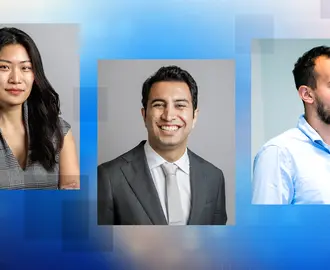

Meet the new faculty members joining MIT Sloan in 2026
These new MIT Sloan School of Management faculty members are experts in workplace instability, microfinance, human-AI interaction, digital economics, and more.
Debiased machine learning, the currency of invoicing, and training good models with bad data: Meet the seven new experts bringing their knowledge and skill sets to the MIT Sloan School of Management.
Clem Aeppli, Assistant Professor of Work and Organization Studies
Comes from: Harvard, where he received a PhD in sociology in 2026.
Research: Aeppli uses quantitative approaches to understand how broad transformations in the organization of work shape inequality and instability. His projects have dealt with pay gaps between workplaces, the effect of rising workplace segregation on racial inequality, payroll instability at subcontractors, and the emergence of modern factories in the early 20th century.
Find out more: On his Google Scholar page.
David Bruns-Smith, Assistant Professor of Finance (shared appointment with the MIT Electrical Engineering and Computer Science Department)
Comes from: Stanford Data Science, where he was a postdoctoral fellow. He received his PhD in computer science from University of California, Berkeley in 2024.
Research: Bruns-Smith develops machine learning methods for causal inference with applications in macroeconomics and household finance. His recent methodological research focuses on debiased machine learning, including for instrumental variables regression and reinforcement learning.
Find out more: On his Google Scholar page or personal web page.
Zana Buçinca, Assistant Professor of Work and Organization Studies (shared appointment with the MIT Electrical Engineering and Computer Science Department)
Comes from: Microsoft, where she was a postdoctoral researcher. She received her PhD in computer science from Harvard in 2025.
Research: Buçinca designs human-AI interaction techniques that complement people and amplify their values in AI-assisted work. To achieve this, she focuses on understanding how people make AI-assisted decisions and designing novel interaction paradigms, explanations, and systems that optimize both task-centric and human-centric outcomes.
Find out more: On her Google Scholar page, LinkedIn, or her personal web page.
Giannis Daras, Assistant Professor of Operations Research and Statistics
Comes from: The MIT Computer Science and Artificial Intelligence Laboratory, where he was a postdoctoral associate. He received his PhD in computer science from the University of Texas, Austin in 2024.
Research: Daras works on practical and theoretical questions regarding deep generative models. A central thrust of his research is developing principled algorithms for training and sampling generative models in the presence of data corruption. Recent publications include “Ambient Diffusion Omni: Training Good Models With Bad Data.”
Find out more: On his Google Scholar page, LinkedIn, or his personal web page.
Ruru Hoong, Assistant Professor of Marketing
Comes from: Harvard Business School, where she received her PhD in 2026.
Research: Hoong’s research interests span AI, digital economics, privacy, and social media. She focuses on the optimal design and integration of new digital technologies into real-world deployment and on the rigorous evaluation of their heterogeneous impacts — specifically, on how variations in user decision-making processes, tasks, and organizational structures shape both individual and firm-level outcomes.
Find out more: On LinkedIn or her personal web page.

Agentic AI: Business Implications and Applications
In person at MIT Sloan
Register now

Anya Shchetkina, Assistant Professor of Marketing
Comes from: The Wharton School at the University of Pennsylvania, where she received her PhD in marketing in 2026.
Research: Shchetkina develops applied methodology for modern marketing decisions, focusing on personalization, targeting, privacy constraints, and marketing mix modeling. Her work combines causal inference, machine learning, Bayesian optimization, and field-experiment data to determine when advertising and personalization create value and how marketers can measure that value reliably.
Find out more: On her Google Scholar page, LinkedIn, or her personal web page.
Sadegh Shirani, Assistant Professor of Operations Management
Comes from: Shirani received his PhD in Operations, Information & Technology at the Stanford Graduate School of Business.
Research: Shirani develops machine learning methods for modeling and decision-making in complex systems, spanning LLM-based simulation of human and human-AI dynamics, causal inference under network interference, and reliable AI for operational decision support. He primarily studies systems where uncertainties, together with limited available data, compromise the quality of decisions. Examples include interventions in public health settings and experiments in ride-sharing systems.
Find out more: On his Google Scholar page, LinkedIn, or personal web page.
Oliver Xie, Assistant Professor of Finance
Comes from: The Stanford Graduate School of Business, where he received his PhD in 2026.
Research: Xie focuses on international finance and microfinance. His research examines how firms choose the currency of invoicing in international-goods trade and how they raise debt in multiple currencies to minimize their cost of capital. Recent publications include “Firm Level Gains From Financial Integration” and “Financial Hedging and Optimal Currency of Invoicing.”
Find out more: On his Google Scholar page, LinkedIn, or his personal web page.