What you’ll learn:
- Faculty presenters emphasized that successful leadership in an era of rapid technological change depends on pairing innovation with uniquely human qualities such as ethics, empathy, judgment, and purpose.
- Addressing climate, social, and business challenges requires systems thinking, cross-sector collaboration, and alumni leadership to drive meaningful change.
- AI is most valuable when it augments human capabilities, while organizations achieve better outcomes by preserving worker voice, relationships, and human-centered decision-making.
Featured Experts



In an era of significant technological advancement, MIT Sloan’s leading thinkers in economics, sustainability, and organizational studies agree: Embracing the human elements of our work is more critical than ever.
Faculty sessions at MIT Sloan Reunion 2026 examined what it means to be a principled, innovative leader in this fast-moving landscape—by adapting to new tools and frameworks while leveraging the distinctly human qualities that cannot be replicated by machines.
Climate at MIT Sloan: From systems thinking to system change
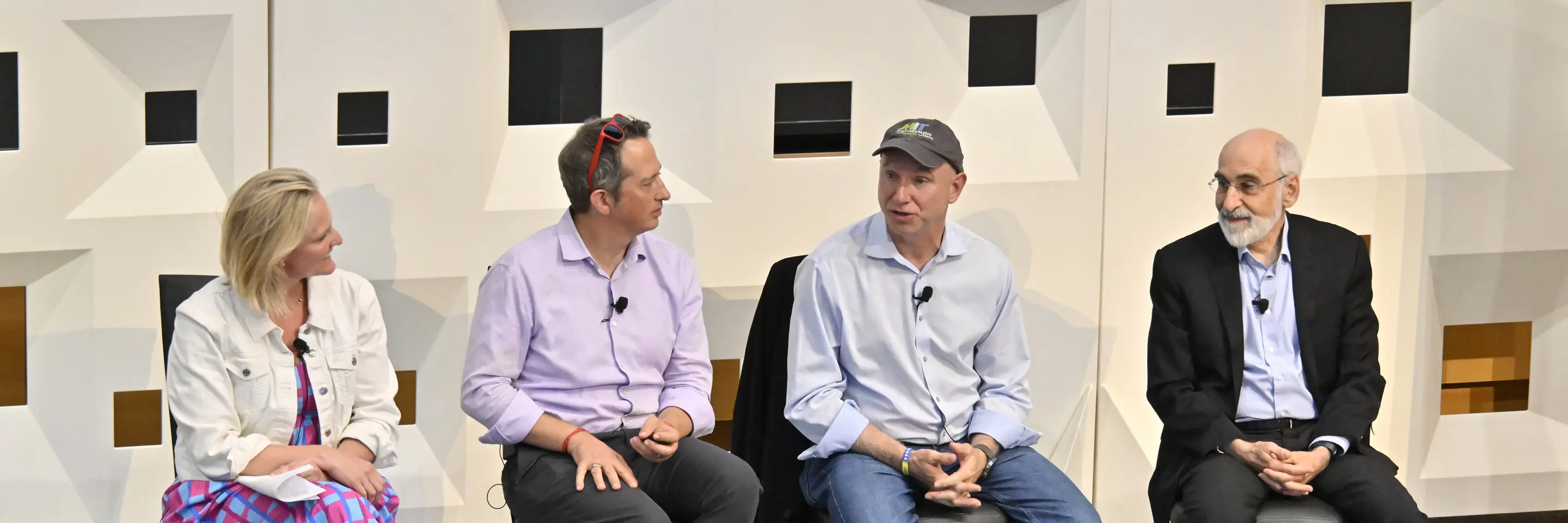
Jason Jay, PhD ’10 (Senior Lecturer; Director, MIT Sloan Sustainability Initiative), Roberto Rigobon, PhD ’97 (Society of Sloan Fellows Professor of Management; Professor, Applied Economics), and John D. Sterman, PhD ’82 (Jay W. Forrester Professor of Management; Professor, System Dynamics; Director, MIT System Dynamics) know a thing or two about adapting to an evolving business landscape. This was covered in a session on the evolution of the initiative, moderated by Lily Russell, MBA ’11, who has led sustainability efforts at Nike and Google.
When the Sustainability Initiative was founded at MIT Sloan in 2006, it helped incorporate frameworks and strategies that support a sustainable world for all—individuals, corporations, and nature—in the school’s core educational offerings. Founding faculty, including John C Head III Dean Richard M. Locke, PhD ’89, drew from system design and systems thinking—groundbreaking models developed at MIT Sloan in the 1960s that continue to inform sustainability research and policy. Twenty years after its founding, the Sustainability Initiative remains committed to furthering a holistic mission.
Your MIT Sloan education is exactly what the world needs to tackle these problems. We need your knowledge of technology, markets, finance, operations, organizations, management, and more. Most of all, we need your passion to make a difference, not just in the short term, and not just for ourselves, but for our children, and for all children.
“Sustainability is not just about climate. It’s not just about environment. This is about a bigger picture,” said Jay. “The environment and society and justice issues that surround us are a critical piece of the context of what it means to be a leader and what it means to do business.”
Action Learning projects facilitated through Sustainability Lab, or “S-Lab,” have supported student-led innovations at leading global organizations such as Amazon, JetBlue, and Novartis. Launched in 2010, MIT Sloan’s Sustainability Certificate is one of the school’s most popular supplemental offerings—with a network of over 800 alumni who lead the way in sustainable business and policy.
As Sterman noted to the audience, it is this community that will chart a better tomorrow by confronting the greatest challenges around climate and AI.
“We need you. We need what you bring. Creating a healthier, safer, more equitable, more prosperous, and more sustainable world in which everyone can thrive requires technological advance, but technology alone cannot solve the problems we face. Your MIT Sloan education is exactly what the world needs to tackle these problems. We need your knowledge of technology, markets, finance, operations, organizations, management, and more. Most of all, we need your passion to make a difference, not just in the short term, and not just for ourselves, but for our children, and for all children.”
The EPOCH of AI: Which human capabilities complement AI?
Research from Rigobon and Isabella Loaiza, SM ’19, PhD ’23, suggests that AI is more likely to complement—not replace—human workers. They’ve developed the EPOCH Index, a robust quantification of the uniquely human capabilities that enable workers to thrive in areas where machines are limited: Empathy and emotional intelligence; Presence, networking, and connectedness; Opinion, judgment, and ethics; Creativity and imagination; Hope, vision, and leadership.
In his session—which filled Wong Auditorium plus surplus viewing classrooms—Rigobon expanded on how the index can help predict the future of work in the age of AI. Automation will augment the workforce, but findings suggest that the number of jobs that rely on human-intensive tasks and the ability to leverage components of EPOCH—such as psychologists or childcare providers—is increasing.
“It’s not about power. It’s about relationships. And it is true that the computers can mimic a relationship, but a relationship is two-way. They cannot mimic empathy.”
Fears around a shifting job market and the potential for job loss, as Rigobon acknowledged, is founded. However, he invited the audience to reframe the AI-driven work revolution. In their development of the EPOCH Index, Rigobon and Loaiza found that AI-led augmentation presents a widespread opportunity to increase the quality of our work.
It’s not about power. It’s about relationships. And it is true that the computers can mimic a relationship, but a relationship is two-way. They cannot mimic empathy.
“I want you to pay attention to the possibilities ... We think that we have a tremendous chance of having an incredible technology that is going to improve humankind. And therefore, what we have to do is to think about how to implement it.”
For further insights into the latter piece, Rigobon referred to his MIT Sloan colleague Kate Kellogg, PhD ’05 (David J. McGrath jr Professor of Management and Innovation; Professor of Business Administration), who researches how organizations can best implement AI products for improved decision making, collaboration, and learning.
To close the session, Rigobon noted that while increased access to data and information will unlock the answers to many questions, data is not perfect—and does not account for critical human elements such as equity, empathy, and dignity. He encouraged attendees to cherish the wisdom held by the more experienced members of our communities—lessons that can only be gained through lived experiences.
“You have so much to teach. We go to every dinner with a phone in our pockets. And we tend to believe that we will learn more from ChatGPT—which has no more investment in us, emotional or otherwise—than our grandparents.”
Designing work that works: Evidence from tough settings
When Rahul Kay, MBA ’16, introduced Erin Kelly (Sloan Distinguished Professor of Work and Organization Studies; Co-Director, MIT Institute for Work and Employment Research) for her session on effective work design, Kay asked the audience to consider, “How many hours are in the average career?” The answer, he said, is 90,000. “Chances are, if you went to MIT, I'm guessing that’s going to be closer to 100,000 hours.”
Kelly’s research on workplace policies and management practices aims to make those hours better for both organizations and employees. Her findings stand in opposition to the notion that “good jobs” always involve more costs for the organization.
Reporting on a large-scale randomized field experiment in U.S. fulfillment centers (a field she described as the “new blue collar”), Kelly explained how Health and Well-being Committees, or “the opportunity to pull together a small group from across departments to do some problem solving, hear concerns, try to implement some changes, and then share that information,” were found to bring positive results.
By leveraging worker feedback, effective work design can support organizational goals and reduce employee distress and turnover rates. “There is space to step back and think about how we organize work. Voice initiatives are one such feasible change, or a deliberate effort to encourage people to share their ideas and concerns, and to do that from the front line on up," Kelly explained.
If we can have more effective voice practices and make them a routine part of these processes, we believe that we can avoid some of the problems of AI implementation and also support job quality and well-being.
How will AI affect these kinds of worker-voice interventions? Kelly provided a few examples from healthcare settings. In one, a billing department launched an AI-support tool to automatically deploy letters to patients, which she identified as a tremendous time-saving opportunity. And yet, over 1,000 letters were sent with incorrect insurance information, resulting in inaccurate coverage estimates provided to patients. What ensued was a large-scale crisis management project. The billing department reflected on the incident as something that could have been handled better by bringing frontline workers in earlier.
Practices that promote equity and humanity in the workplace are as essential as ever. “If we can have more effective voice practices and make them a routine part of these processes, we believe that we can avoid some of the problems of AI implementation and also support job quality and well-being,” said Kelly.
“When people have a voice, they’re able to share their wisdom and they feel supported in this change process.”
Check out the MIT Sloan Reunion 2026 website to see more highlights and videos.